AI Agents in E-commerce: Automating Inventory and Competitor Pricing
-
- by Fiaz Ahmad
- June 13, 2026
- in AI Agents News, AI Business Solutions

Introduction
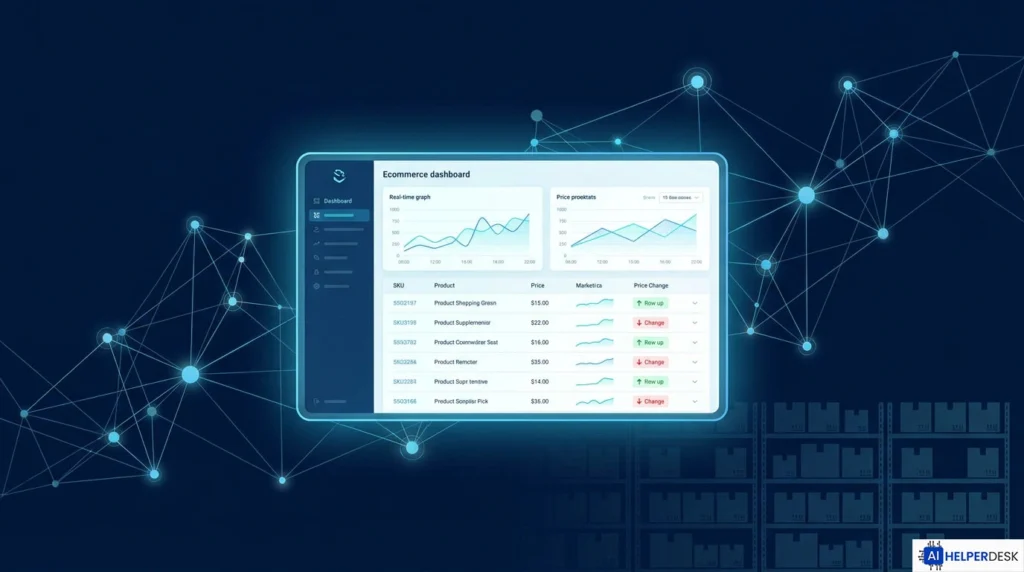
The rules of online retail have shifted dramatically. Speed, data, and precision now separate stores that grow from those that stagnate. AI agents in e-commerce have become the core infrastructure driving that separation. These are not basic chatbots or simple rule-based scripts. They are autonomous systems that monitor stock levels, track competitor price changes, trigger reorders, and reprice thousands of SKUs without waiting for a human to open a spreadsheet.
According to Deloitte’s 2026 Retail Outlook Report, 68% of retailers plan to adopt agentic AI within the next 12 to 14 months. The AI-enabled e-commerce solutions market is already valued at an estimated $8.65 billion in 2026, growing at a compound annual rate of roughly 24%. That growth reflects a genuine operational shift, not just a wave of vendor marketing.
This article breaks down how inventory and pricing agents actually work, what results businesses are seeing in 2026, and what challenges are still worth thinking through before you commit to deployment at scale.
How AI Agents in E-commerce Actually Operate
Traditional automation follows fixed rules. Stock drops below 50 units, send a reorder alert. A competitor drops their price by 10%, flag it for a manager. These rules react to one variable at a time and still require a human to close the loop.
AI agents in e-commerce work differently. They evaluate dozens of variables at once, make decisions based on probability models, and execute actions through direct API integrations with platforms like Shopify, WooCommerce, BigCommerce, and Amazon Seller Central. The agent is not flagging a problem and waiting. It is resolving it.
In inventory management, an agent continuously monitors sales velocity across every SKU, accounts for supplier lead times, and places orders when a projected stockout crosses a defined threshold. In pricing, an agent watches competitor feeds in real time, reads demand signals, and adjusts prices within pre-set margin floors to protect conversion rates without eroding profit.
The real difference between ai agents in e-commerce and older automation tools is shared context across functions. An inventory agent communicating with a pricing agent can automatically trigger markdown pricing on overstocked items. That kind of cross-system coordination is what makes agentic approaches genuinely new territory. As ai business solutions in e-commerce mature, this cross-functional design is becoming the standard architecture rather than an advanced configuration reserved for enterprise teams.
Inventory Automation: How AI Agents in E-commerce Deliver Results
Poor inventory management bleeds money in both directions. The average store, whether deploying ai agents in e-commerce or not, loses between 4% and 8% of annual revenue to stockouts, and another 3% to 5% to overstock costs including markdowns, storage fees, and write-offs. AI forecasting addresses both problems at the same time.
Machine learning models now predict demand at the SKU level with 70% to 90% accuracy, compared to 50% to 65% for manual methods, according to research from Shopify’s inventory forecasting team. That accuracy gain translates directly into fewer emergency shipments, less capital tied up in slow-moving stock, and better customer satisfaction scores.
Research from Appinventiv shows that businesses switching from traditional to AI-based forecasting see accuracy improvements of 8% to 20%, with volatile product categories sometimes delivering even stronger gains. Stockouts can fall by 30% to 60% with consistent AI-driven forecasting in place, a figure that appears across multiple industry benchmarks reviewed for this article.
A fashion retailer managing 50,000 SKUs across 200 store locations illustrates the practical scope of the problem. AI agents in e-commerce inventory management, in that kind of environment, analyze sales velocity by location, account for seasonal demand spikes, factor in shipping delays by individual supplier, and place orders automatically. No human team could do that analysis continuously across a catalog of that size. An agent does it without stopping.
Competitor Pricing Agents: Real-Time Intelligence at Scale
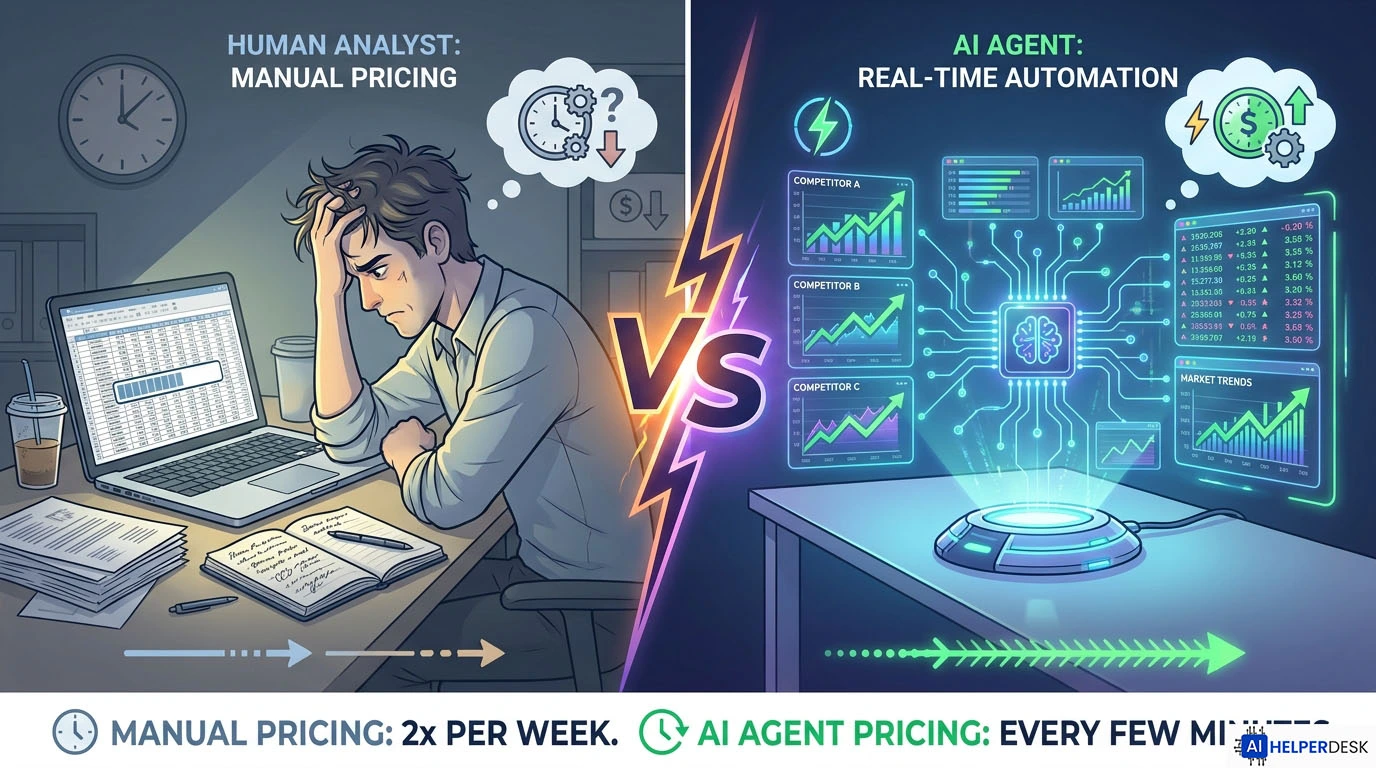
Pricing is where the speed gap between business ai agents and human teams is most visible. Amazon reportedly adjusts prices approximately 2.5 million times per day. Smaller retailers checking competitor prices manually twice a week are making decisions based on information that is days old in a market that moves every few hours.
A well-configured e-commerce price automation agent closes that gap by continuously crawling competitor feeds, identifying price changes across monitored SKUs, and executing repricing decisions within minutes. These systems can evaluate up to 60 signals at once, including demand patterns, inventory levels, customer segment data, and seasonal trends, to find the optimal price in real time rather than reacting to a single data point.
The financial results are meaningful. According to McKinsey, AI-based pricing increases revenue by 2% to 5% and improves gross margins by 5% to 10%. Gartner’s 2025 Digital Commerce Pricing Intelligence Survey found that brands implementing automated competitor price monitoring see an 8% to 14% gross margin improvement within 12 months. A separate analysis found that brands running connected dynamic pricing automation, combining competitive monitoring and demand sensing, see an average 12% gross margin improvement within the first 90 days.
These ROI figures are worth looking at carefully, though. The strongest results come from brands that already have clean competitor URL mapping, well-calibrated margin floor rules, and consistent data quality across their SKU catalog. Brands starting from a weaker data foundation will see slower returns and more calibration work up front.
Real-World Use Cases for AI Agents in E-commerce
B2B procurement represents one of the more advanced examples of multi-agent pricing coordination. An enterprise procurement agent queries a supplier’s own agent for pricing, availability, and delivery terms. Both sides of the transaction are automated, and negotiation happens at machine speed with no human involved until approval is needed for high-value exceptions. This is one of the more mature deployments of ai agents in e-commerce at an enterprise scale today.
For direct-to-consumer brands, the application is more straightforward. A mid-size Shopify store with 500 SKUs can deploy an e-commerce price automation agent to monitor 8 to 10 competitors, set margin floors by product category, and automate repricing entirely. Brands that previously spent an average of 5.2 hours per week on manual pricing tasks eliminate that labor, recovering roughly $20,000 in annual labor cost at standard rates, according to Shopify’s Commerce Trends Report.
Subscription-based retailers face a specific implementation challenge. Their ai agents in e-commerce workflows need live access to inventory feeds, fulfillment APIs, and post-purchase management systems. If subscription controls require human login flows rather than API access, the automation breaks at exactly the wrong moment. Experienced implementation teams flag this dependency early and build workarounds before the first deployment.
In the perishable goods segment, inventory and pricing agents work in direct coordination. When stock approaches a date threshold, the inventory agent signals the pricing agent to begin automatic markdown flows. The margin recovered by reducing waste typically outweighs the discount cost, which is an outcome that manual processes rarely capture in time to make a real difference.
Benefits for Growing Online Retailers
Deploying ai agents in e-commerce produces three compounding advantages. The first is operational speed. Decisions that previously took hours or days now take minutes or seconds. That speed compounds over time because competitors are also responding to pricing changes, and the brand that responds first is the one that captures the conversion.
The second advantage is scale without proportional headcount growth. A team of three cannot manually monitor 500 SKUs across 10 competitors while also running daily inventory reviews. An agent handles all of that continuously, freeing the team for strategic work instead of data maintenance.
Third, connected pricing and inventory agents create a data feedback loop that improves over time. Pricing data flows into email marketing triggers. Inventory signals inform paid media bid adjustments. Demand spikes picked up by the pricing engine refine the forecasting model. Each system makes the others more accurate, a compounding return that static automation tools cannot replicate.
For context on how this connected architecture differs from older workflow approaches, see our analysis of agentic workflows vs. traditional automation, which covers why rule-based systems hit scaling limits that agent-based approaches consistently avoid.
Risks, Challenges, and Limitations
The technology works, but deployment is not frictionless. Several challenges come up consistently in real-world implementations of ai agents in e-commerce environments.
Data quality is the most common obstacle. AI pricing and inventory agents depend on structured, accurate data. Broken competitor URLs mean missed price signals. Inconsistent historical sales data produces unreliable demand forecasts. Brands starting with poor data hygiene should expect a 4 to 8 week remediation period before agent performance stabilizes into something reliable.
Floor price misconfiguration is the most costly operational error in pricing agents. Setting margin floors too low allows the agent to compress margins during a competitive pricing war. Setting them too high means the agent rarely triggers and delivers no value. Calibrating floor rules by product category and margin structure is a prerequisite for responsible deployment, not an optional refinement.
Consumer trust and perception present an emerging challenge. Research from a 2026 agentic commerce analysis found that fewer than 40% of consumers fully trust AI for autonomous purchasing decisions, particularly at higher price points. For retailers, the practical concern is brand consistency. Prices that change too frequently can signal instability, especially in markets where customers expect rate consistency, such as subscription tiers or B2B contracts.
Regulatory risk is also growing. The European Union’s AI Act places compliance requirements on systems making automated decisions with material business consequences, which includes pricing agents operating in EU markets. Brands expanding into European e-commerce need legal review of their agent configurations before going live.
Expert Analysis
The market data for AI inventory and pricing agents is genuinely strong. Revenue improvements of 2% to 12%, stockout reductions of 30% to 60%, and gross margin gains of 8% to 14% are not outlier results. They appear consistently across credible sources including McKinsey, Gartner, Deloitte, and Shopify’s own merchant data. The case for deploying ai agents in e-commerce is clear for mid-size and enterprise brands with enough catalog depth to justify the integration work.
What the headline statistics tend to understate is the implementation cost of actually reaching those results. First-year ROI figures cited by some vendors assume clean data, correct floor configuration, and stable competitor URL mapping from day one. Brands that skip the data hygiene phase or misconfigure margin rules will spend their first months fixing errors rather than capturing margin.
The more important strategic point is that the advantage of ai agents in e-commerce is relative, not absolute. If your competitors are running pricing agents and you are not, you are responding to market changes days after they have already captured the conversion. The ROI of deployment is partly the return on the tools themselves and partly the cost of the competitive disadvantage from not deploying.
For smaller retailers with catalogs under 100 SKUs and fewer than three active competitors, the integration cost may outweigh near-term returns. The stronger business case for ai business solutions in this space is for brands with 200 or more SKUs operating in categories where competitor pricing is volatile and consumer price sensitivity is high.
The next 12 to 18 months will see pricing and inventory agents become standard infrastructure rather than a competitive differentiator. Brands that complete their integration now will spend that period refining their models. Brands that delay will spend it closing the gap.
Future Outlook
The direction of development for ai agents in e-commerce in 2026 and beyond points toward what analysts are calling agentic commerce. In this model, AI agents represent retailers in fully automated procurement negotiations, and increasingly, AI agents also represent consumers in automated purchasing decisions, with both sides of a transaction running autonomously.
Shopify’s Winter 2026 Edition introduced agentic storefronts that sell directly inside ChatGPT sessions. Google’s Universal Commerce Protocol is enabling AI-native transactions that bypass traditional browsing flows entirely. These developments suggest that the current generation of inventory and pricing agents is early infrastructure for a more fundamental shift in how commerce operates at a structural level.
For retailers using ai agents in e-commerce today, the practical implication is that their configurations will need to be architecturally compatible with these emerging transaction protocols. Brands building on flexible, API-first platforms are better positioned to integrate with agent-to-agent commerce as it moves from early adoption into standard practice.
Conclusion
AI agents in e-commerce are no longer experimental. They are active infrastructure in the operations of competitive online retailers, handling inventory forecasting and competitor price monitoring at a speed and scale that human teams simply cannot match. The data from 2026 is consistent: brands that deploy connected pricing and inventory ai agents in e-commerce operations see measurable margin improvements, fewer stockouts, and a real operational advantage over competitors still relying on manual processes.
Getting to those results requires investment in data quality, careful calibration of margin protection rules, and architectural choices that keep your stack compatible with the agent-to-agent commerce protocols already being introduced by Shopify and Google. Brands that treat this as a simple plug-in will be disappointed. Brands that treat it as an infrastructure project will find the returns are substantial and compound over time.
For most online retailers today, the question is not whether to deploy ai agents in e-commerce operations. It is how quickly they can build the data foundation that makes deployment reliable and the margin gains predictable.
Frequently Asked Questions
AI agents in e-commerce are autonomous systems that complete multi-step operational tasks, such as inventory reordering and competitor repricing, through API integrations with e-commerce platforms. Chatbots respond to customer queries through conversational interfaces. The distinction matters because ai agents in e-commerce execute decisions autonomously, while chatbots assist with information. Agents take action across connected systems without requiring human confirmation at every step.
An e-commerce price automation agent uses structured web crawling and direct data feeds to pull competitor pricing at regular intervals, often every few minutes for high-velocity categories. It compares those prices against your current listings, evaluates your margin floor rules, and adjusts your price automatically within the parameters you define. Tools like Prisync, Wiser, and Omnia Retail are commonly integrated competitor data sources.
ROI varies by catalog size, data quality, and category volatility. McKinsey data shows revenue improvements of 2% to 5% from AI pricing, while Gartner cites 8% to 14% gross margin gains from price intelligence automation within 12 months. Inventory forecasting accuracy improvements of 20% to 50% translate into stockout reductions of 30% to 60%, recovering 4% to 8% of annual revenue that would otherwise be lost to unavailable product.
As of 2026, Shopify supports AI natively through Shopify Magic and its Sidekick assistant, with agentic storefronts launched in the Winter 2026 Edition. WooCommerce supports third-party AI agents through REST API and webhook integrations. BigCommerce and Magento support AI through API connections. Amazon provides native listing tools and supports third-party repricing agents through Seller Central.
The primary risks are margin floor misconfiguration, which can trigger destructive pricing wars, and data quality failures, which produce incorrect pricing signals. Regulatory compliance is an emerging risk in EU markets under the AI Act. Consumer trust remains a consideration in high-value categories where frequent price changes may reduce purchase confidence.
Most brands running pilots on their top 100 to 500 SKUs see measurable ROI within 60 to 90 days, according to 2026 pricing research. Full catalog deployment with connected inventory signals typically produces consistent results in months 3 to 6 as the models calibrate to specific demand patterns and the competitive landscape.
