Voice AI Agents: How to Set Up Bland AI for Inbound Customer Calls
-
- by Fiaz Ahmad
- June 14, 2026
- in AI Agents News, AI Business Solutions

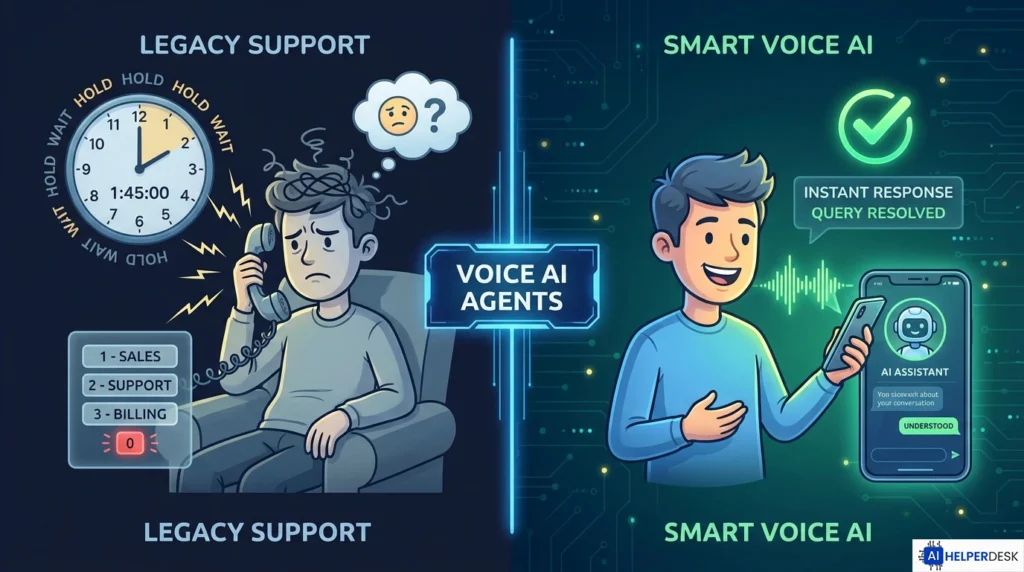
Voice AI agents are reshaping how small businesses handle customer calls, and 2026 is the year this technology stopped being a novelty and started being a standard. If your phone lines are constantly busy, your team is stretched thin, and callers are fed up with outdated IVR menus, automating inbound calls with Bland AI is one of the smartest moves you can make right now. This guide walks you through exactly how to configure Bland AI for inbound customer calls, from building your first conversational pathway to provisioning a live phone number and connecting it to your CRM.
Whether you run a clinic, a consulting firm, or an e-commerce business, voice AI agents can absorb the repetitive, high-volume end of your phone traffic so your human team can focus on the conversations that actually need their attention.
What Are Voice AI Agents and Why Do They Matter in 2026
Voice AI agents are software systems that handle phone calls on their own using conversational AI. They pick up inbound calls, understand natural speech, gather information, resolve common questions, and only pass the call to a human when the situation genuinely calls for it. This is fundamentally different from old-school IVR, where callers punch numbers on a keypad. A voice AI agent actually talks with the caller, back and forth, like a real conversation.
The growth numbers tell you everything. According to market data compiled in 2026, the global voice AI agents market was valued at 2.4 billion dollars in 2024 and is projected to hit 47.5 billion dollars by 2034, growing at a compound annual rate of 34.8 percent. Gartner forecasts that conversational AI will cut contact center labor costs by 80 billion dollars in 2026 alone. And the per-call math is hard to argue with: a human agent costs 7 to 12 dollars per call, while an AI-handled call runs around 0.40 dollars.
For small businesses, the case is straightforward. Voice AI agents replace the need for salaried headcount on repetitive call types, with costs tied to per-minute usage rather than full-time salaries.
Key Statistics and Insights for 2026
Production deployments of voice AI grew 340 percent year-over-year across more than 500 organizations, according to AI Voice Research data. By early 2026, 67 percent of Fortune 500 companies had already rolled out production voice agent systems. A Forrester Consulting study commissioned by PolyAI found that companies using voice AI report a three-year ROI between 331 and 391 percent.
Among businesses already running automated inbound call systems, 74 percent report positive ROI within 12 months. Contact centers that apply voice AI agents to structured call types like lead qualification, appointment booking, and account inquiries are seeing 30 to 50 percent cost reductions on those specific categories. A 2026 Gartner survey found that 91 percent of customer service leaders are under executive pressure to implement AI, which signals just how decisively this conversation has moved from IT exploration to board-level priority.
What Bland AI Offers for Inbound Call Automation
Bland AI is a voice automation platform built from the ground up for phone calls. It runs on self-hosted infrastructure, which means your call data never passes through third-party APIs. According to Bland AI’s official documentation, every decision in an agent’s call flow is defined inside a custom configuration, including guardrails, escalation rules, tone guidelines, and transfer conditions.
The platform is built around three core components for inbound call setup. First, Conversational Pathways are visual flow builders where you map out exactly how a call should unfold, from greetings and data collection to conditional routing and escalation triggers. Second, dedicated inbound phone numbers can be provisioned directly inside the dashboard on a monthly subscription per number. Third, native integrations connect the platform to Salesforce, HubSpot, Zendesk, Twilio, and SIP trunks, so you do not need to tear out your existing phone infrastructure to get started.
Pricing covers the language model, speech-to-text, text-to-speech, and telephony in a single per-minute rate, with no per-token charges stacked on top of that.
How to Set Up Bland AI for Inbound Customer Calls: Step-by-Step
Step 1: Create Your Bland AI Account
Head to app.bland.ai and sign up. Once you are inside the dashboard, go to the API keys section under Settings and generate your key. You will need this for any API-level configuration. Bland AI also provides a full developer portal and documentation at docs.bland.ai, covering every endpoint and configuration parameter in detail.
Step 2: Build a Conversational Pathway
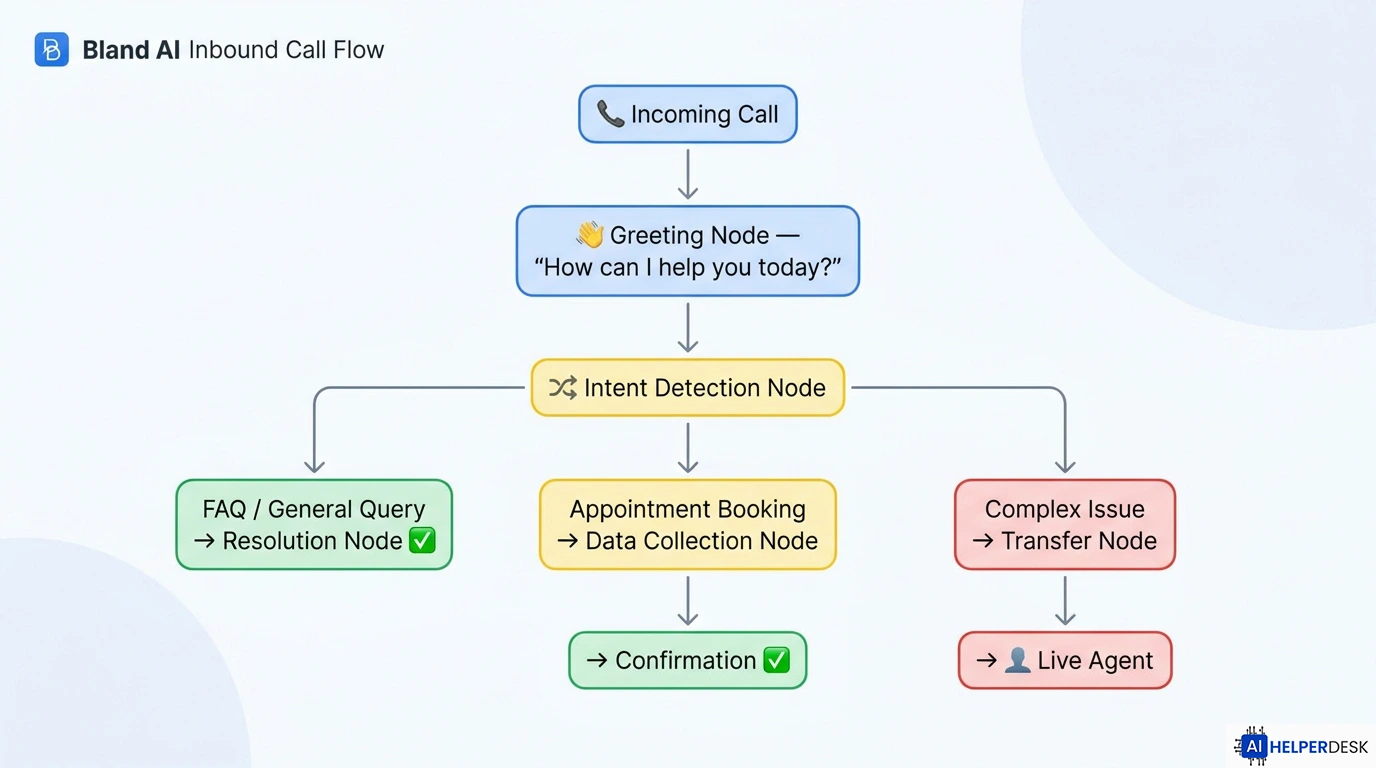
From the dashboard, select Conversational Pathways and create a new pathway. A pathway is a node-based conversation map where each node represents a stage in the call: a greeting node, an intent detection node, a data collection node, and a resolution or transfer node.
For a standard inbound customer support scenario, a basic pathway flows like this. The opening node greets the caller and asks how you can help. A condition node checks the caller’s intent and branches toward FAQ answers, appointment scheduling, or escalation depending on the response. A data collection node gathers relevant details like an order number or account name. A resolution node delivers the answer or confirms the action. A transfer node routes complex cases to a live agent.
The platform recommends keeping prompts under 2,000 characters and writing them as positive instructions. For example, say “Keep the tone friendly and concise” instead of “Do not sound robotic.” Concrete direction consistently produces more predictable agent behavior during live calls.
Step 3: Provision an Inbound Phone Number
Inside the dashboard, navigate to Phone Numbers and select Purchase Inbound Number. Choose a three-digit area code and a country, currently US or Canada, and Bland AI provisions the number on a monthly subscription. Once it is active, assign your conversational pathway to the number. The pathway you attach defines how every incoming call is handled from the first ring forward.
Step 4: Configure Agent Behavior
Within the inbound number settings, choose the agent’s voice from the available voice library, set the language and timezone, and define escalation rules that specify when the agent should transfer a call rather than continue handling it. Set a webhook URL so that after each call, the transcript and call data are pushed automatically to your backend or CRM.
Bland AI connects natively to HubSpot and Salesforce. Every call event, from intent detection to resolution outcome, syncs to your customer records automatically, so there is no manual data entry after the call ends.
Step 5: Test Before Going Live
Use Bland AI’s built-in testing tools to simulate conversations against your pathway. Run through edge cases: a caller who gives incomplete information, a caller who goes off-script, and a caller who wants a transfer immediately. Refine specific nodes based on what breaks. The call transcript review inside the dashboard gives you exact records of how the AI responded at each stage, which is the most direct way to find and close gaps before you go live.
Step 6: Connect Your Existing Telephony (Optional)
If your business already uses Twilio or SIP trunks, Bland AI connects directly to your existing numbers. You do not need to reissue numbers or rebuild your phone infrastructure. Inbound calls continue arriving on your current lines, and the voice AI agents handle them according to the pathway you configured.
Real-World Use Cases for Voice AI Agents
Medical and dental practices use Bland AI to handle appointment scheduling and patient intake calls outside office hours, which reduces no-shows and eliminates hold times for routine requests. Real estate agencies deploy voice AI agents to qualify incoming inquiries from listing ads, collecting property interests and budget ranges before a human agent follows up. E-commerce businesses route order status and return policy calls through the AI, cutting support ticket volume significantly.
If you are building a broader AI automation stack, the practical guide to AI agents for small businesses at aihelperdesk.com covers deployment patterns across multiple channels, including how inbound call automation fits alongside email and chat agents in an integrated workflow.
Benefits of Voice AI Agents for Small Businesses
The most immediate benefit is availability. A voice AI agent picks up at 2 AM on a Sunday with exactly the same accuracy it brings at noon on a Tuesday. For small teams without dedicated support staff, this closes a significant coverage gap that previously required after-hours contracts or voicemail.
The second benefit is consistency. Human agents vary in tone, accuracy, and how closely they follow scripts. A voice AI agent follows the configured pathway precisely on every single call, which matters enormously in regulated industries where what you say on a call is a compliance issue, not just a service preference.
The third benefit is scalability without adding headcount. A single Bland AI configuration handles 1 call or 1,000 calls with the same infrastructure cost. Hiring to absorb call volume spikes is expensive and slow. Scaling a configured voice AI agent takes minutes.
Risks, Challenges, and Limitations
Voice AI agents are not the right fit for every call type. High-touch scenarios like complex financial advising, crisis support, or luxury concierge services still require human judgment and contextual flexibility that current AI systems do not reliably deliver. Deploying AI on the wrong call category produces poor outcomes regardless of the platform you use.
Configuration quality matters enormously. A poorly designed conversational pathway produces an agent that frustrates callers rather than helping them. Most failed deployments trace back to under-tested pathways, vague prompt instructions, or missing escalation logic. Thorough testing before launch is not optional if you want reliable results.
Regulatory compliance is also worth thinking through carefully. In the US, the FCC ruled in 2024 that AI voices fall under TCPA regulations in certain outbound contexts. For inbound calls where the customer initiates contact, the picture is cleaner, but businesses in healthcare and financial services should verify their specific obligations before deploying automated inbound call systems.
Bland AI’s developer-oriented model also means that businesses without technical staff may find the initial setup challenging. The platform gives you precise control over call behavior, but that control comes with configuration overhead that more no-code alternatives trade away in exchange for simplicity.
Expert Analysis
The shift toward voice AI agents in 2026 is not primarily a cost story, even though the economics are genuinely compelling. It is about what becomes possible when routine call handling stops being a constraint on your team’s capacity. A three-person operation that previously spent half its day on inbound calls can redirect that time toward sales, product development, and relationship-building. The AI does not replace the team; it removes the ceiling on what the team can accomplish with the same headcount.
Bland AI holds a specific and defensible position in this market. Its self-hosted infrastructure and developer-first approach make it well-suited for businesses with sensitive data requirements or precise control needs over conversation logic. The platform is not the fastest to configure out of the box, but it is one of the most controllable once you have it dialed in. For businesses where call quality and compliance are non-negotiable, that trade-off is the right one to make.
The risk most businesses underestimate is pathway quality. The technology itself works. What varies is how accurately your pathway reflects the real conversations your customers are actually having. Teams that invest in thorough testing and iterate based on actual call transcripts consistently outperform teams that deploy a first-draft pathway and leave it alone. Treat your conversational pathway like a product, not a one-time setup task.
The 2026 ROI data is also worth interpreting carefully. A 331 to 391 percent three-year return applies to organizations that automated the right call types. Automating low-volume, high-complexity calls produces weaker results than automating high-volume, structured calls like scheduling, order status inquiries, and FAQ resolution. Start with your most repetitive inbound call category, measure the results, and expand from there.
Future Outlook for Voice AI Agents
By the end of 2026, Gartner projects that 40 percent of enterprise applications will incorporate task-specific AI agents. For voice, the next evolution is emotional intelligence: real-time detection of caller frustration or urgency that adjusts the agent’s responses dynamically, rather than waiting for a preset escalation condition to trigger. Early deployments are already reporting 25 percent reductions in agent escalations as a direct result of this capability.
Multimodal capabilities are also expanding quickly. Voice AI agents that send a follow-up SMS mid-call, confirm a booking via email while the conversation is still active, or pull a live record from a connected CRM before answering a billing question are moving from prototype to production. Bland AI supports Twilio-based SMS follow-ups today, which is an early, working implementation of exactly this pattern.
The pricing trajectory also favors wider small business adoption. As the per-minute cost of AI inference continues to fall, the economic case keeps improving. What currently requires a deliberate ROI calculation will, within two to three years, simply be a default infrastructure decision for any business that handles customer calls.
Conclusion
Voice AI agents have moved well past proof-of-concept. In 2026, the question for most small businesses is not whether to automate inbound calls but how to do it in a way that fits their existing infrastructure and customer base. Bland AI offers one of the most configurable approaches available, combining a self-hosted model stack, a visual pathway builder, and direct integrations with the CRM and telephony tools most businesses already use. The setup process is straightforward for technically capable teams: create an account, build a pathway, provision a number, configure escalation rules, test thoroughly, and go live. The per-call economics are compelling, the availability benefits are immediate, and the path to scaling is clear. If your team is spending hours each week on repetitive inbound calls, deploying voice AI agents is the most direct fix available today.
Frequently Asked Questions
Voice AI agents handle inbound customer calls autonomously. Common applications include appointment scheduling, order status inquiries, FAQ responses, lead qualification, and after-hours call coverage. They cut hold times and free human staff for higher-complexity interactions that actually require judgment.
Bland AI charges a per-minute rate that bundles the language model, speech-to-text, text-to-speech, and telephony into a single cost. There are no separate per-token or per-feature charges layered on top. Enterprise plans are volume-based and contracted separately. Current pricing is listed on the Bland AI website.
Modern voice AI agents, including those deployed on Bland AI, use advanced speech synthesis that most callers cannot distinguish from a human agent in standard blind tests. The 2026 generation of voice AI operates with sub-800 millisecond response latency, which removes the noticeable pause that used to give AI calls away immediately.
Yes. Bland AI connects directly to existing Twilio accounts and SIP trunks. You do not need to replace your current phone numbers or rebuild your telephony setup to start using the platform for automated inbound calls.
Bland AI is a developer-oriented platform that gives precise control over conversation logic through its API and dashboard. Small businesses without technical staff may want to work with a developer for the initial setup. More no-code-oriented platforms trade configuration depth for faster deployment, though they give you less control over how calls actually behave.
A conversational pathway is a visual, node-based flow that defines how an inbound call moves from greeting to resolution. Each node represents a stage in the conversation, and conditions control how the agent transitions between stages based on what the caller says.
The process covers four main steps: create a Bland AI account and generate an API key, build a conversational pathway inside the dashboard, purchase and assign an inbound phone number, then configure the agent’s voice, language, escalation rules, and webhook for call data. Thorough testing before going live is essential for reliable call handling.
