AI Lead Generation Agents: Multi-Agent Systems for Social Media Content Creation
-
- by Fiaz Ahmad
- June 12, 2026
- in AI Agents News, AI Business Solutions

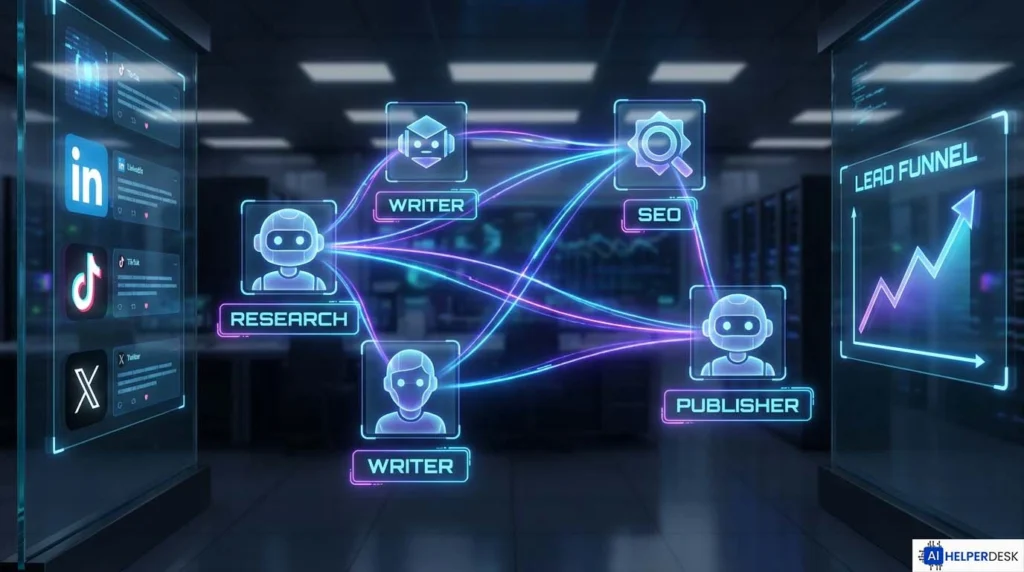
Social media content used to be a human job. Now, multi-agent systems are handling it faster, smarter, and at a scale most teams simply cannot keep up with. For businesses that depend on social channels to drive leads, this is not some distant possibility. It is already underway, and the companies leaning into it are outpacing those still manually scheduling posts. In 2026, the question is not whether to automate social media content creation. It is which architecture to use and how to execute it properly.
This article walks through how multi-agent systems actually work for social media automation, what frameworks like CrewAI make possible in practice, the real adoption data behind the shift, the risks you need to plan for, and how to treat implementation as a business decision rather than a technical experiment.
What Are Multi-Agent Systems and Why Social Media Needs Them
A single AI agent can draft a post or answer a specific question. Multi-agent systems can research a topic, produce platform-specific content, verify it against brand guidelines, optimize hashtags, schedule for peak engagement, and analyze performance afterward, all without a human touching anything between those steps.
The architecture matters because social media in 2026 is not one channel. LinkedIn, TikTok, X, and Instagram each require content that is natively formatted, algorithmically aligned, and tailored to a specific audience. As one industry analysis framed it, the algorithmic landscape now demands that content be fundamentally restructured for each platform rather than broadcast uniformly. Running one agent to manage all of that creates bottlenecks. Specialized agents working in parallel eliminate them.
The real distinction here is between automation and autonomy. Legacy scheduling tools publish what humans write. Autonomous agents research trends, generate content, adapt based on live engagement data, and self-correct without waiting for a weekly human review. According to MindStudio’s 2026 marketing benchmark, multi-agent systems outperform single-agent approaches by 90.2 percent on complex tasks. That gap grows considerably as the number of platforms and content types increases.
How Multi-Agent Systems Work: Architecture and Roles
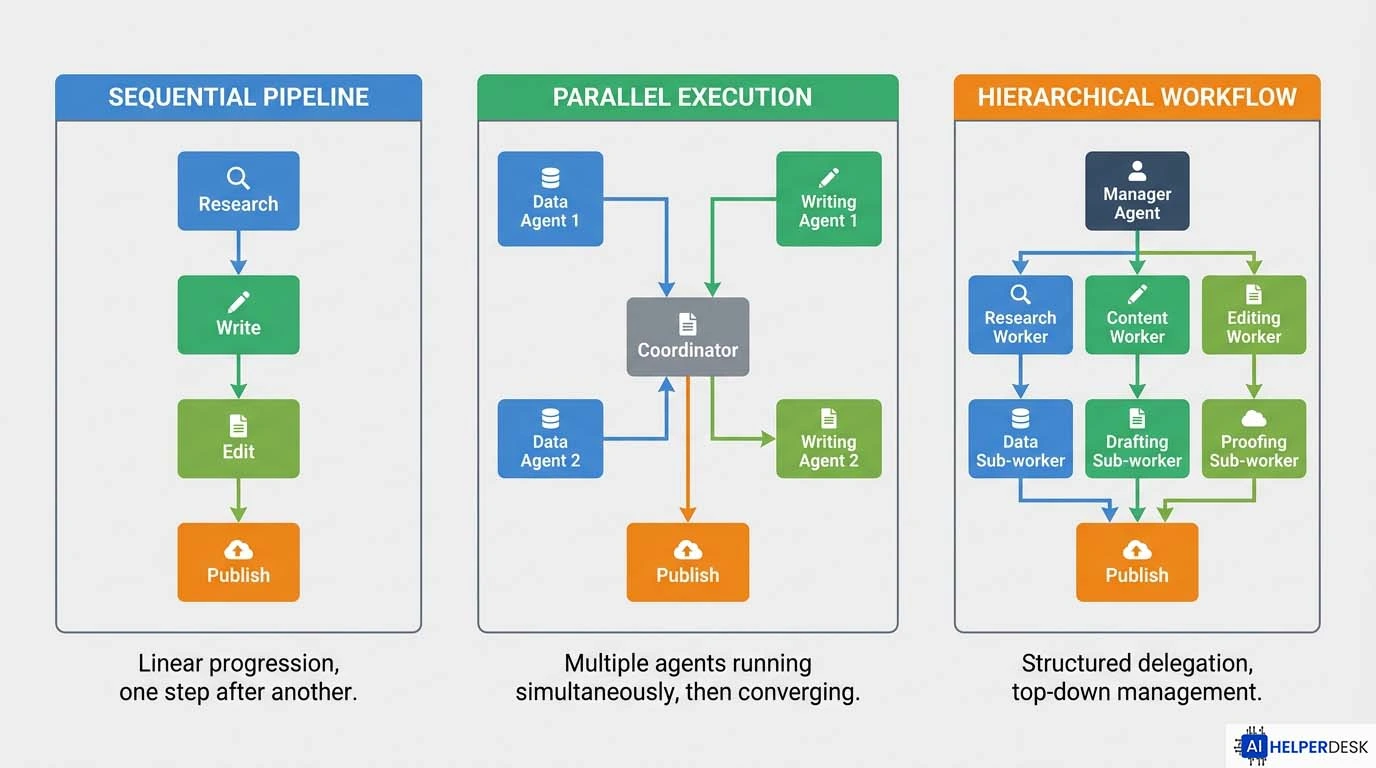
Understanding the internal structure of multi-agent systems in a social media pipeline helps any business evaluate whether the investment makes sense for their operation. Most production deployments follow one of three patterns.
Sequential Pipelines
Each agent completes its task and hands the output to the next. A research agent pulls trending topics, a writing agent drafts the content, an editing agent checks tone and brand compliance, and a distribution agent publishes and schedules. This is the simplest architecture and works well for teams focused on one or two platforms.
Parallel Execution
Multiple agents work at the same time. A trend-monitoring agent, a content production agent, and an analytics agent each handle their own domain independently, then a coordinator agent pulls everything together. This model cuts latency significantly and is the right approach for organizations managing several platforms or high-frequency publishing schedules.
Hierarchical Workflows
A manager agent oversees specialized worker agents and delegates tasks dynamically based on real-time conditions. This is exactly what frameworks like CrewAI are built for, and it is the architecture best equipped to handle ambiguity. If engagement data signals a sudden shift in audience sentiment, the manager agent can redirect content strategy without waiting on a human decision.
According to Sprout Social’s 2026 analysis of AI agent deployments, most marketing teams start with a single agent for one specific use case and then expand into multi-agent workflows as their needs and confidence grow. That incremental approach is sensible, particularly given the governance risks covered later in this article.
CrewAI Social Media Automation: A Practical Framework
CrewAI has become one of the most widely used open-source frameworks for building multi-agent systems in production. Its design philosophy mirrors the structure of a real editorial or marketing team. Each agent has a defined role, a specific goal, and a backstory that shapes how it reasons about tasks. Agents can use external tools, search the web, access APIs, and pass structured outputs to each other.
A practical CrewAI social media automation setup for lead generation typically looks something like this.
A Content Strategist Agent uses tools like Google Trends and web scrapers to surface high-engagement topics relevant to the brand’s audience, then outputs a brief covering the topic, target platform, tone, and primary keyword. A Writer Agent picks that up and produces the post, formatted for the platform and calibrated to the configured brand voice. An SEO and Hashtag Agent reviews the content, adds relevant hashtags, and ensures discoverability without stuffing keywords. A Distribution Manager Agent connects to scheduling APIs like Buffer or Hootsuite and publishes at the algorithmically optimal time.
According to documented CrewAI deployments reviewed in early 2026, this architecture consistently delivers three times the content output without additional headcount while maintaining a consistent brand voice across platforms. IBM’s technical documentation on CrewAI confirms that the framework enables genuine multi-agent collaboration across tasks that would otherwise require extensive sequential human review.
For developers building AI tools in this space, the implementation patterns behind CrewAI share structural similarities with other agent-driven micro-tools. If you are also exploring how to monetize AI-powered tools, the article on how to build and monetize an AI Bio Generator Tool using React and Node.js covers practical approaches to deploying AI utility tools as standalone products.
Key Statistics and Market Data
The adoption numbers for autonomous agents in AI tell a consistent story. Multi-agent systems are moving from experimentation into production at a pace analysts did not fully anticipate even eighteen months ago.
Gartner reported that 40 percent of enterprise applications will include task-specific AI agents by 2026, up from less than 5 percent in 2025. The multi-agent AI market is projected to grow at a compound annual rate of 48.5 percent through 2030, reflecting demand for systems that can coordinate complex business processes rather than just automate isolated tasks. McKinsey estimates that AI-driven automation overall could generate between 2.6 trillion and 4.4 trillion dollars in annual economic value across industries.
In marketing specifically, the results are measurable. Sales and marketing deployments of agentic AI are producing two to three times improvements in pipeline velocity, according to verified analyst data from Joget and Gartner’s 2026 benchmarks. Wowcher cut its lead generation costs by 31 percent using AI automation. Lyft reduced customer service resolution times by 87 percent. These are not edge cases. They are documented outcomes from production systems that were designed and governed correctly.
The 2026 Social Media Content Strategy Report found that 40 percent of marketers are already using some form of AI content generation, with adoption accelerating as platform algorithms increasingly reward both volume and platform-native formatting simultaneously. Two demands that human teams consistently struggle to meet at scale.
Real-World Use Cases for Lead Generation
How do multi-agent systems actually connect social media content creation to lead generation outcomes? The clearest examples come from B2B companies running LinkedIn content pipelines and SaaS brands publishing high-frequency thought leadership on X.
A B2B software company might deploy a CrewAI pipeline where the research agent monitors competitor announcements, public forum discussions, and industry news. Multi-agent systems like this let the writing agent produce LinkedIn posts that position the company as a subject matter authority, with a call-to-action driving traffic to a lead capture page. The analytics agent tracks which content types generate the highest click-through rates and feeds that back to the strategist agent. Over time, the system self-optimizes toward the content producing the most qualified leads, without anyone manually reconfiguring the workflow.
For e-commerce brands, the pattern shifts slightly. A monitoring agent tracks trending product categories and user-generated content. A content agent produces TikTok and Instagram caption variations optimized for each platform’s character limits, hashtag conventions, and current algorithmic preferences. A publishing agent handles timing and cross-posting. The result is a content operation that would otherwise require a team of three to five people to run manually.
These systems work particularly well alongside other AI business solutions such as CRM integrations and lead scoring tools, where the social media content pipeline feeds qualified interest signals directly into the sales process.
Risks, Challenges, and Limitations
The honest picture of multi-agent systems includes real failure modes worth understanding before deployment, not after. Across the agentic AI landscape in 2026, the most visible failures are coming from systems that were deployed without structured governance from the start.
Security vulnerabilities are the top concern, cited by 56 percent of enterprise leaders in UiPath’s 2026 survey on autonomous agent adoption. When agents have access to social media APIs, scheduling tools, and content management systems, a misconfigured permission set or a compromised API key can trigger cascading failures across multiple platforms simultaneously. Unlike a human making an error, an agent making an error at scale can do so at machine speed before anyone notices.
Hallucinations remain a structural limitation. An agent that fabricates a statistic or misattributes a quote and publishes it to a brand’s LinkedIn audience creates a credibility problem that no framework can fully prevent without human review checkpoints. UiPath’s 2026 data shows that 32 percent of enterprise AI leaders cite hallucinations as a significant concern, and that figure is higher in content-generation workflows than in data-processing ones.
Governance gaps are the deeper problem. Gartner estimates that more than 40 percent of agentic AI projects will be canceled by 2027, primarily because of escalating costs, unclear business value, and inadequate governance frameworks established at the start. Only 21 percent of organizations currently have a mature governance model for autonomous AI agents, according to Deloitte. Building without governance in 2026 means building something that will likely get shut down in 2027.
Brand voice drift is a subtler risk. Agents optimizing for engagement metrics can gradually push content tone toward whatever generates clicks, which may not align with the brand identity the business has built over time. Regular human audits of content direction are not optional in a production multi-agent pipeline. They are a core part of the operating model.
Expert Analysis
The 2026 data tells a bifurcated story. On one side, the performance case for multi-agent systems in social media content creation is well-documented and commercially proven. On the other side, the failure rate for poorly governed deployments is high enough that rushing into this creates more risk than competitive advantage.
What separates the deployments that generate measurable lead generation improvements from those that stall or get shut down is not the choice of framework. It is the organizational readiness surrounding it. Teams that define clear role boundaries for each agent, establish human review checkpoints at content-sensitive stages, and integrate their agent pipeline with existing CRM and analytics infrastructure consistently outperform those treating the deployment as a standalone automation tool.
CrewAI and similar frameworks have lowered the barrier to building these systems considerably. But a lower barrier to entry does not lower the barrier to doing it well. The 48.5 percent projected CAGR for the multi-agent AI market reflects genuine enterprise demand. Gartner’s projection that 40 percent of projects fail also reflects what happens when that demand outpaces governance thinking.
The strategic opportunity in 2026 is not simply to automate content creation. It is to build a self-improving content intelligence system that gets better at generating qualified leads the more it runs. That requires treating the agent pipeline as a product with its own lifecycle management, performance benchmarks, and ongoing iteration, not a tool that gets configured once and runs unsupervised.
For businesses in competitive markets where content volume and quality both matter, the organizations that move deliberately but early on this architecture will build a compounding advantage. The ones that wait for the technology to mature further will find themselves playing catch-up against competitors who have already accumulated months of optimization data.
Future Outlook
The trajectory for autonomous agents in AI is clear, and social media content creation sits near the center of it. By 2028, analysts project that one-third of user-facing digital experiences will shift from native apps to agentic front ends, meaning the agent pipeline itself becomes the product interface rather than a back-end tool.
Google’s Agent-to-Agent interoperability protocol, now in broad adoption across enterprise platforms, is making it easier for multi-agent systems built on different frameworks to communicate with each other. This means a CrewAI social media pipeline built on multi-agent systems can connect directly with Salesforce Agentforce for lead scoring or with a customer support agent system for a unified customer journey, without requiring custom integration work for each connection.
The platforms themselves are adapting. Social media algorithms in 2026 already reward engagement signals that indicate genuine audience interest rather than raw posting volume. As more brands deploy agent-driven content pipelines, the differentiation will shift from who posts the most to whose agents generate the highest-quality engagement signals. That is a performance optimization problem, and agent systems with feedback loops are significantly better at solving it than human editorial cycles.
According to Sprout Social’s 2026 guide on building AI agents for social media, 93 percent of social media practitioners believe AI can meaningfully reduce creative fatigue by handling the monitoring and data-intensive work that consumes most of a content team’s cognitive bandwidth. The teams that deploy agent systems to reclaim that capacity will spend more time on strategy and creative direction, which are the areas where human judgment still provides irreplaceable value.
Conclusion
The evidence from 2026 is unambiguous. Multi-agent systems have moved from a technical curiosity to a production-grade business tool for social media content creation and lead generation. The frameworks exist, the performance data is documented, and the competitive pressure from organizations already running these architectures is measurable. What remains as a genuine differentiator is not access to the technology but the quality of how it is implemented, governed, and iterated over time.
For any business generating leads through social media, the practical starting point is a clearly scoped pilot using multi-agent systems. Pick one platform, define three to four agent roles, establish a human review checkpoint, and measure lead quality against the baseline. That first deployment is where the organizational learning happens that makes every subsequent expansion faster and lower-risk. The compounding advantage belongs to whoever starts building that learning now rather than waiting for a more convenient moment the market is unlikely to offer.
Understanding how autonomous agents in AI connect to broader AI business solutions is the logical next step. Organizations that treat the social media pipeline as one component of a larger agentic infrastructure, rather than a standalone tool, will be the ones that extract the most durable competitive value from this technology cycle.
Frequently Asked Questions
Multi-agent systems for social media marketing use an architecture where multiple specialized AI agents each handle a distinct part of the content workflow, such as research, writing, optimization, and publishing, working in coordination to produce and distribute content autonomously. Unlike single-agent tools, multi-agent systems can handle complex, multi-step tasks across several platforms simultaneously.
CrewAI is an open-source framework that lets developers define agents with specific roles, goals, and tools. For social media, a CrewAI setup might include a trend researcher, a writer, an SEO optimizer, and a scheduler, each operating on the tasks it is specialized for. The framework handles coordination, output passing between agents, and supports both sequential and hierarchical workflows.
Largely yes, but with important caveats. Autonomous agents in AI can research, write, post, and analyze performance entirely without human input. That said, most production deployments include periodic human review checkpoints for brand alignment and fact-checking. Full autonomy without oversight introduces risks such as hallucinated claims and tone drift that can damage brand credibility over time.
The primary risks of multi-agent systems include security vulnerabilities from API access permissions, hallucinations producing inaccurate content, brand voice drift from over-optimization toward engagement metrics, and governance gaps that cause projects to stall or be canceled. Gartner estimates that more than 40 percent of agentic AI projects will be shut down by 2027, primarily because of these structural issues.
A basic CrewAI pipeline with three to four specialized agents can be configured by an experienced developer in one to two weeks. Production-ready deployments with monitoring, guardrails, CRM integrations, and human review checkpoints typically take four to eight weeks. The more platforms and content types involved, the more time the initial configuration and testing phases require.
Both, but the entry point differs. Small businesses typically start with a simpler two or three agent setup focused on one platform and expand from there. Enterprise teams run parallel pipelines across many channels with hierarchical coordination. The core framework and the ROI case apply to organizations of any size, provided the deployment is scoped appropriately from the beginning.
