Agentic Workflows vs. Traditional Automation: Which One Actually Scales Your Business?
-
- by Fiaz Ahmad
- May 21, 2026
- in AI Agents & Automation

The Automation Question Every Growing Business Is Asking
Picture this: your operations team has spent two solid years automating invoices, routing support tickets, and syncing data between systems. Everything hums along nicely until your business doubles in size, regulations shift, and customers start sending PDFs, voice notes, and messy email threads instead of clean form submissions. Suddenly, your automation stack starts throwing errors at 2 a.m.
This is the moment most businesses run headfirst into an uncomfortable truth: not all automation is built to scale.
The conversation in 2025 has moved well beyond “should we automate?” to something far more specific. Should you rely on traditional automation, or are agentic workflows the smarter path for long-term growth? These are genuinely different approaches with different trade-offs, and picking the wrong one can cost you time, money, and more than a few late-night debugging sessions. Let’s break it down properly.
What Is Traditional Automation, Really?
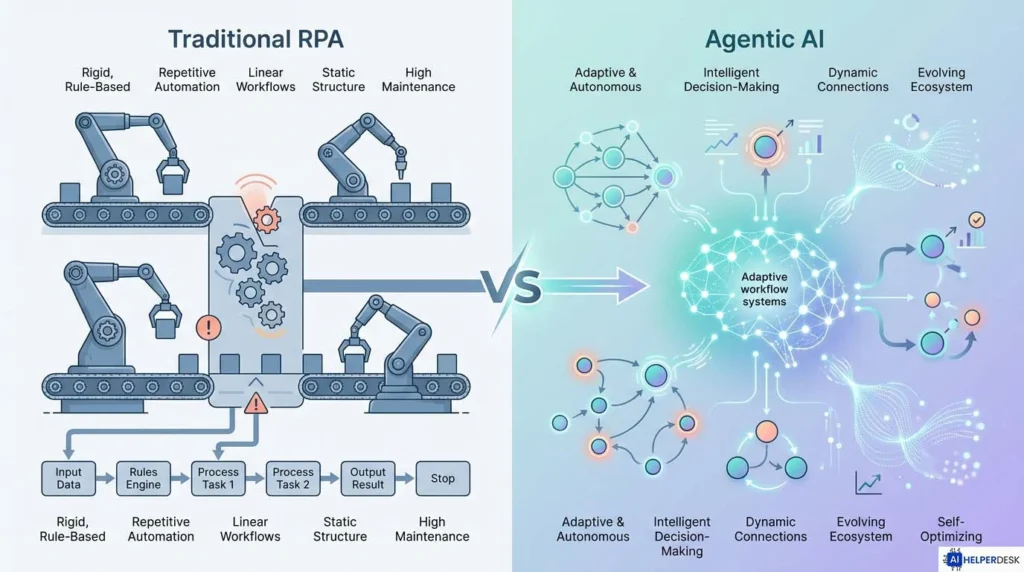
Traditional automation, most commonly associated with Robotic Process Automation (RPA), works on a deceptively simple principle: if X happens, do Y. You define every step, every rule, every condition. The bot executes it faithfully, fast, and without complaint.
RPA has done enormous heavy lifting for enterprises over the past decade. Payroll processing, compliance form submissions, data migration between ERP systems, monthly report generation: these are exactly the kinds of tasks where it shines. You get measurable results in weeks, the ROI is visible, and implementation risk stays relatively low.
But here’s where things start to crack. RPA scales only if your processes stay frozen. The moment regulations shift, new products launch, or a partner updates their system, you’re back to rewriting bots. At some point, the maintenance burden quietly swallows the efficiency gains. Traditional automation is brilliant at doing one thing perfectly, right up until that one thing changes.
What Are Agentic Workflows? A Different Kind of Automation
Agentic workflows are what emerge when you combine the reasoning capabilities of large language models (LLMs) with the ability to take real-world actions across multiple systems, autonomously. This isn’t just a souped-up version of RPA. This approach represents a fundamentally different architecture for getting work done.
Unlike bots that follow a fixed script, the AI agents powering agentic workflows understand the goal and figure out how to get there. They can read unstructured data like emails and PDFs, make contextual decisions, call external APIs, handle exceptions, and loop back to try a different approach when something doesn’t work. In short, these systems pursue outcomes through strategic reasoning rather than rote rule-following. If you want a deeper look at how these agents actually work under the hood, our Ultimate Guide to Autonomous AI Agents covers the mechanics in full detail.
A useful mental model: RPA is like a very fast, very obedient clerk who can only follow written instructions. An AI agent is like a capable junior analyst who understands the objective, reads between the lines, and knows when to handle something independently versus when to escalate.
Agentic Workflows vs. Traditional Automation: The Key Differences
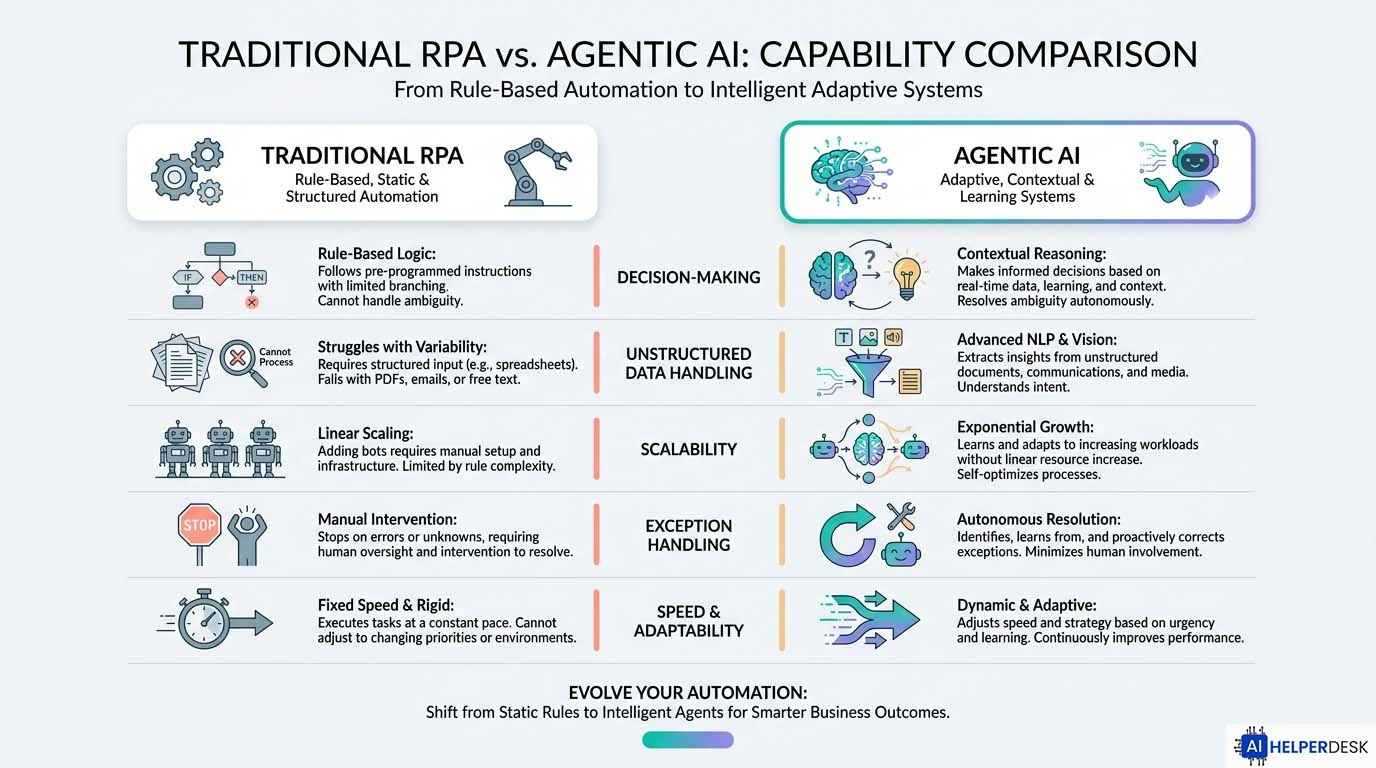
Here’s how agentic workflows and traditional automation compare across the dimensions that genuinely matter for scaling a business.
Decision-Making
Traditional automation is deterministic. If X, do Y, every time, without exception. AI agents are probabilistic and adaptive. Because they draw on models trained across vast datasets, they handle uncertainty and variation in ways that fixed rule sets simply cannot.
Handling Unstructured Data
This is where the gap becomes most obvious in practice. Emails, PDFs, chat transcripts, scanned invoices: this is the data that actually drives most business decisions day to day. RPA sees noise in unstructured data. Agentic workflows extract signal from it.
Scalability
RPA scales linearly. Every new task requires building a new bot or modifying existing scripts. These systems scale by generalizing across tasks and handling varied inputs without requiring manual rule updates for every new scenario.
Exception Handling
Traditional automation hits an exception and stops, or worse, silently fails and moves on. AI agents interpret exceptions. They assess whether an issue is a data quality problem that can be auto-corrected or something that genuinely needs a human to weigh in. That distinction alone makes agentic workflows far more resilient in messy, real-world environments.
Implementation Speed vs. Capability
RPA wins on speed to deploy. You can have bots running in weeks. This approach takes longer to set up properly. You need data pipelines, governance frameworks, and a clear sense of where human oversight needs to sit. The payoff is significantly greater capability over time, which is exactly why this technology is attracting serious enterprise investment right now.
Real-World Use Cases: Where Each Approach Wins
Traditional Automation Does This Well
- Payroll processing: Fixed rules, structured data, identical workflow every cycle
- Regulatory form submissions: Defined fields, predictable structure, high-stakes accuracy
- Data sync between systems: Moving invoice data from one ERP to another, reliably
- Report generation: Pull standard metrics, apply formatting, distribute on schedule
When speed and consistency matter more than judgment, and when your data is clean and your processes never change, RPA delivers excellent ROI. No argument there.
Agentic Workflows Handle This Better
- Customer support at scale: These AI systems can read a customer complaint, look up account history, check the relevant policy, draft a resolution, and escalate only if something genuinely falls outside expected patterns. A standard bot routes a ticket. These AI agents resolve it. If you are ready to build these kinds of agents yourself, see our hands-on comparison of the top no-code AI agent builders available in 2026.
- Complex vendor onboarding: A process spanning procurement, legal, finance, and IT simultaneously is exactly where this approach earns its keep. The system coordinates all of that without step-by-step programming, understanding that “process this vendor” involves checking compliance documents, validating credentials, and routing approvals across departments.
- Insurance claims processing: AI agents can review incoming claims, cross-reference them with policy documents, and pull key details from unstructured files, handling the kind of variability that causes traditional bots to break.
- Supply chain monitoring: Continuous tasks like demand forecasting, anomaly detection, and dynamic rerouting require active reasoning. These systems are built for exactly this kind of ongoing, adaptive work.
The Numbers Behind Agentic Workflows Adoption
The business case is growing quickly, but so is the reality check that comes with it.
The global agentic AI market is expected to grow from USD 5.2 billion in 2024 to USD 227 billion by 2034, a CAGR of 45.8%. That’s not hype. It reflects genuine enterprise adoption playing out across industries right now. McKinsey reported that 62% of organizations are either experimenting with or actively scaling AI agents, with 23% already deploying agentic workflows in at least one business function.
Companies report an average ROI of 171% from these implementations, with U.S. enterprises coming in around 192%, roughly three times the return of traditional automation.
Here’s the honest counterweight: while 30% of organizations are exploring these options and 38% are running pilots, only 14% have solutions ready to deploy, and just 11% are actively using these systems in production. The gap between pilot and production is real, and it catches organizations off guard more often than vendors like to admit.
Pros and Cons: An Honest Look
Traditional Automation (RPA)
What it does well:
- Fast to implement, with results in weeks rather than months
- High accuracy on structured, repetitive tasks
- Lower upfront complexity and cost
- Easy to audit and explain for compliance purposes
Where it falls short:
- Brittle: breaks when processes or underlying systems change
- Struggles badly with unstructured data
- Scales linearly, meaning more automation equals more maintenance burden
- No judgment, no adaptability when things go sideways
Agentic Workflows
What they do well:
- Handle complexity, exceptions, and unstructured data with confidence
- Scale intelligently without requiring a rewrite for every new scenario
- Operate autonomously across multiple systems and tools
- Deliver significantly higher ROI over a multi-year horizon
Where they fall short:
- Longer, more complex implementation cycles than traditional automation
- Require strong data governance and oversight frameworks before going live
- Key adoption barriers include cybersecurity concerns (cited by 35% of organizations), data privacy (30%), and regulatory uncertainty (21%)
- Risk of “agentic AI washing,” where vendors relabel legacy automation as AI without real capability uplift
The Hybrid Reality: Agentic Workflows and RPA Together
One of the most important things practitioners are learning in 2026 is that you don’t need to pick a side. The smarter move is knowing where each approach fits in your specific context.
For high-volume, repetitive, well-defined tasks, traditional automation still provides exceptional value. But when processes grow more complex, agentic workflows click into place as the natural complement. These systems handle the exceptions, extract meaning from unstructured data, and surface insights that rule-based tools miss entirely. Traditional automation doesn’t disappear. It becomes the reliable foundation on which your AI agents operate.
In practice, this looks like RPA bots handling the structured, predictable backbone of your operations, while these AI agents sit on top to manage exceptions, cross-system coordination, and anything requiring contextual reasoning. Neither replaces the other.
What’s Coming: The Near Future of Agentic Workflows
The direction is clear, even if the exact timeline is still debated among practitioners.
By 2028, projections suggest that 15% of routine workplace decisions will be made independently by AI agents without human intervention. Around 70% of surveyed business leaders believe AI-driven automation will surpass traditional RPA within three years. On the customer-facing side, 68% of customer interactions are expected to be handled by these intelligent systems by 2028, though 89% of leaders still emphasize human-AI collaboration over full replacement.
The governance angle deserves equal attention. As these systems take on more consequential decisions, the organizations that win will be those that build clear accountability structures. Knowing exactly where AI authority ends and human judgment begins is not a technical problem. It’s an organizational one. Get that right, and agentic workflows become a genuine competitive advantage rather than a liability. For a closer look at the specific shifts reshaping how businesses operate with AI, our breakdown of 5 major next-gen AI agent shifts every business owner should know in 2026 is worth reading alongside this one.
For a deeper technical look at how this technology is being architected today, Anthropic’s research on AI agents and LangChain’s documentation on agentic patterns are both worth your time.
How to Decide: A Practical Framework
Before committing to either path, work through these questions honestly:
- Is your process stable and structured? Start with traditional automation. You’ll get faster ROI and lower implementation risk.
- Do you deal with unstructured data, frequent exceptions, or rapidly changing workflows? Agentic workflows deserve a serious look, probably sooner than you think.
- Are you scaling rapidly across different business functions at once? A hybrid approach combining both approaches is almost certainly the right answer.
- Do you have solid data infrastructure and governance frameworks in place? If not, build those first. This technology is only as capable as the foundation underneath it.
- What’s your risk tolerance? RPA is auditable and highly predictable. Agentic workflows deliver more power but require more robust oversight to deploy responsibly.
For further reading on how enterprises are navigating this decision, McKinsey’s perspective on AI automation strategy and Deloitte’s 2026 tech trends report both offer grounded, practitioner-level perspectives.
The Smarter Question Isn’t Which One: It’s When to Use Each
The agentic workflows vs. traditional automation debate misses the point when it turns into a binary choice. Both have a genuine role to play, and the businesses scaling fastest right now are those treating this technology and RPA as complementary tools rather than competitors.
If you’re just getting started with automation, traditional RPA is still a sensible first step: low risk, fast results, solid ROI on structured work. But if your processes involve messy data, frequent exceptions, or cross-system coordination that shifts regularly, building toward this approach is no longer optional. It’s the difference between an automation stack that serves your business today and one that actually grows with it.
The technology is ready. The real question is whether your data infrastructure, governance practices, and organizational mindset are ready too. Start there, and the right path forward becomes much clearer than any vendor comparison chart will tell you.
Have thoughts on where agentic workflows fit in your tech stack? Drop your questions or experiences in the comments. This is a conversation worth having in the open.
Frequently Asked Questions
Agentic workflows are AI-powered processes where software agents autonomously plan, decide, and take actions across multiple steps to reach a goal, without needing a human to specify every instruction in advance. Agentic workflows can read unstructured data, handle exceptions, and coordinate across different systems on their own. Think of them as automation that actually understands what it’s trying to accomplish.
Not at all. Traditional automation remains highly effective for structured, high-volume, repetitive tasks. The real shift is that it’s becoming one layer within a broader stack, rather than the entire strategy. Most forward-thinking enterprises now combine RPA with agentic workflows for a more capable, resilient hybrid approach.
For most small businesses, traditional automation is the smarter starting point. It’s cheaper to implement, delivers results faster, and requires less infrastructure. Agentic workflows make more sense once you have complex, multi-system processes or significant volumes of unstructured data, or once you’re operating at a scale where exceptions are a daily challenge rather than an edge case.
Upfront, agentic workflows tend to cost more in both time and infrastructure. That said, the ROI over time is substantially higher, with some industry analysis putting it at roughly 3x the return of traditional automation. The real cost driver is not the AI tooling itself. It’s getting your data readiness and governance infrastructure in good shape before you launch your agentic workflows.
Financial services, insurance, healthcare, and large-scale enterprise operations are currently seeing the highest adoption of agentic workflows. These industries handle high volumes of unstructured data, complex decision-making, and frequent exceptions, exactly the conditions where agentic workflows outperform rule-based automation by a wide margin.
Agentic workflows are designed to handle the routine, repetitive, and data-heavy parts of knowledge work, not to replace human judgment on consequential decisions. The most effective agentic workflow implementations keep humans accountable for approvals, exception handling, and risk calls, while AI handles coordination, triage, and high-volume operational work.
