Open-Source AI Agents Comparison: CrewAI vs AutoGen vs LangGraph
-
- by Fiaz Ahmad
- June 17, 2026
- in AI Agents News, AI for Developers

Open-source AI agents have come a long way since 2023. What started as a handful of impressive demos and research experiments has quietly turned into serious production infrastructure that real businesses are betting on. In 2026, teams building lead generation pipelines, content automation systems, and customer support workflows have largely settled on three dominant frameworks: CrewAI, AutoGen, and LangGraph. Each one takes a fundamentally different approach to orchestrating multi-agent systems, and picking the wrong one can cost your team weeks of painful rewrites down the road.
This article breaks down the real architectural differences between these open-source AI agents frameworks, the benchmark numbers that actually matter, and the real-world deployment outcomes that help you make a sound decision before writing a single line of code.
According to Markets and Markets, the global AI agent market hit $7.84 billion in 2025 and is on track to reach $52.62 billion by 2030, growing at a compound annual growth rate of 46.3%. With Gartner predicting that 40% of enterprise applications will feature task-specific AI agents by the end of 2026, choosing the right open-source framework has become a genuine business decision, not just a developer preference.
What Are Open-Source AI Agents and Why Do They Matter for Lead Generation
Open-source AI agents are autonomous software systems that can plan, reason, use tools, and complete multi-step tasks without constant human input. They are not the same as a basic prompt-response model sitting behind a chatbot. These agents observe their environment, make decisions, and iterate until they reach a defined goal. In a lead generation context, that means an agent can autonomously prospect LinkedIn profiles, qualify leads against a set of criteria, draft personalized outreach messages, and log results to a CRM, all without a human touching each step.
The three frameworks covered in this article represent the clearest paths to custom AI agent development in 2026. They are all open-source, Python-based, and actively maintained, but they solve the same core problem from very different angles. Understanding those differences before you start building will save you a lot of time.
Understanding the Three Open-Source AI Agents Frameworks
CrewAI: Role-Based Teams for Business Automation
CrewAI models agents as a collaborative team where each agent has a defined role, a backstory, and a goal. The metaphor maps directly to how business teams already operate: a Researcher finds qualified prospects, a Writer drafts outreach messages, a Quality Reviewer checks tone and compliance, and a Publisher sends the final message. This role-based delegation is intuitive for developers and business teams who understand workflows but do not particularly want to think in graph theory.
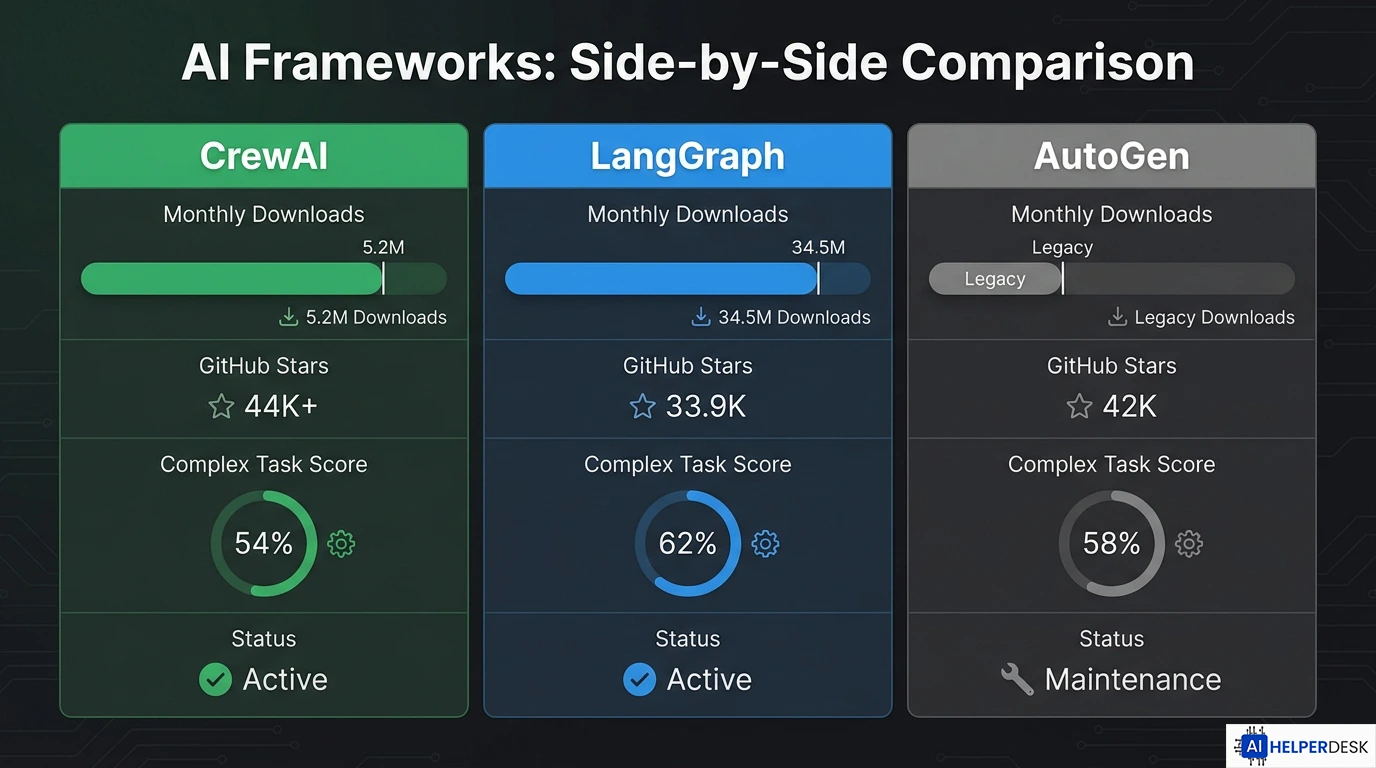
As of mid-2026, CrewAI has surpassed 44,000 GitHub stars and 5.2 million monthly downloads. It has reached roughly 60% Fortune 500 adoption for business process automation, content pipelines, sales prospecting, and lead qualification workflows. Independent benchmarks put CrewAI at an 82% task success rate with an average latency of 1.8 seconds per task. The January 2026 addition of streaming tool call events addressed the biggest production-readiness complaint from enterprise teams, so the setup friction that plagued earlier versions is largely gone.
CrewAI also introduced Flows in 2025, an event-driven pipeline mode that provides more predictable execution for production-oriented workloads. This makes CrewAI a stronger candidate for linear business processes where deterministic output matters more than flexible control flow.
LangGraph: The Production Standard for Stateful Workflows
LangGraph takes a completely different approach to open-source AI agents. It models workflows as a directed graph of nodes and edges, where nodes are functions or LLM calls and edges define the control flow between them. State passes through the graph as a typed dictionary, which means every transition is explicit, debuggable, and persistent. This architecture directly solves the most common failure mode in production agents: losing state mid-workflow.
According to LangChain’s State of Agent Engineering report published in 2026, over 60% of production agent incidents trace back to state management failures. Agents lose context mid-workflow, repeat steps, or crash without any way to recover. LangGraph was built specifically to eliminate this problem, and the production track record backs that up.
With 33,900 GitHub stars and 34.5 million monthly downloads as of May 2026, LangGraph is the most downloaded agent orchestration framework available. Around 400 companies now run LangGraph Platform in production, including Cisco, Uber, LinkedIn, BlackRock, and JPMorgan. The framework reached a stable v1.0 milestone in October 2025 and shipped LangGraph 1.2 in May 2026.
LangGraph integrates natively with LangSmith, which provides step-by-step traces with token counts per node, the ability to replay workflows from any checkpoint, and the option to inject modified inputs mid-run. For lead generation systems that need auditable records of every agent decision, this observability layer is genuinely difficult to replicate with other tools.
AutoGen: Maintenance Mode and What That Means
AutoGen was one of the earliest open-source AI agents frameworks to prove the concept of multi-agent conversation back in 2023 and 2024. Its conversation-centric design allowed agents to collaborate through structured dialogue, which worked well for research tasks and code execution scenarios. At the time, it was impressive.
In 2026, however, AutoGen is effectively in maintenance mode. Microsoft shifted its strategic focus to the broader Microsoft Agent Framework, which merges AutoGen and Semantic Kernel into a unified SDK that reached general availability in April 2026. AutoGen still receives bug fixes and security patches, but major new feature development has stopped. For teams with existing AutoGen codebases, migration is not urgent. For new projects, choosing AutoGen in 2026 means building on a framework that will not keep pace with CrewAI or LangGraph in terms of new capabilities, protocol support, or community tooling. That is a real risk worth acknowledging upfront.
Key Statistics and Market Insights
Here are the numbers that matter most when evaluating open-source AI agents in 2026. LangGraph leads on downloads with 34.5 million monthly, 33,900 GitHub stars, and 400 verified enterprise production deployments. CrewAI has 5.2 million monthly downloads, over 44,000 GitHub stars, and roughly 60% Fortune 500 adoption for business automation. AutoGen sits at 42,000 GitHub stars but has no active major feature development following Microsoft’s strategic pivot. The global agent market stood at $7.84 billion in 2025 with a projected trajectory to $52.62 billion by 2030. According to LangChain’s 2026 State of Agent Engineering report, 57% of organizations now have AI agents in production, and 89% of those organizations treat observability tooling as standard practice.
On task completion benchmarks using Qwen3 32B across 200 tasks per complexity tier, LangGraph leads on complex multi-step tasks at 62% completion, AutoGen follows at 58%, and CrewAI reaches 54%. For simple single-tool tasks, all three frameworks cluster tightly between 79% and 88%, which means framework selection is largely irrelevant for straightforward use cases. The real differentiation shows up when workflows get complicated.
Real-World Use Cases: Open-Source AI Agents in Production
Lead Generation and Sales Prospecting with CrewAI
CrewAI is the dominant open-source AI agents choice for lead generation automation in 2026. Its role-based structure maps naturally to sales workflows: one agent scrapes and qualifies prospects from LinkedIn or Apollo, a second agent personalizes outreach based on firmographic data, and a third agent manages follow-up sequences. The setup time from concept to working prototype is typically two to four hours for developers already familiar with Python, which is a meaningful advantage when you are trying to validate an idea before committing to a full build.
Teams building multi-agent systems for social media content and lead nurturing, similar to the approaches covered in automating social media with multi-agent systems, find CrewAI’s delegation model intuitive because it mirrors existing content team structures.
Enterprise Customer Support and Compliance with LangGraph
Klarna deployed LangGraph to power its customer support AI, handling inquiries for 85 million active users. Average resolution time dropped from 11 minutes to 2 minutes, an 80% improvement. The system now manages the equivalent workload of 700 full-time employees, contributing to approximately $40 million in projected annual cost savings. Those are not proof-of-concept numbers. That is production at scale.
LinkedIn built SQL Bot on LangGraph, a multi-agent system that converts natural language questions into SQL queries so non-technical employees across departments can access data insights independently. Uber’s Developer Platform team used LangGraph to build agent networks for large-scale code migrations and automated unit test generation, saving approximately 21,000 developer hours.
Custom AI Agent Development for Internal Tools
LangGraph’s graph-based architecture has become the standard choice for custom AI agent development where workflows require cycles, branching logic, retry mechanisms, or human approval steps. AppFolio rebuilt its property management copilot on LangGraph and doubled response accuracy while saving property managers more than 10 hours per week. That kind of outcome is hard to achieve when you are fighting your framework’s abstractions instead of working with them.
Benefits and Opportunities
CrewAI’s main advantages are speed and accessibility. It offers the fastest path to a working multi-agent prototype, the most readable configuration, the best alignment with business process automation, and the lowest barrier for developers who do not have a systems architecture background.
LangGraph’s main advantages are durability and depth. It is the most production-hardened framework in 2026, with native checkpointing and state persistence, best-in-class observability through LangSmith, the largest verified enterprise deployment list, and the only framework with documented outcomes at the scale of Klarna and JPMorgan.
Both open-source AI agents frameworks operate under permissive licenses, which means teams can inspect, modify, and self-host their agent infrastructure without vendor lock-in on model choice. That is a meaningful advantage over SaaS agent platforms that charge per execution and restrict which models you can run.
Risks, Challenges, and Limitations
If you choose CrewAI over LangGraph, you should know that CrewAI’s role-based abstraction is both its strength and its ceiling. Cyclical workflows where an agent needs to loop back based on evaluation results are technically supported but genuinely painful to debug. Teams consistently report that once workflows exceed five or six agents or require complex conditional branching, the abstraction becomes a limitation rather than an advantage.
If you choose LangGraph for early-stage projects, expect a steeper learning curve than the documentation suggests. Developers unfamiliar with directed graph concepts, typed state schemas, and node-edge mental models will spend significant time on architecture before writing a single agent prompt. For rapid prototyping or proof-of-concept work, that upfront cost is hard to justify when CrewAI can get you to a demo in a few hours.
A shared limitation across open-source AI agents frameworks is that none of them ship with governance built in. Multi-tenancy, per-tenant rate limiting, data residency compliance, and access controls all have to be built separately, regardless of which framework you choose. This is a significant gap for teams building SaaS products where each customer’s agents must operate in isolated environments. It is not a reason to avoid these frameworks, but it is a scope item you need to plan for.
On the AutoGen side, the risk is straightforward: building new projects on a framework in maintenance mode means accepting that it will not keep pace with evolving protocol standards, community tooling, or new capabilities. Migration costs later may exceed whatever savings you get from building on a familiar codebase today.
Expert Analysis
The 2026 open-source AI agents landscape has effectively resolved into a two-framework market. CrewAI owns rapid deployment and business process automation. LangGraph owns production infrastructure and enterprise workflows. AutoGen served an important purpose by demonstrating that agents could collaborate through structured conversation, but its architectural model did not solve the durability and observability problems that became critical as organizations moved from demos to production.
The most important insight buried inside the benchmark data is this: the performance gap between frameworks on simple tasks is essentially negligible. Where they diverge sharply is on complex, multi-step workflows that require state recovery after failure. LangGraph’s 62% complex task completion versus CrewAI’s 54% is an eight-percentage-point gap that translates directly into reliability at scale. For a lead generation pipeline running thousands of prospect touches per day, that difference compounds quickly.
The Fortune 500 adoption figure for CrewAI is real, but it is worth reading carefully. CrewAI adoption at large enterprises typically refers to internal automation and content pipeline use cases, not the mission-critical infrastructure that LangGraph powers at Klarna and JPMorgan. The two frameworks are not competing for the same workloads, and understanding that distinction will save you from making a framework decision based on the wrong comparison.
For teams making framework decisions in 2026, the most reliable signal is not GitHub stars or benchmark percentages. It is whether the workflow you are building needs state persistence across failures, conditional branching, or human-in-the-loop checkpoints. If the answer is yes, start with LangGraph. If the workflow is linear, role-delegated, and fits a clear team metaphor, CrewAI will get you to production faster with far less architecture overhead.
The governance gap is the real risk that both frameworks leave unaddressed. As enterprises move from single-tenant internal tools to multi-tenant agent products, the scaffolding around the framework matters as much as the framework itself. Teams that win in 2026 will treat governance, observability, and tenant isolation as first-class concerns from the start, not retrofits they will deal with later.
Future Outlook
The open-source AI agents framework landscape will not stay static. Protocol standardization is already underway: CrewAI has added support for the Agent-to-Agent protocol, and the broader industry is converging on Model Context Protocol as the standard for tool integration. LangGraph’s managed cloud offering, LangGraph Cloud, signals that the framework intends to compete with hosted agent infrastructure providers, not just serve as an open-source library.
By 2027, the line between open-source AI agents and fully managed commercial platforms will narrow further. The frameworks that survive will be the ones that solve real production problems, including governance, multi-tenancy, cost observability, and compliance controls, not just the ones with the most intuitive developer experience at the prototype stage.
For lead generation specifically, the opportunity is significant right now. AI agents that can autonomously research prospects, personalize outreach at scale, and adapt follow-up sequences based on engagement signals are already delivering measurable pipeline improvements for early adopters. The frameworks to build them are mature, well-documented, and production-tested at enterprise scale. The window for competitive advantage from being an early mover is still open, but it will not stay open indefinitely.
Conclusion
Selecting the right open-source AI agents framework in 2026 comes down to one honest question: how complex does your workflow need to be, and how reliable does it need to be at scale? Among open-source AI agents frameworks, CrewAI wins on speed, readability, and alignment with business process thinking. LangGraph wins on production reliability, state management, and enterprise-grade observability. AutoGen, despite its important role in proving the multi-agent concept, is no longer a credible choice for new projects.
For lead generation pipelines specifically, both frameworks are capable tools. CrewAI gets you from idea to working prototype in an afternoon. LangGraph gets you to a system that survives real production load without state failures or opaque errors. The decision is not which framework is objectively better. It is which framework matches where your team is today and where your workflow complexity will take you over the next six months.
Open-source AI agents are no longer a research curiosity. They are the infrastructure layer that serious AI-powered businesses are building on in 2026. Choosing your foundation carefully is worth the extra hours of evaluation upfront, because changing it later is never as easy as the migration guides make it sound.
Frequently Asked Questions
CrewAI is the most widely adopted framework for lead generation and sales automation workflows in 2026. Its role-based design maps naturally to prospecting, qualification, and outreach pipelines. For teams building open-source AI agents that need more control over stateful, long-running workflows, LangGraph is the better production choice.
LangGraph models workflows as directed graphs with typed state management, built-in checkpointing, and durable execution. It is optimized for complex, production-grade systems. CrewAI models agents as collaborative teams with assigned roles and goals. It is faster to set up and better suited to linear business automation tasks.
AutoGen is in maintenance mode as of 2026. Microsoft shifted development focus to the Microsoft Agent Framework. Existing AutoGen projects can continue running without issues, but new projects should use LangGraph or CrewAI instead.
Open-source frameworks like LangGraph and CrewAI have no licensing cost. The primary expenses are LLM API usage, hosting infrastructure, and developer time. LangGraph Cloud and CrewAI’s enterprise tier add managed hosting costs on top of the open-source base.
CrewAI is the most beginner-friendly option. Its role-based setup requires minimal boilerplate, YAML configuration files keep agent definitions readable, and the team metaphor is intuitive for anyone who has managed a real-world project before.
Open-source AI agents eliminate per-seat and per-execution SaaS costs, allow full customization of prospecting and qualification logic, and scale lead touches without proportional headcount increases. Teams using CrewAI for sales prospecting report the ability to run personalized outreach campaigns at volumes that would otherwise require a team of five to ten human SDRs.
