AI Agents for Real Estate: Automating Lead Nurturing and Follow-Ups
-
- by Fiaz Ahmad
- June 18, 2026
- in AI Agents News, AI Business Solutions


The average real estate agent takes over 15 hours to respond to a new lead inquiry. In an industry where a five-minute response makes an agent 21 times more likely to qualify that lead, this is not a minor inefficiency. It is the difference between a signed agreement and a lost commission. AI agents for real estate are closing that gap in 2026, and not just by speeding up the first response. They are sustaining the entire lead nurturing process through intelligent, autonomous follow-up that never sleeps and never misses a signal.
This is no longer a fringe experiment. A January 2026 survey by Delta Media found that 97 percent of brokerage leaders report their agents are actively using AI tools. The technology has crossed from optional add-on to operational infrastructure. What follows is a grounded look at how AI agents for real estate actually work, which platforms are producing real results, and what agents need to understand before building their own automation stack.
What Are AI Agents for Real Estate?
AI agents for real estate represent a genuine category shift from traditional automation tools. The term gets used loosely across the industry, so let us be precise. A traditional AI tool in real estate is generative: you prompt it, it responds. A listing description generator waits to be asked. An AI agent works completely differently. It monitors data, makes decisions, and takes action on its own without waiting for a human to trigger every step.
In practical terms, an AI agent for real estate might watch your CRM around the clock, spot a contact who just viewed three listings and adjusted a mortgage calculator, draft and send a personalized follow-up text, update the lead status in the pipeline, and flag the contact for agent review. All of this happens without a human clicking anything. PwC’s Emerging Trends in Real Estate 2026 report specifically distinguishes this second wave of AI as “agentic AI” and notes that broader deployment across the industry is expected within the next 24 months.
This shift from generative to agentic is the central development in real estate AI right now. Agents who understand it gain a durable workflow advantage. Those who still treat AI as just a content tool are using roughly one percent of its available leverage.
Why Lead Response Speed Defines Modern Real Estate Outreach
Speed-to-lead data has been consistent for years, and the 2026 numbers only reinforce the urgency. Research from Real Trends and InsideSales.com confirms that agents who respond within five minutes are 21 times more likely to qualify a lead than those who wait 30 minutes. Yet Inman’s 2025 Real Estate Technology Survey found the average response time sits at 917 minutes. That is more than 15 hours.
This gap between what agents know and what they actually do is almost entirely a workflow problem, not a motivation problem. Most agents are at showings, in negotiations, or simply unavailable when a web lead arrives at 10:47 pm on a Tuesday. AI agents for real estate solve this by removing the dependency on agent availability entirely. The system responds immediately, asks qualifying questions about timeline, financing, and property preferences, and holds the conversation in natural language until either the lead disengages or the agent is ready to take over.
The result is a pipeline that never goes dark. One solo agent documented by AIscending in April 2026 described going from missing after-hours inquiries entirely to booking three additional showings in her first two weeks, simply because an AI follow-up caught leads she would have lost overnight.
AI Agents for Real Estate: The Core Workflow
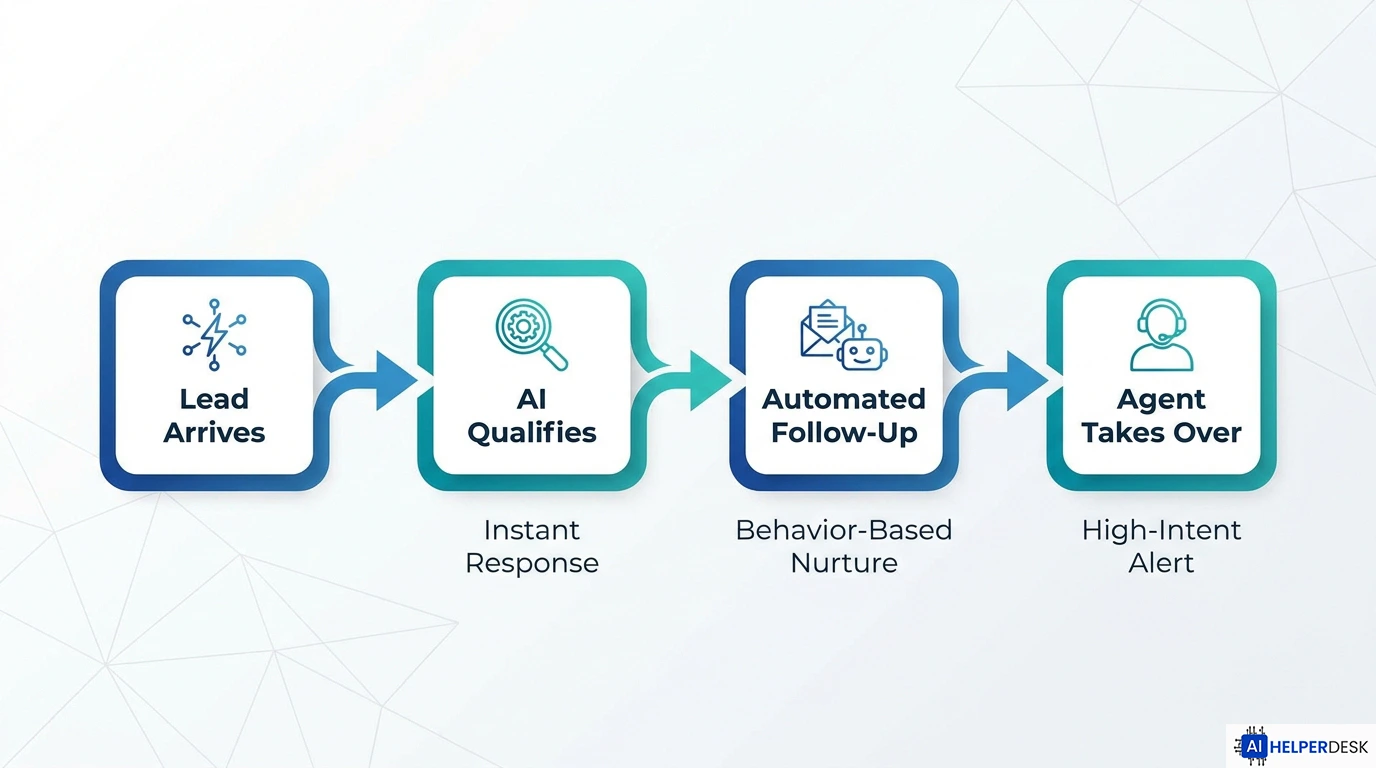
Before evaluating specific platforms, it helps to understand how AI agents actually operate across the lead lifecycle.
Lead Capture and Qualification
The first stage of deploying AI agents for real estate replaces the static contact form with a conversational AI that engages visitors the moment they land on an agent’s website or IDX page. Instead of a name and email field, prospects enter a guided conversation that captures their buying or selling timeline, financing status, neighborhood priorities, and budget range. Platforms like Perspective AI and Structurely operate specifically in this lane. The qualifying data gathered here shapes every subsequent interaction, giving downstream nurture sequences the context to feel relevant rather than generic.
Automated Follow-Up and Nurture Cadences
This is where AI agents for real estate generate the most visible business impact. Rather than manual drip campaigns that send the same email to every lead on the same schedule, agentic systems adapt based on behavior. If a lead opens an email and clicks on two listings, the system escalates. If a lead goes quiet after three touchpoints, the cadence shifts to a lower-frequency sequence to avoid opt-outs.
The data on follow-up consistency is compelling. According to Goliath Data’s 2026 lead research, 80 percent of sales require five or more follow-up contacts, yet 44 percent of agents give up after one. AI-powered follow-up sequences execute all five to ten touches automatically across email, SMS, and sometimes voice, with no manual input required from the agent after the initial setup.
Lead Scoring and Prioritization
AI agents for real estate use lead scoring to make sure agents focus their attention where conversion probability is highest. Not all leads deserve the same time. AI lead scoring analyzes behavioral signals including email opens, listing saves, search frequency, and repeat website visits to assign a probability score to each contact. Agents see a ranked list of their highest-intent prospects rather than an undifferentiated pile of names. According to Goliath Data, AI lead scoring alone boosts conversion by 20 percent and cuts time spent on low-probability leads by 30 to 50 percent.
Agentic CRM Automation
The most sophisticated tier of AI agents for real estate operates at the CRM level, running continuous background processes that surface seller intent before a homeowner ever raises their hand. Lofty’s Homeowner Agent, launched in April 2026, monitors existing CRM contacts for signals such as equity position, local market activity, and browsing behavior on sold listings, then automatically delivers personalized market reports to those contacts. When a homeowner requests a CMA or books an appointment, the system shifts them into a handoff stage and pauses automated outreach so the human agent can step in. This is always-on pipeline generation from a database the agent already owns.
Key Statistics on AI in Real Estate Lead Generation (2026)
The quantitative picture of AI agents for real estate makes a clear case for any agent still on the fence about investing.
According to Ascendix’s 2026 industry analysis, over 87 percent of brokerages and agents now use AI tools daily. AI-enhanced CRMs are projected to be adopted by nearly 89 percent of top agents before the end of 2026. Real estate deal close rates rise by 27 percent when agents use AI CRM systems. Agentic CRMs specifically are projected to boost overall conversion rates by 67 percent by reducing the volume of leads that fall through follow-up gaps. Meanwhile, AI-powered lead nurturing increases conversion rates by 40 percent compared to manual follow-up, according to Inside Real Estate’s benchmark study. The global AI in real estate market is projected to reach 1.3 billion dollars by 2029, per MarketsandMarkets.
One statistic worth particular attention: the average cost per lead in real estate hit 503 dollars in 2026, up 12.3 percent from the prior year. At a national conversion rate that remains flat at 2 to 5 percent, that means each closed deal can cost between 10,000 and 25,000 dollars in lead acquisition alone. AI-powered lead scoring and follow-up automation directly compress this cost by converting a higher percentage of leads already in the pipeline rather than requiring agents to buy more.
Real-World Use Cases: How Agents Are Deploying AI
The following platforms show how AI agents for real estate move from concept into revenue-generating workflows across different lead generation and nurture models.
Ylopo: Paid Lead Generation with Integrated AI Follow-Up
Ylopo pairs paid social advertising with Raiya, a conversational AI texting assistant that engages, nurtures, and qualifies leads automatically once they enter the pipeline. This closed-loop model addresses a core weakness in most lead generation strategies: paying for clicks without the follow-up infrastructure to convert them. Agents using Ylopo report behavior-based follow-up triggered by listing views and search activity, keeping prospects engaged without manual effort.
CINC: Behavioral Nurture Throughout the Lead Lifetime
CINC generates over six million leads annually for its clients and uses AI to move well beyond first-touch engagement. When leads revisit listings, click on properties, or go quiet, the platform automatically re-engages them with contextually relevant content. This behavioral re-engagement model reflects a core principle in real estate AI outreach: the goal is not just to respond first but to stay relevant throughout the entire consideration period, which can stretch across months for both buyers and sellers.
BoldTrail: Machine Learning Lead Prioritization
BoldTrail’s AI engine analyzes lead behavior, segments contacts, and routes the highest-conversion opportunities to agents first. If a lead views several listings, they receive a targeted text automatically. If they save a property, an email with comparable homes follows. This behavioral trigger system removes the guesswork from follow-up timing and content selection, two areas where manual follow-up is most inconsistent.
Predictive Seller Identification
Platforms like SmartZip, Top Producer, and Goliath Data show how AI agents for real estate can shift prospecting from reactive to proactive. These tools use machine learning to flag homeowners who are statistically likely to sell based on factors such as length of ownership, equity position, local sold-listing activity, and demographic transitions. This intelligence allows agents to run real estate AI outreach campaigns toward people who have not yet expressed intent, positioning the agent as a trusted resource before the decision process even begins. This is a meaningful shift from reactive lead response to proactive pipeline creation.
Benefits and Opportunities for Agents and Teams
The compounding advantages of deploying AI agents for real estate go well beyond faster response times.
Agents running AI-powered follow-up sequences can maintain meaningful contact with significantly larger databases than manual methods allow. Where an agent might realistically sustain personal outreach to 100 to 150 contacts, an AI system can manage thousands simultaneously, delivering personalized updates, market reports, and check-ins at scale. This database leverage is particularly valuable for agents who have spent years building a contact list but lack the infrastructure to activate it consistently.
For small teams and entrepreneurs building real estate practices, AI agents for real estate reduce dependency on expensive portal leads. If you are exploring the broader landscape of automation tools that support business growth beyond real estate specifically, the 10 Best AI Tools for Entrepreneurs to Scale Business Workflows (2026) is worth reading alongside this guide, as it covers AI automation frameworks that apply across client-facing workflows including outreach, scheduling, and CRM management.
The time savings also compound in less obvious ways. Agents who stop manually sorting through cold leads reclaim hours per week that can be redirected toward listing appointments, negotiations, and relationship-building, the activities that actually close transactions. According to the RPR 2026 survey, the agents generating the best results from AI are not using more tools. They are using AI on the right three workflows: lead intake, follow-up, and listing preparation.
Risks, Challenges, and Limitations
Any honest evaluation of AI agents for real estate has to acknowledge where these systems create friction and where they fall short.
The most frequently cited risk is tone misalignment. AI follow-up that feels generic, overly formal, or robotic can damage a prospective client relationship before the human agent ever enters the conversation. This is especially acute in high-value markets where buyers and sellers expect concierge-level communication. Agents must invest real time in customizing AI messaging to match their voice and review outgoing sequences regularly rather than treating setup as a one-time event.
Data quality is a second constraint. AI lead scoring and predictive seller identification depend on accurate, current CRM data. Outdated contact records, missing engagement history, and incomplete property data all degrade the accuracy of AI recommendations. Agents with poorly maintained databases will not see the same results as those with clean, enriched records.
Privacy and compliance considerations also apply. Automated SMS and email outreach must comply with CAN-SPAM regulations, TCPA rules governing text messaging, and state-specific real estate marketing requirements. Agents should verify that any platform they deploy has built-in compliance controls and consult legal counsel where needed before launching automated outreach campaigns.
Finally, the NAR data point that only 17 percent of agents report a significant positive impact from AI, despite 82 percent using it, points to a real workflow design problem. Buying an AI tool does not produce results. Integrating it into a well-structured lead management process does. Those are two very different things.
Expert Analysis
The 2026 data on AI in real estate reveals a specific and instructive pattern. Adoption is nearly universal, but impact is highly concentrated. The 17 percent of agents generating meaningful results from AI share a common approach: they deploy AI on a narrow set of high-leverage workflows rather than spreading tools across every touchpoint indiscriminately.
The shift from generative AI to agentic AI is the most significant structural development in real estate technology in several years. Generative tools that produce content on demand have already been commoditized. The real competitive differentiation for AI agents for real estate in 2026 comes from agentic systems that act without being prompted. Lofty’s Homeowner Agent, launched in April 2026, illustrates this clearly. The tool monitors an agent’s existing CRM for seller intent signals and initiates nurture automatically. This is not a faster version of a task the agent was already doing manually. It is a fundamentally new capability that enables pipeline generation from a dormant database at no additional lead acquisition cost.
For business AI agents operating in client-acquisition contexts more broadly, real estate provides a useful model. The highest-value deployments are those where AI handles the latency problem, the gap between when a prospect expresses intent and when a human can respond, while preserving human involvement for the judgment-intensive moments: pricing strategy, negotiation, and building relationship trust. The agents who will lose ground over the next two to three years are not those who refuse to use AI entirely. They are the ones who deploy it haphazardly, treat automated follow-up as a substitute for relationship building, and neglect the human touchpoints that actually close deals.
The opportunity is real and accessible. An agent does not need a large team or complex technical infrastructure to benefit from AI lead nurturing. A single agentic CRM configured properly around a clean contact database can materially change conversion rates and reduce the cost per closed transaction. For AI tools for entrepreneurs building real estate practices from the ground up, starting with the conversation layer, the tool that qualifies inbound leads in real time, is the highest-return first deployment before layering in predictive scoring and agentic CRM automation.
Future Outlook: Where AI in Real Estate Is Heading
The trajectory for AI agents for real estate points toward deeper integration and greater autonomy. PwC’s Emerging Trends in Real Estate 2026 specifically calls out agentic AI as the next major wave, predicting that within 24 months, AI systems will routinely check CRM context, pull relevant listings, schedule follow-up calendar items, and update lead status without any human input across the full transaction lifecycle.
Yardi Virtuoso is already operating in this space at the property management level. Broader deployment across residential sales is expected as the tooling matures and setup complexity decreases. For agents, this means that building clean, well-structured CRM data today creates a durable competitive asset as AI capabilities expand. The platforms that can read and act on that data will become increasingly powerful over the next two to three years.
Predictive seller identification will also become more granular as AI agents for real estate gain access to richer behavioral data sources. Platforms like Goliath Data already update seller intent signals hourly. As behavioral data sources grow richer and model accuracy improves, agents will be able to identify likely sellers with meaningful lead time before formal listing activity begins, compressing the prospecting cycle and reducing dependence on purchased portal leads.
The regulatory environment will also evolve. Automated outreach at scale will attract greater scrutiny from consumer protection regulators, and agents who build compliance into their AI workflows now will be far better positioned than those who try to retrofit it later.
Conclusion
The case for deploying AI agents for real estate is no longer theoretical. The 2026 data is consistent across multiple sources: agents using agentic CRM systems close more deals, respond faster, and sustain larger pipelines without proportionally more manual effort. The technology has moved from experiment to infrastructure across 87 percent of active brokerages.
The gap that remains is not adoption. It is workflow design. The agents generating outsized results from AI agents for real estate are deploying it on the three workflows where it has the highest leverage: lead intake, automated follow-up, and behavioral nurture. They are not using AI as a marketing gimmick or a content shortcut. They are using it to eliminate the latency and inconsistency that drain revenue from every agent’s pipeline.
For any real estate professional evaluating where to start, the 2026 data points to a clear answer. Fix the speed-to-lead problem first. Deploy a conversational AI that qualifies inbound leads in real time, review the results after 60 days, and then layer in predictive scoring and agentic CRM automation from there. The agents who build this infrastructure in 2026 will have a compounding advantage that is very difficult to close later. AI agents for real estate are not a future consideration. They are a present competitive reality.
Frequently Asked Questions
Traditional chatbots respond to questions when a user initiates contact. AI agents for real estate operate autonomously, monitoring CRM data, triggering follow-up sequences, scoring leads, and updating pipelines without waiting for human input. The key distinction is proactive action versus reactive response.
AI agents for real estate automate the entire outreach cadence from first response through multi-touch nurture. They send personalized texts and emails based on behavioral triggers, adjust frequency based on lead engagement, and escalate high-intent contacts to the agent for direct follow-up. This keeps outreach consistent at a scale that manual methods simply cannot sustain.
Lofty, BoldTrail, CINC, and Ylopo are among the most widely deployed platforms for AI agents for real estate in 2026. The right choice depends on whether an agent’s primary bottleneck is converting new leads or activating an existing database. Lofty’s Homeowner Agent is particularly strong for seller prospecting from existing contacts, while CINC and Ylopo focus on converting new inbound leads.
Pricing varies significantly. General-purpose AI writing tools start near 20 dollars per month. Agentic CRM platforms like Lofty start at approximately 299 dollars per month for solo agents. Predictive lead generation platforms can run several hundred dollars monthly. The most cost-effective approach is to identify the single biggest conversion bottleneck and deploy AI there first before expanding.
No. AI handles the speed, consistency, and scale problems in lead follow-up effectively. However, the highest-value moments in a transaction including pricing strategy, negotiation, and building trust with clients making a major financial decision require human judgment and relationship intelligence that current AI systems cannot replicate. The productive model is AI handling first touch through qualification, with the agent stepping in for high-stakes conversations.
Yes. Automated SMS campaigns must comply with TCPA regulations, and email outreach must meet CAN-SPAM requirements. State real estate commissions may also impose specific rules on automated client communication. Agents should verify that any platform they deploy includes built-in compliance features and review applicable regulations before launching automated outreach at scale.
