AI Logo Generator SaaS: How to Build One With React, Node and OpenAI’s Image API
-
- by Fiaz Ahmad
- June 15, 2026
- in AI Business Solutions, AI for Developers

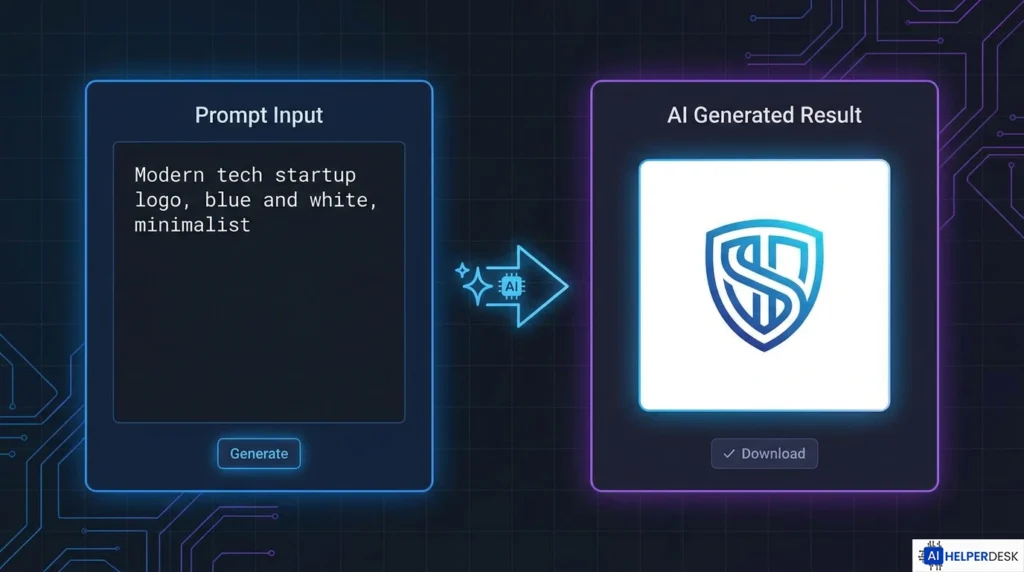
The market for an ai logo generator saas product is genuinely strong right now, and that is not hype. The global AI logo generation market is projected to grow from $333.2 million to over $2 billion by 2033, riding a 20% compound annual growth rate. About 40% of small businesses are already using some form of AI for visual branding, and that number is still climbing. For developers who know how to connect a React frontend, a Node.js backend, and an image generation API, this is a real commercial opportunity sitting in plain sight. This guide covers every layer of that build: architecture, API integration, authentication, billing, and the judgment calls that separate a hobby project from something people will actually pay for.
Why Build an AI Logo Generator SaaS in 2026
The timing has never been better. AI-powered SaaS is growing at roughly 38% annually, about three times faster than traditional software. Gartner projects that 85% of all software spending will flow through SaaS by 2026, and generative AI initiatives are delivering an average return on investment of 3.7 times, with top adopters hitting 10 times or more. An ai logo generator saas sits right at the intersection of two fast-moving markets: design automation and cloud software delivery.
The business model is also genuinely defensible. Logo generation is a task most small business owners need once or twice, which makes credit-based pricing far more natural than a monthly subscription. Users buy a pack of credits, generate their logos, download the assets, and return when they rebrand. That keeps churn low and removes the constant pressure to ship new features just to hold onto subscribers.
The underlying API economics work out nicely too. OpenAI’s image generation API, which forms the core of any ai logo generator saas built on this stack, currently prices standard quality generation at around $0.04 per image. A product charging $5 for five logo concepts has a direct API cost of roughly $0.20. That leaves a comfortable margin for infrastructure, payment processing, and profit.
Understanding the Tech Stack for Your AI Logo Generator SaaS
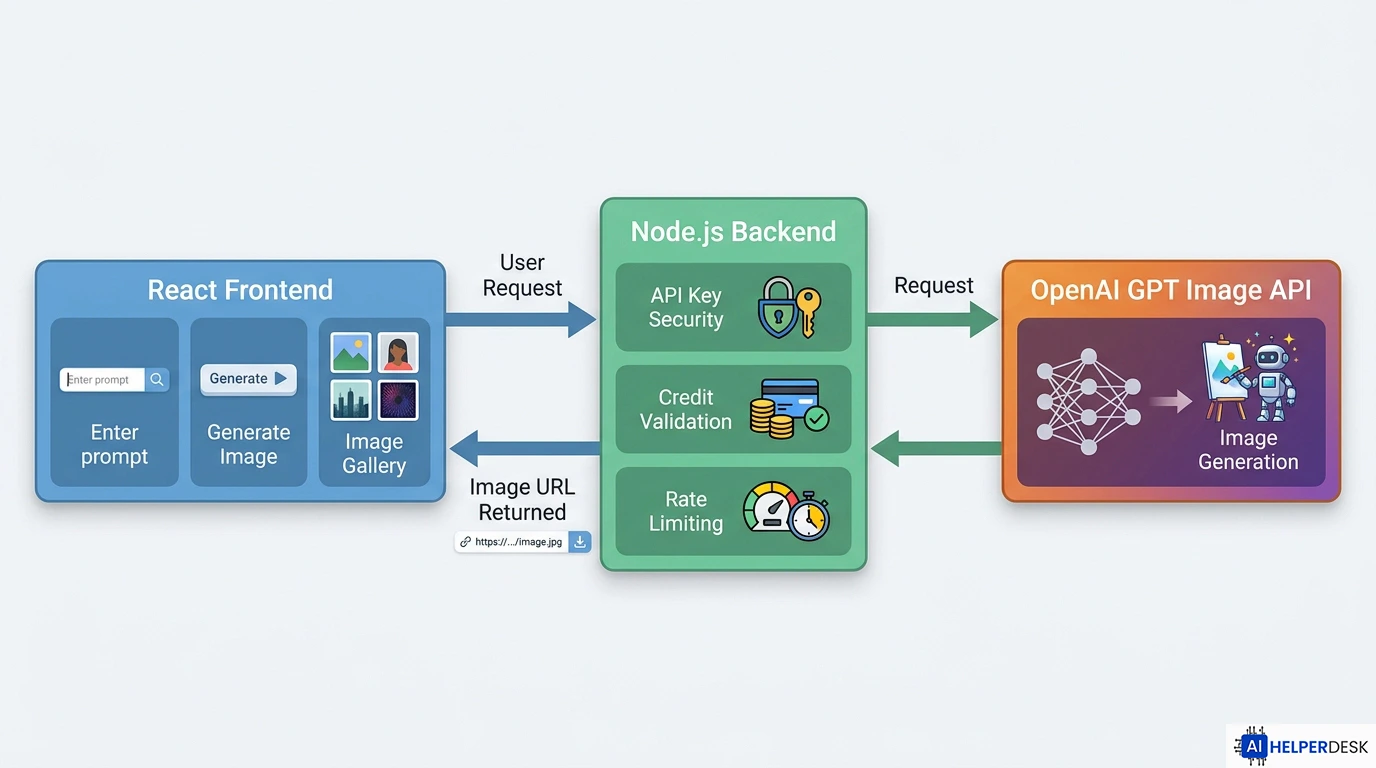
The most reliable architecture for an ai logo generator saas follows a three-layer model: a React frontend, a Node.js backend, and the OpenAI image generation service. Each layer has a distinct job, and keeping those jobs clearly separated makes the product easier to maintain, scale, and debug over time.
The React Frontend
React is the dominant choice for this type of frontend because its component model maps cleanly onto the user workflow: a prompt input, a style selector, a loading state, and a results gallery. For state management, React Context combined with hooks is plenty for most MVPs. Zustand is a solid lightweight alternative if application state grows complex without needing the boilerplate overhead that Redux brings.
The UI framework matters less than the workflow clarity. A user entering a brand name, picking a color palette, selecting a style (minimalist, bold, illustrative), and clicking generate should hit zero friction points. Every extra step before the first image appears is a drop-off risk. Tailwind CSS handles layout and styling efficiently, and shadcn/ui provides accessible, well-built components that keep the design looking professional without piling on custom CSS.
For the react node ai tool setup specifically, the most important decision at the frontend layer is how you handle loading states. Image generation takes anywhere from three to fifteen seconds depending on quality settings and API load. A well-designed ai logo generator saas shows a skeleton loader, communicates progress clearly, and never silently hangs. Most users will abandon a spinner that gives no feedback after about eight seconds.
The Node.js Backend
All API calls to OpenAI must route through the Node.js backend, no exceptions. Exposing an OpenAI API key inside a React frontend is a serious security vulnerability that will lead to unauthorized usage and unpredictable billing. The backend acts as a controlled gateway: it receives the user’s prompt and style parameters, validates the request, enforces rate limits, deducts credits, calls the image API, stores the result, and returns a permanent image URL to the frontend.
A production-ready ai logo generator saas backend built with Express needs these core dependencies: the OpenAI Node.js SDK, a database client (MongoDB with Mongoose or PostgreSQL with Prisma both work well), a JWT library for authentication, the Stripe SDK for payments, and dotenv for environment variable management. The setup follows a standard pattern: run npm init -y, install dependencies, configure the .env file with your OpenAI API key and Stripe secret, and build routes for user authentication, credit management, and image generation.
Rate limiting at the backend layer is not optional. Without it, a single user or a malicious actor can drain the monthly API budget in minutes. Express Rate Limit is a clean middleware choice for this, and for production deployments, Redis-backed rate limiting through Upstash gives you persistence across server restarts.
Integrating OpenAI’s Image Generation API
One important update before writing any code: DALL-E 3 was removed from the OpenAI API in May 2026. Developers building an ai logo generator saas today should target the GPT Image family instead. GPT Image 1 Mini is the cost-effective starting point at $0.005 to $0.052 per image depending on quality tier and resolution. GPT Image 1.5 offers the strongest balance of quality and cost for production use. The integration pattern stays the same regardless of which model you choose.
The core Node.js call to generate a logo is straightforward. The route receives a brand name, a style description, and a quality preference. It builds a structured prompt to guide the model toward clean vector-style output, calls the images endpoint, and returns the generated URL. A well-crafted prompt for an ai logo generator saas might read something like: “A minimalist flat vector logo for [brand name], using [color palette], [style adjective] aesthetic, clean white background, no text, scalable icon design.” The specificity of that prompt determines output quality far more than the model tier.
For developers working on the react node ai tool setup, there is one critical step that tutorials often skip: the image URL returned by the API expires after a short window. Your backend needs to download the image immediately, store it in an S3-compatible bucket (AWS S3, Cloudflare R2, and Supabase Storage all work), and return a permanent URL to the frontend. This is not a nice-to-have. It is essential for any ai logo generator saas where users expect to return and download their assets days later.
Key Statistics and Market Insights
The global SaaS market is projected to reach $315 billion by 2026. OpenAI’s official image generation documentation outlines the current GPT Image model capabilities and the API integration patterns developers need to build on this stack. AI-enabled SaaS within that broader market is growing at approximately 38% annually. Over 80% of enterprises will have deployed AI-enabled applications by 2026, up from less than 5% just a few years ago.
On the design side, AI tools have already cut logo design turnaround times by up to 50%. A product that delivers production-ready concepts in under 30 seconds, including download in SVG and PNG formats, offers a measurable time advantage over commissioning a freelance designer. That value proposition is easy for a small business owner to understand and quantify.
Real-World Use Cases
The clearest market for an ai logo generator saas is solo founders and early-stage startups who need a professional logo before they can afford a brand agency. These users typically have a business name, a rough sense of their visual identity, and a budget somewhere between $5 and $50. They want to generate several variations, pick their favorite, and use it across their website, social profiles, and printed materials.
A second strong use case is marketing agencies that offer white-label logo generation as part of a broader branding package. An agency can integrate an ai logo generator saas via API, generate initial concepts for clients within minutes of onboarding, and include those concepts as part of a professional branding engagement. The per-image pricing model makes this economically attractive at almost any agency margin.
Freelance designers represent a third segment. Rather than replacing their design work, this type of tool speeds up the initial concept phase. A designer who used to spend two hours on mood boards and rough sketches can generate ten variations in five minutes, then spend the saved time on typography refinement, color grading, and client presentation. This is how ai for developers and designers coexist productively instead of competing.
Knowing how to build custom ai agents that handle specialized creative tasks is increasingly a core skill for developers. For a deeper technical grounding in that area, including comparisons between low-code and full-stack approaches, the Developer’s Guide to Building Custom AI Agents: Low-Code vs Full-Stack covers the architectural decisions in detail.
Benefits and Revenue Opportunities
An ai logo generator saas opens up multiple revenue paths from a single codebase. Credit packs are the most natural starting point: users buy 5, 20, or 50 generation credits based on how much they expect to use the tool. A premium tier can offer higher resolution exports, SVG output, brand color palettes, and saved project history. An API tier for agencies and developers who want to embed generation into their own tools is a logical third stream once the core product is stable.
The credit model aligns well with usage-based pricing trends across the SaaS industry. About 44% of SaaS companies now use usage-based pricing, and small improvements in price calibration translate directly to outsized profit gains. A well-designed ai logo generator saas can size credit packs so that most users exhaust their credits and return for a top-up, which is effectively high-margin repeat business without subscription churn risk.
Stripe Checkout is the standard payment integration for a react node ai tool setup. The flow involves creating a Stripe checkout session on the backend, redirecting the user to Stripe’s hosted payment page, receiving a webhook confirmation on payment success, and crediting the user’s account in the database. The full integration takes less than a day and handles international payments, tax compliance, and fraud detection without any custom engineering.
Risks, Challenges and Limitations
Every ai logo generator saas built on third-party APIs carries vendor dependency risk. OpenAI restructured its image generation model lineup multiple times in recent years, including removing DALL-E 3 from the API in 2026. Any product built on a single API provider should treat the image generation layer as a replaceable module. That way, swapping to an alternative provider (Flux, Imagen, Ideogram) means changing configuration rather than rewriting core business logic.
Copyright and commercial rights are a legitimate concern for both users and platform operators. OpenAI’s terms grant users full ownership of generated images for commercial use, but that does not mean a generated logo is automatically trademark-registerable in every jurisdiction. Operators should include clear terms of service explaining what the product delivers and what it does not guarantee, and should avoid making specific legal representations about trademark eligibility.
Output consistency is a technical limitation worth being upfront about. Generative image models do not produce identical results from the same prompt. A user who regenerates with the same inputs will get a different image. For users who need exact reproducibility, storing the image immediately on generation, as described in the backend architecture section above, is the correct solution rather than a workaround.
Prompt injection is also a real attack surface for any product that passes user text directly into API calls. All user input should be sanitized and wrapped in a structured prompt template before it reaches the API. This prevents users from attempting to manipulate the model into generating inappropriate content, which would violate OpenAI’s usage policies and could result in account suspension.
Expert Analysis
The broader opportunity here goes beyond logo generation itself. What developers are really building when they create an ai logo generator saas is a template for AI-powered creative tooling. The same architecture, a React frontend communicating through a Node.js gateway to a generative AI backend, applies equally well to an AI business card generator, a brand color palette tool, a favicon creator, or a social media visual generator. A developer who ships one of these successfully walks away with a reusable architectural foundation for an entire product category.
The market data supports this reading. AI-powered SaaS is growing at three times the rate of traditional software, and the companies capturing that growth are not necessarily the ones with the most sophisticated models. They are the ones with the clearest use cases and the smoothest user experience. The underlying models are increasingly commoditized. OpenAI, Flux, Google Imagen, and Ideogram are all capable of producing strong visual output. The real differentiation in an ai logo generator saas comes from prompt engineering, user experience design, output format support, and the speed of iteration between a user’s first input and a result they are genuinely happy with.
Developers approaching this as a learning project will find that the react node ai tool setup itself teaches more transferable skills than most tutorials on abstract AI concepts. Handling async API calls, managing loading states gracefully, implementing webhook-based payment confirmation, and designing a credit ledger in a database are skills that carry over to every AI SaaS product category. The logo generator is a well-scoped, contained problem that surfaces all of those challenges in a manageable context.
There is also a meaningful shortcut worth knowing about: several production-ready Next.js boilerplates now include GPT Image integration, Stripe billing, and authentication out of the box. For developers who want to validate market demand before committing serious engineering time, these boilerplates can compress the time to a working MVP from weeks to days. The trade-off is less control over the codebase and potential licensing constraints on commercial use. How you weigh that depends on your technical comfort level and how urgently you need to reach paying users.
Future Outlook
The ai logo generator saas space will get more competitive over the next two years as image generation quality keeps improving and API pricing keeps falling. The products that survive that consolidation will be those that have built up the most user-generated data: prompt patterns that reliably produce good output, style preferences correlated with specific industry verticals, and iteration histories that inform a feedback loop between what users ask for and what they actually download.
Multimodal AI is the next architectural shift on the horizon. Models that understand text, images, and structured brand data simultaneously will be able to generate an entire visual identity system rather than a single logo from a brief business description. An ai logo generator saas built today should be designed with that capability in mind. Storing user brand preferences, past generations, and feedback signals creates a dataset that will make model personalization increasingly viable as the technology matures.
By 2027, embedded AI features will be a standard expectation in virtually every enterprise SaaS application. That normalization will accelerate adoption of specialized AI creative tools among users who are still hesitant today. The developers and founders who build and iterate on an ai logo generator saas now will have a meaningful head start in user trust, product maturity, and organic search authority when that broader adoption wave arrives.
Conclusion
Building an ai logo generator saas in 2026 is one of the more accessible paths from developer skills to a revenue-generating product. The market is large and still growing, the underlying APIs are affordable and well-documented, and the technical complexity, while real, is manageable with a clear architecture in place. A React frontend, a Node.js backend, OpenAI’s GPT Image API, Stripe for billing, and a cloud storage solution for output files covers every core requirement. The developers who ship this product rather than plan it indefinitely will capture the organic search traffic, user trust, and iteration data that compounds into a durable competitive position as the AI SaaS market continues its rapid expansion.
Frequently Asked Questions
The most reliable stack combines a React frontend with a Node.js backend and an OpenAI image generation API integration. React handles the user interface and generation workflow, Node.js manages API key security and credit validation, and the image API handles generation. Stripe covers payment processing, and a service like Supabase or MongoDB Atlas works well for the database layer.
Using OpenAI’s current GPT Image 1 Mini model at standard quality, image generation costs between $0.005 and $0.052 per image depending on resolution and quality tier. A product generating five logo concepts per user session has a direct API cost of roughly $0.025 to $0.26. At a selling price of $3 to $10 per session, the margins are workable even before any optimization.
OpenAI’s terms grant full commercial rights to generated images, but trademark eligibility is a separate legal question determined by jurisdiction-specific intellectual property law. The logo must be sufficiently distinct to qualify for trademark registration regardless of how it was created. Users should consult a trademark attorney before relying on a generated logo for brand protection.
Never expose your OpenAI API key in the React frontend. All image generation requests must pass through a Node.js backend that holds the API key as a server-side environment variable. The frontend sends a request to your own API endpoint, which validates the user session, checks credit balance, and only then makes the authenticated call to OpenAI. This is the fundamental security requirement for any react node ai tool setup.
No. OpenAI removed DALL-E 3 from the API in May 2026. Developers building an ai logo generator saas today should use the GPT Image model family instead. GPT Image 1 Mini is the budget option, GPT Image 1.5 offers the best quality-to-cost ratio, and GPT Image 2 is the current flagship for premium output quality.
Start with a React and Node boilerplate that already includes authentication, Stripe billing, and a database layer. Focus your initial engineering time on the image generation integration and the user experience around the prompt-to-result workflow. Use a service like Cloudflare R2 or Supabase Storage for generated image hosting. A working MVP with these components in place can be ready within one to two weeks of focused development.
