AI Customer Support Agents: Zendesk AI vs Custom Build for SMBs
-
- by Fiaz Ahmad
- June 10, 2026
- in AI Agents News, AI Business Solutions

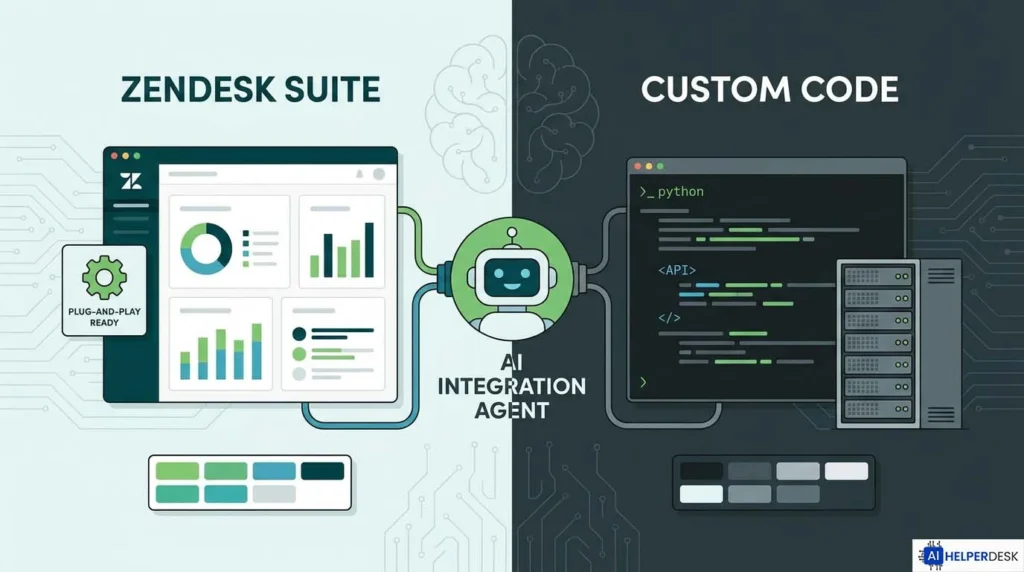
If you run a small or medium-sized business in 2026, deciding how to deploy ai customer support agents is one of the more consequential technology calls you will make this year. Salesforce’s State of Service 2026 found that 66% of service organizations are already running these agents, up from just 39% a year ago. The question has shifted. It is no longer whether to automate support with AI. It is whether to plug into a polished platform like Zendesk AI or build something custom from the ground up. Both paths have real trade-offs, and getting this decision right depends on your team size, technical resources, ticket volume, and where you want to be in three to five years.
What AI Customer Support Agents Actually Do in 2026
Today’s ai customer support agents are a completely different breed from the keyword-matching chatbots that gave automation a bad name a few years back. Modern agents use agentic reasoning to understand what a customer actually wants, pull answers from connected knowledge sources, work through multi-step resolution flows, and hand off to a human only when the situation genuinely requires it. That shift from scripted logic to autonomous resolution has quietly rewritten the cost structure of customer support.
McKinsey’s AI in Customer Service 2026 research puts the average cost of an AI-resolved ticket at $0.62, compared to $7.40 for a human-handled one. Gartner’s benchmarks land at $1.84 for self-service contacts versus $13.50 for agent-assisted ones, a 7.3x cost advantage. For an SMB processing several hundred tickets a month, those numbers compound into meaningful savings quickly.
The same research found that companies deploying GenAI-enabled ai customer support agents saw a 14% improvement in issue resolution per hour and a 9% reduction in handle time. But those gains do not show up automatically. There is a wide gap between average and high-performing AI support implementations, and the platform or architecture you choose is one of the biggest factors that determines which side of that line you end up on.
Zendesk AI Agents: What SMBs Get in 2026
Zendesk made a significant change to its AI packaging this year. As of May 11, 2026, the platform removed the Essential and Advanced tier distinction and rolled full agentic capabilities, including multi-step procedures, agentic reasoning, and external API integrations, into all Suite and Support plans. That is a meaningful shift. An SMB on a standard Zendesk plan now has access to tools that were previously locked behind a premium add-on.
Zendesk’s ai customer support agents come pre-trained on over 18 billion real customer interactions, which gives them a solid baseline understanding of common support patterns from day one. You connect your help center, build out conversation flows using a no-code builder, and start deflecting tickets without touching a line of code. For a lean support team with no dedicated developer, that accessibility is a genuine advantage, not just a marketing bullet point.
The pricing model runs on a per-resolution basis, typically cited around $50 per agent per month for the AI layer. For low to mid-volume SMBs, that is workable. For businesses growing quickly, the per-conversation billing can get unpredictable. Third-party analysis from Kustomer notes that support managers running real-world Zendesk AI deployments regularly flag UX friction and billing complexity as ongoing pain points once the honeymoon phase ends.
Zendesk AI: Strengths for SMBs
The strongest argument for Zendesk’s ai customer support agents is time to value. You can be up and running in days, not months. Omnichannel coverage across chat, email, and social messaging is built in. Reporting dashboards give non-technical managers a clear view of resolution rates and agent performance without needing custom analytics work. If your business runs primarily inside the Zendesk ecosystem and handles fairly standard support queries, the platform is genuinely reliable without demanding engineering resources.
Zendesk AI: Limitations to Understand
The cracks start to show when your workflows fall outside what the platform was built for. Deep CRM integrations, proprietary order management systems, or industry-specific compliance requirements often need workarounds that quietly degrade automation quality. Zendesk’s ecosystem is broad, but it is not infinitely flexible. If your support tickets touch unusual data flows or span multiple internal systems, you will likely find that your ai customer support agents underperform on exactly the queries that matter most to your customers.
Custom AI Agent Development: The Build Path for SMBs
Custom ai agent development operates from a completely different starting point. Instead of fitting your workflows into a platform’s constraints, you build ai customer support agents from scratch around your specific data, integrations, and business rules. Frameworks like LangChain, CrewAI, and Azure OpenAI provide the technical foundation, while a development agency or internal engineering team handles the architecture. For ai agents for small business scenarios where workflow precision and differentiation matter, this path delivers higher ceiling performance, but it also comes with a higher floor cost.
Industry pricing analysis from April 2026 puts custom-built ai customer support agents from development agencies at $15,000 to $200,000 in project fees, with ongoing hosting and maintenance running $500 to $10,000 per month. Teams building on open-source frameworks spend less on licensing, but developer time, almost always the most expensive variable, tends to exceed the cost of a managed SaaS solution in the first 12 to 18 months. The build path makes most sense for SMBs that either have an internal developer on hand or a clear budget commitment to a multi-year solution.
At scale, the per-conversation operating cost of a custom-built ai customer support agent drops dramatically. One independent analysis puts operational costs as low as $0.02 per conversation on a self-hosted architecture, compared to $0.15 to $1.50 per conversation on a SaaS billing model. At high ticket volumes, that gap builds a compelling ROI case. Industry benchmarks from 2026 suggest custom AI solutions deliver average ROI of 55% over five years versus 42% for SaaS alternatives, with total SaaS spending over five years often exceeding custom development costs by 72%.
Custom Build: Strengths for SMBs
Control is the core advantage here. Your ai customer support agents can hit any API, follow your exact escalation logic, operate under your data residency and compliance requirements, and keep improving as your team iterates on them. For businesses in regulated industries, those handling sensitive customer data, or those operating across multiple languages and regional rules, a custom build provides the architectural flexibility that platforms simply cannot match. Over a three to five year horizon, the economics also tend to favor ownership at mid-tier usage volumes.
Custom Build: Risks to Plan Around
Scope creep is the most consistent risk in custom ai agent development. Automations that look clean and well-defined during scoping often uncover integration complexity and edge-case handling challenges that push timelines and budgets. The maintenance burden is real and ongoing. As your CRM, ticketing system, or product evolves, your agent needs to evolve with it. Teams that underestimate this recurring cost tend to end up with strong ai customer support agents at launch and quietly degrading performance 18 months later. Starting with a narrow, well-defined use case and expanding from there is the advice you will consistently hear from practitioners who have done this more than once.
Key Statistics and Market Context
The market backdrop here is moving fast. The Zendesk 2026 CX Trends Report found that nearly 90% of CX leaders believe 80% of customer issues will eventually resolve without any human involvement. Gartner projects conversational AI will cut contact center agent labor costs by $80 billion globally in 2026. Customer service leads all sectors in AI deployment, with 56% of organizations running agents in production, according to McKinsey’s 2026 Global AI Survey.
For SMBs specifically, the entry-level cost of capable AI support automation has dropped an estimated 35% between 2023 and 2025, as model infrastructure costs have fallen and platform competition has intensified. Capabilities that ran $500 per month in 2022 are available under $100 today in off-the-shelf configurations. That commoditization of basic functionality makes the Zendesk-style approach increasingly accessible for budget-conscious businesses, provided their support needs fit within standard parameters.
That said, 66% of businesses still needed more than six months to see measurable ROI from AI implementations, according to Verint research. Regardless of which path you choose, deployment quality and change management within your support team matter as much as the technology itself.
Real-World Use Cases for SMBs
Take a mid-sized e-commerce company handling 2,000 tickets per month. That is a very common SMB profile. For a business like that, Zendesk AI can deflect order tracking queries, shipping status questions, and return request initiations without any custom development work. With the 2026 unified plan, multi-step procedures can handle refund flows up to a certain complexity level, with the agent escalating to a human rep when edge cases come up. For the bulk of that company’s support volume, the platform holds up well. Developer resources required are minimal, and going live is measured in days.
Now take a B2B SaaS company with 500 tickets per month. Completely different picture. Their support queries involve account configuration, API troubleshooting, and billing logic tied to a proprietary system that Zendesk cannot integrate with cleanly. Custom agents built on a RAG architecture, wired directly into their internal knowledge base and CRM, deliver resolution rates and response accuracy that no platform can match. The upfront investment is higher, but the agent handles complex queries that would otherwise require senior technical support staff. For a deeper look at how this kind of architecture gets built and maintained, our guide on building custom AI agents: low-code vs full-stack covers the full development decision framework.
Zendesk AI vs Custom Agent: Direct Comparison for SMBs
When you break down zendesk ai vs custom agent deployments, the decision really comes down to five variables: technical capacity, ticket volume, workflow complexity, time-to-value requirements, and five-year cost planning.
Zendesk ai customer support agents win on deployment speed, zero engineering requirement, omnichannel coverage, and predictable monthly costs at low to mid volume. Custom builds win on workflow precision, long-term cost efficiency at scale, compliance flexibility, and the ability to handle queries that fall outside what any platform supports. Off-the-shelf agent platforms for SMBs generally cost $30 to $150 per user per month in 2026, while custom builds require $15,000 to $100,000 upfront and $2,000 to $10,000 per month to operate, putting the break-even point typically between 15 and 27 months at mid-tier usage volumes.
A practical rule of thumb: if your top 20 support query types are fairly standard and your team has no in-house developer, Zendesk ai customer support agents are the right starting point. If your top 20 query types are deeply tied to proprietary systems, industry-specific logic, or customer data that lives outside your help center, a custom build deserves a serious look.
Expert Analysis
The 2026 data points in a clear direction. Organizations hitting 3.5x to 8x ROI from these agents are not necessarily the ones who chose the most sophisticated platform. They are the ones who matched their tool choice to their actual support topology, invested in quality knowledge bases, and treated agent performance as an ongoing operational discipline rather than a one-time setup task.
Zendesk’s platform evolution this year matters for SMBs. Removing the tier distinction and opening agentic capabilities to all plans lowers the barrier meaningfully. The planned deprecation of legacy bot-builder functionality by August 2026 is also a clear signal about where the industry is heading: toward reasoning-capable ai customer support agents, away from scripted flows. If your business is still running rule-based chatbots, treat this as a transition signal, not just a product update from a vendor.
There is one caution worth flagging on the customer preference side. Gartner data shows that 64% of customers would prefer companies not use AI for customer service at all, and 53% would consider switching to a competitor if they found out AI was handling their support. That is not an argument against deploying these agents. It is an argument for deploying them well. An ai customer support agent that resolves issues completely and accurately builds trust. One that deflects without resolving, or hands off poorly, causes reputational damage that no cost savings can offset.
For SMBs evaluating this in the second half of 2026, the practical guidance is straightforward: start with Zendesk AI if your support volume and query types fit the platform, measure resolution rates honestly at 90 days, and revisit the build decision if you consistently see a gap between what the platform resolves and what your customers actually need. Do not build a custom agent to solve a problem you have not yet confirmed exists at scale.
Future Outlook
The trajectory of ai customer support agents points toward greater autonomy and lower per-interaction cost. Gartner predicts that by 2030, generative AI cost per resolution may climb past $3, which would start closing the gap with offshore human agents for complex queries. Voice AI is already handling 19% of inbound contact center volume in 2026, up from 6% in 2024 per Forrester Wave research. For SMBs ready to automate phone support specifically, our guide on setting up voice AI agents with Bland AI for inbound calls covers the exact setup process end to end.
The build-vs-buy decision will also keep evolving. Open-source frameworks and low-code configuration tools are making the custom-build path more accessible to smaller teams with every passing quarter. McKinsey projects AI agents could add $2.6 to $4.4 trillion in annual value across business use cases globally, with customer service among the highest-impact deployment categories. For SMBs, the window to build a meaningful competitive advantage through support automation is open, but it will narrow as adoption becomes universal.
Conclusion
Deploying ai customer support agents is no longer a question of whether the technology is ready. The 2026 data confirms that ai customer support agents deliver measurable ROI across business sizes when you match the right architecture to the right use case. Zendesk AI gives SMBs a fast, capable, and now more fully featured entry point that requires no engineering investment and delivers genuine ticket deflection from week one. Custom ai agent development offers greater precision, long-term cost efficiency, and the flexibility to handle workflows that no platform can accommodate, at the cost of higher upfront investment and ongoing maintenance commitment.
For most SMBs, the pragmatic path is to start with Zendesk’s ai customer support agents, measure honestly, and build custom only when the platform ceiling becomes a demonstrated bottleneck rather than a theoretical one. Either way, the businesses that treat their AI support agent as a product requiring ongoing ownership and iteration, rather than a deployment that runs itself, are the ones that will pull ahead of competitors still relying entirely on reactive human support queues.
Frequently Asked Questions
They are software programs that use large language models and agentic reasoning to understand customer queries, pull relevant answers from connected knowledge sources, work through multi-step resolution flows, and escalate to human agents when the situation requires it. Unlike older rule-based chatbots, they interpret intent rather than match keywords, which allows them to handle a far wider range of customer interactions without any human involvement.
Yes, especially after Zendesk’s May 2026 packaging update that brought advanced agentic features into all plans. Small businesses with standard support query types, a Zendesk-based help center, and limited developer resources can deploy capable AI agents without any custom development. The platform performs best when support queries align well with knowledge base content and do not require deep integration with proprietary internal systems.
Custom builds typically run $15,000 to $100,000 upfront for an SMB-scale implementation, with ongoing hosting and maintenance adding $2,000 to $10,000 per month. Prompt engineering implementations using frameworks like LangChain or RAG architectures sit at the lower end of that range and are sufficient for most business support use cases without requiring expensive model fine-tuning.
Zendesk ai customer support agents are a managed platform solution with built-in omnichannel support, no-code configuration, and pre-trained models. Custom ai customer support agents are built specifically around your data, APIs, and business rules, giving you full control over behavior, integrations, and cost structure. Zendesk wins on speed and simplicity. Custom builds win on precision and long-term cost efficiency at scale.
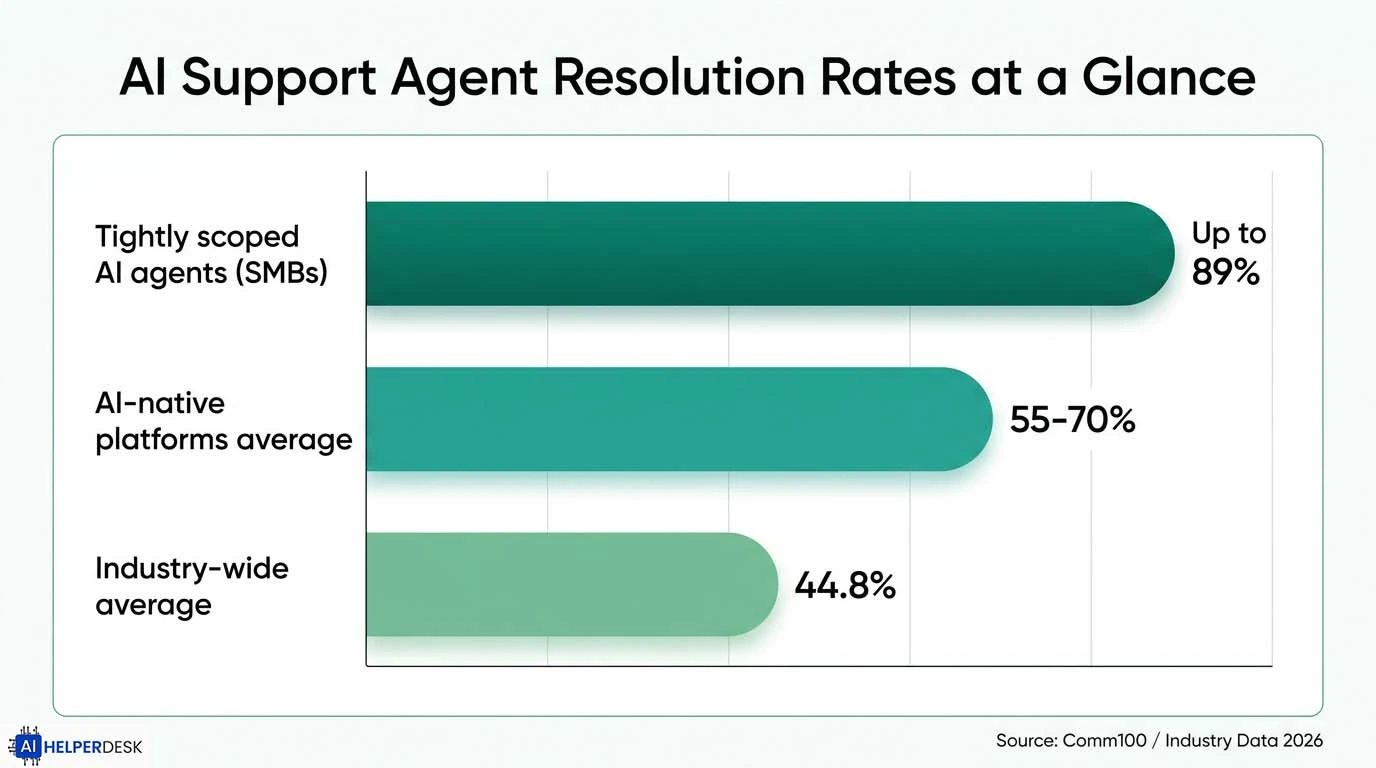
Small support teams with tightly scoped ai customer support agents achieve up to 89% resolution rates on the volume they handle, according to Comm100 data. AI-native platforms across all business sizes average 55 to 70% first-contact resolution with handle times under three minutes. The average industry-wide resolution rate sits at 44.8%, which means implementation quality and use case selection have an enormous impact on real-world outcomes.
Yes. The main risks include poor resolution quality on complex or unusual queries, hallucination-related errors (which account for 0.34% of AI-handled tickets but carry outsized reputational risk), over-reliance on automation for queries that genuinely require human judgment, and scope creep in custom build projects. Gartner also notes that 40% of agentic AI projects are expected to be canceled by 2027 due to unclear value and weak governance, which underscores the importance of defining measurable success criteria before deploying ai customer support agents.
