AI Bio Generator Tool: How to Build and Monetize a Micro Tool Site Using React and Node.js
-
- by Fiaz Ahmad
- June 9, 2026
- in AI Business Solutions, AI for Developers

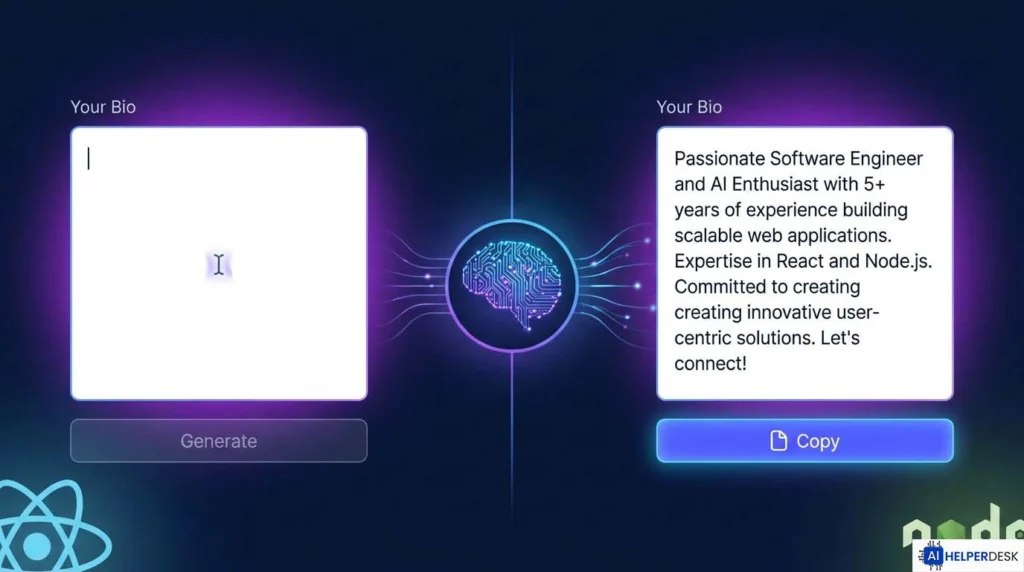
You do not need a team of engineers or months of runway to build a profitable web product anymore. In 2026, one of the fastest routes to a real revenue stream is launching a focused AI Bio Generator Tool site. These single-purpose tools pull in high-intent organic traffic, convert visitors into subscribers, and cost almost nothing to run once they are live. This guide covers every stage of that journey: architecture decisions, the actual build, deployment, and monetization, using a React frontend and a Node.js backend powered by the OpenAI API.
If you have been looking for a low-overhead product you can actually ship quickly, an AI Bio Generator Tool checks every box. The demand is consistent, the technical lift is manageable, and the path to making money from it is well-defined. Let us start with some market context before getting into the build itself.
Why an AI Bio Generator Tool Is a Smart Micro Product in 2026
The micro-SaaS market has matured quite a bit. Data tracked across 2,463 startups in BigIdeasDB’s Revenue Intelligence database puts the average micro-SaaS product at $1,735 in monthly recurring revenue, with developer tools reaching profit margins as high as 76.8%. Solo founders are now regularly hitting $2,000 to $10,000 MRR within their first year. A well-scoped AI Bio Generator Tool fits squarely into that window.
The demand side is equally compelling. Professionals across LinkedIn, Twitter, freelance platforms, and personal websites constantly need short, polished bios. Recruiters, consultants, coaches, and founders update their bios multiple times a year. They search for quick solutions, land on tool pages that solve the problem in under sixty seconds, and convert at rates editorial content rarely touches. The intent is already there when they arrive.
Beyond direct traffic, an AI Bio Generator Tool also works as a lead generation asset. Users who get real value from your free tier are warm prospects for a paid upgrade, an email list, or a related product. The tool becomes a top-of-funnel engine that runs without any outbound effort on your part.
Understanding the Architecture Before You Write a Single Line of Code
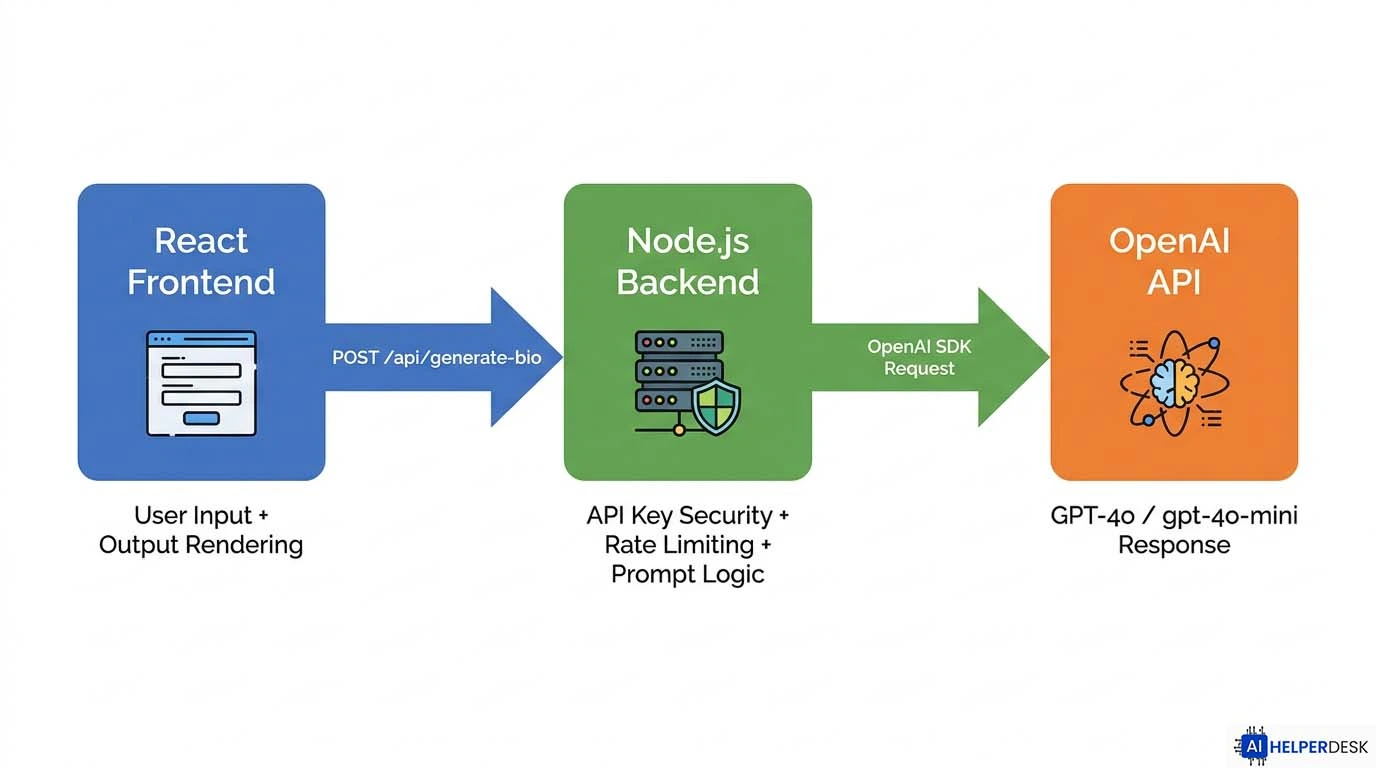
The most reliable way to build an AI-powered web application in 2026 follows a three-layer structure: a React frontend, a Node.js backend, and an external AI service. Each layer has one clear job. React handles user input and renders the AI Bio Generator Tool output. Node.js acts as secure middleware that holds your API credentials and handles rate limiting. The OpenAI API processes the prompt and returns the generated bio.
This separation matters for two practical reasons. First, you should never expose an API key on the frontend. Anyone who inspects your browser’s network requests can steal a client-side key, and the billing consequences can be severe. Second, keeping your prompt logic on the backend means you can iterate on it without redeploying the frontend. You can test new prompt templates, add tone parameters, or swap model versions without touching a single React component.
For the AI model itself, OpenAI’s official text generation documentation recommends pinning production applications to a specific model snapshot to keep output consistent. For an AI Bio Generator Tool in practice, GPT-5.5 is the current flagship for complex text generation, while the more cost-efficient GPT-5.4 mini delivers strong quality at a fraction of the cost, which keeps your unit economics clean even on a free tier.
Setting Up the Node.js Backend
Start by initializing a Node.js project and installing the packages you need. That means Express for routing, the official OpenAI SDK, dotenv for environment variable management, and cors so your React app can talk to the server.
Create a file called server.js and configure a single POST endpoint at /api/generate-bio. This endpoint accepts a JSON body containing the user’s name, profession, tone preference, and platform type (LinkedIn, Twitter, portfolio, and so on). The backend then constructs a detailed prompt and sends it to the OpenAI API using the chat completions interface.
Keep your prompt engineering modular. Store the base system prompt in a separate file so you can refine it on its own. A well-structured prompt for an AI Bio Generator Tool might instruct the model to write in first person, stay under a specific character count, avoid generic filler phrases, and match a chosen tone, whether that is professional, conversational, or creative. The more specific your system prompt, the more consistent your outputs will be across different user inputs.
Most developers add rate limiting too late. Use a package like express-rate-limit from the very start and cap free users at a sensible number of requests per hour. This protects your API budget and gives you a clear upgrade trigger when free users hit the ceiling.
Building the React Frontend for Your AI Bio Generator Tool
The React frontend for an AI Bio Generator Tool is intentionally simple. You are building a form, not a full application. Keep the interface focused on five inputs: full name, current role or title, key skills or achievements (a short textarea), platform selection (a dropdown), and tone preference (another dropdown). Add a submit button and a results area below. That is the whole interface.
Use React state to manage the form inputs and the loading state. When the user clicks generate, set a loading flag, disable the submit button, and fire a POST request to your Node.js backend using the Fetch API or Axios. When the response comes back, render the output in a styled card with a copy-to-clipboard button.
The copy button is not optional. It is the moment of delight that makes users share the tool. Use the Clipboard API and add a brief visual confirmation like a “Copied!” state on the button so the action feels clear and immediate.
For styling, Tailwind CSS is still the dominant utility-first framework in the React ecosystem in 2026 and works naturally with AI-assisted development workflows. Keep the color palette neutral and the layout single-column. A cluttered interface makes the AI Bio Generator Tool feel untrustworthy, which directly hurts conversion.
If you want to add a tone regeneration option that lets users get a different style without re-entering all their form data, store the last successful payload in component state and send it again with just the tone parameter changed. This creates a fast iteration loop that keeps users on the page longer.
Prompt Engineering That Actually Produces Quality Bios
The quality of your AI Bio Generator Tool output comes down almost entirely to prompt design. A vague prompt produces generic results that feel like every other AI tool out there. A structured prompt produces bios that feel personal and immediately usable.
A reliable pattern looks like this: open the system message by defining the model’s role as a professional copywriter who specializes in short-form personal branding. Then pass the user’s inputs as structured data within the user message. Specify a word or character limit based on the selected platform. For LinkedIn, a 200 to 250 word third-person summary is standard. For Twitter or X, a 160 character limit applies. For a personal portfolio, first-person conversational writing performs better.
Add an explicit constraint to avoid phrases that show up constantly in mediocre AI bios: “results-driven,” “passionate about,” “dynamic professional,” and similar expressions. Recruiters recognize these instantly and they undermine credibility. When your tool avoids them, users notice the quality difference right away and are far more likely to come back.
Test your prompts across at least a dozen varied inputs before you launch. Build a small internal testing spreadsheet with different professions, seniority levels, and tone combinations. Check whether the outputs feel distinct from one another. If they all sound the same, your prompt is too constraining. If the quality varies wildly, your prompt is not structured enough.
Key Statistics and Market Insights
The numbers behind building a micro tool site in 2026 are encouraging for first-time founders. Builder’s analysis of the React and AI stack for 2026 confirms that Next.js and Tailwind CSS are still the dominant choices for shipping fast, with the ecosystem fully supporting streaming AI responses and React Server Components. AI coding assistants have already cut development time by roughly 50%, meaning a developer can realistically ship a working AI Bio Generator Tool in a single focused weekend.
On the revenue side, Zylo’s 2026 SaaS Management Index shows AI-native application spend jumping 108% year over year. Intercom’s Fin AI agent hit nine-figure annual revenue while charging less than a dollar per resolved interaction. That outcome-based pricing model translates directly to micro tools: users who get one high-quality bio from your free tier are genuinely willing to pay $5 to $15 per month for unlimited generations, tone variants, and platform-specific formatting.
The freemium model works particularly well for tools with a natural sharing mechanic. When a user drops their new bio into LinkedIn and it lands well, they mention where they made it. That organic referral loop is the most cost-efficient acquisition channel available to an early-stage AI Bio Generator Tool site.
Real-World Use Cases for an AI Bio Generator Tool Site
Understanding who actually uses an AI Bio Generator Tool helps you write better landing page copy, choose the right secondary features, and target the right search queries.
Freelancers update their bios constantly as they take on different types of work. A designer who adds video editing to their services needs a new bio for every platform where they have a profile. The tool solves that in seconds instead of hours.
Job seekers are another high-volume segment. When someone is actively applying for positions, their LinkedIn bio needs to reflect the role they are targeting, not the one they are leaving. Being able to generate a bio tuned for a specific job title or industry is a concrete, immediate value proposition.
Startup founders use short bios constantly for press kits, speaking submissions, podcast introductions, investor decks, and company About pages. Each context needs a slightly different version. A tone-switching feature within your AI Bio Generator Tool that lets a founder instantly shift from formal investor language to casual conference speaker copy addresses a real workflow pain point.
Agencies and career coaches are power users who represent a clear upsell opportunity. A career coach who generates ten bios per week for clients will pay for a team plan without hesitation. Spotting this segment early and adding bulk generation or a client management feature can significantly increase your average revenue per user.
How to Monetize Your AI Tool Site in 2026
Three monetization structures consistently work for micro AI tool sites. The first is freemium with a hard generation limit. Allow three to five free bio generations, then require an account and a paid subscription for more. This gives users enough output to experience real value before you ask for payment.
The second is a credit-based model. Users buy a pack of credits and spend them on generations. This works well when your costs are variable and you want pricing to align with actual usage. It also removes the psychological barrier of a monthly commitment for users who only need the AI Bio Generator Tool occasionally.
The third is a white-label or API tier for agencies and platforms. If another tool or platform wants to embed your bio generation feature, you charge a monthly license or per-call fee. This B2B tier typically generates higher revenue per customer with lower support overhead. For a deeper look at building AI agent capabilities into B2B products, the Developer’s Guide to Building Custom AI Agents: Low-Code vs Full-Stack on AI Helper Desk covers the architectural decisions involved in powering these kinds of embedded products.
Display advertising is a fourth option, but it only works once you have meaningful traffic. At fewer than 10,000 monthly visitors, ad revenue will not cover your API costs. Nail conversion-based monetization first.
Benefits and Opportunities of the Micro Tool Model
The micro tool model has structural advantages that make it especially well-suited to AI-powered products. The feature scope is small and fixed, which means development time is short and the product is easy to explain in a single headline. Users understand immediately what the site does, which reduces the bounce rate from confused visitors.
Tool sites also tend to do well in search. When a user spends three minutes filling out a form and reading their generated bio, that session duration sends a positive signal to search engines. An AI Bio Generator Tool page also earns backlinks naturally because bloggers and newsletter writers regularly share useful free resources with their audiences.
The operational cost of an AI Bio Generator Tool site scales predictably. Your main variable cost is API usage, which you can estimate accurately based on average token counts per generation. For a bio tool generating outputs of roughly 250 words, a typical API call costs a fraction of a cent. Even at thousands of monthly generations, costs stay manageable long before you hit the revenue thresholds that justify server upgrades.
For developers who have already worked with AI API integrations in other languages or frameworks, switching to a React and Node.js stack is a small jump. If you have experience with the OpenAI API in a Laravel environment, the underlying request and response structure is identical. The main difference is the JavaScript SDK syntax and the React component model for rendering streamed output.
Risks, Challenges, and Limitations
No tool site is without risk. The primary technical risk for any AI Bio Generator Tool is output quality inconsistency. Language models do not guarantee identical quality across every input. An unusual profession or a very sparse set of inputs might produce a weak bio that reflects badly on the tool. The best defense is extensive prompt testing before launch and, ideally, a simple thumbs-up or thumbs-down feedback mechanism so you can identify which input combinations consistently underperform.
Market risk is real too. The bio generator space already has competitors. Differentiating on quality, platform specificity, and tone variety is possible, but generic tools with no clear angle will struggle to build an audience. Your AI Bio Generator Tool needs a specific hook, whether that is better LinkedIn bios, bios for technical founders, bios for creative professionals, or multilingual output.
API cost volatility is a practical concern. OpenAI retired GPT-4o, GPT-4.1, and gpt-4o-mini from ChatGPT in February 2026 and continues to release new model tiers rapidly, with GPT-5.5 now the current flagship as of April 2026. Build your backend with provider abstraction in mind so you can switch to an updated model or alternative provider if costs shift. The Vercel AI SDK provides a unified interface across multiple providers, which means that kind of switch becomes a configuration change rather than a full code rewrite.
Content safety is a responsibility that every AI product owner carries. Add a basic content filter on both the input and output sides. Users occasionally test AI tools with adversarial inputs, and a bio containing inappropriate content will hurt your brand and your standing with payment processors.
Expert Analysis
The AI Bio Generator Tool category sits at an interesting intersection of high demand and a low technical barrier. That combination creates both an opportunity and a competitive trap. The opportunity is that any developer with a working knowledge of React and Node.js can ship a functional product in a weekend. The trap is that most who do so ship something nearly identical to what already exists.
The tools that will stand out are not the ones with the most features or the cheapest pricing. They are the ones with the clearest positioning and the most trustworthy output quality. An AI Bio Generator Tool that reliably produces bios that do not sound AI-generated will earn organic word of mouth. One that occasionally produces generic filler will not.
From a business model perspective, the freemium approach makes sense for early traction but requires discipline. The free tier has to deliver real value, not a crippled experience, or users will not return. The upgrade trigger should feel natural, not coercive. A user who hits a generation limit mid-workflow is well-primed to convert. A user who gets blocked before experiencing any value will simply leave.
The broader market signal is clear: AI-native application spend jumped 108% year over year in 2026 according to Zylo’s data, and that growth shows no sign of slowing. Developers who build and launch micro AI tools now, collect user feedback, and iterate over the following six months are positioning themselves ahead of a market that is still in formation. The window is open. It will not stay this accessible indefinitely.
Future Outlook
The next wave of AI bio tools will go beyond static generation. Expect features like real-time personalization based on a user’s existing LinkedIn data pulled via OAuth, A/B testing of bio variants against actual engagement metrics, and multilingual generation that adapts not just the language but the cultural conventions of professional self-presentation in different markets.
Voice bio generation, producing audio introductions for podcast guest spots or conference speaker pages, is an adjacent feature that several platforms will likely adopt within the next twelve to eighteen months. If you build your AI Bio Generator Tool today with a clean, modular architecture, adding audio output later becomes a backend change rather than a product rebuild.
The long-term value of a micro tool site is not the tool itself. It is the audience. Every user who generates a bio has told you their profession, their platform of choice, and their tone preference. That behavioral data, collected with proper consent, is the foundation for something more ambitious: a personal branding assistant that evolves with a user’s career over time.
Conclusion
Building and launching an AI Bio Generator Tool site in 2026 is one of the most accessible paths to recurring software revenue that exists right now. The technical requirements are modest, the demand is consistent, and the distance between a working prototype and a paying user base is shorter than it is for almost any other type of software product. The stack is proven: React handles the user experience, Node.js keeps your API credentials secure and your backend logic flexible, and the OpenAI API with the current GPT-5 family delivers output quality that would have required a large content team just a few years ago.
The founders who succeed with an AI Bio Generator Tool will not be the ones who ship the most features first. They will be the ones who understand their target user deeply, invest in prompt quality before they invest in marketing, and treat the tool site as the first chapter of a longer product story. Start with the bio generator, learn from your users, and let the data tell you what to build next.
Frequently Asked Questions
A working prototype with a React frontend and Node.js backend takes one to three days for a developer with prior JavaScript experience. Adding payment integration, rate limiting, and a polished UI typically stretches the timeline to one to two weeks of part-time work.
For most bio generation use cases in 2026, GPT-5.4 mini is the recommended starting point. It delivers strong output quality at a cost-efficient price point, making it well suited for high-volume generation workloads. If your use case demands maximum consistency or nuanced tone matching, GPT-5.5 is the current flagship and worth the higher token cost. Note that GPT-4o and gpt-4o-mini were retired from ChatGPT in February 2026, so new production builds should target the GPT-5 family. Always pin to a specific model snapshot to avoid unexpected behavior changes when OpenAI releases updates.
Combine IP-based rate limiting on the Node.js backend with an email verification requirement before the third or fourth free generation. This adds just enough friction to block automated abuse without creating a barrier that frustrates legitimate users.
You can proxy API calls through serverless functions on Vercel or Netlify without managing a traditional server, which reduces operational overhead. That said, you still need a server-side execution environment to keep your API key secure. There is no safe way to call the OpenAI API from a pure client-side application.
A freemium model with three to five free generations followed by a flat monthly subscription of $9 to $15 for unlimited access works well for the freelancer segment. Credit packs (for example, $5 for 20 generations) are a useful complement for users who update their bios infrequently and are not ready to commit to a recurring fee.
Prioritize SEO from day one. Write one or two supporting articles targeting long-tail queries around professional bios, LinkedIn profile optimization, and personal branding. Submit the tool to AI tool directories and Product Hunt. Create short-form video content showing the tool in action. These channels cost time but not money, and they compound over months rather than requiring ongoing spend.
