No-Code AI Agent Builders: Make.com vs Flowise vs Langflow Compared (2026)
-
- by Fiaz Ahmad
- June 11, 2026
- in AI Agents News, AI for Developers

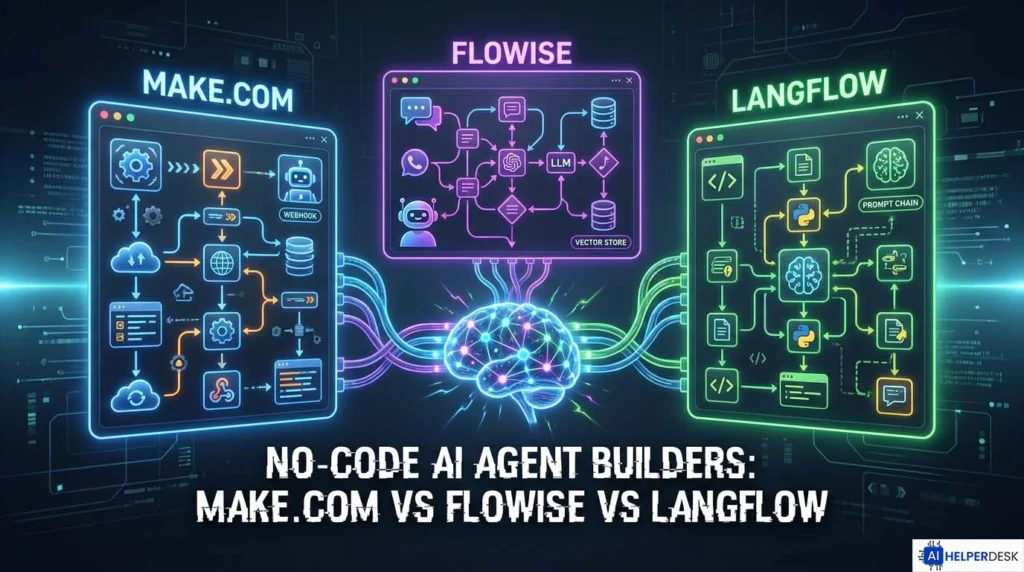
The push to automate business workflows with AI has given rise to an entirely new category of tools, ones that do not require a developer to be useful. No-code AI agent builders are now showing up across marketing teams, revenue operations, and engineering departments alike, handling everything from prospect research and lead qualification to CRM updates and follow-up sequences, all without human input at each step. In 2026, three platforms are leading this space: Make.com, Flowise, and Langflow. Each one is built for a different kind of builder and tackles a different part of the agentic workflow problem. Pick the wrong one and you can lose weeks. This guide lays out the real differences so you can make the right call before you start building.
Why No-Code AI Agent Builders Are Growing So Fast
Agentic AI has moved from experimental project to enterprise infrastructure faster than almost any technology category before it. The market hit $7.6 billion in 2025 and is on track to reach $10.8 billion by the end of 2026. Gartner forecasts that 40% of enterprise applications will include task-specific AI agents by year end, up from under 5% just twelve months ago. Teams that have already deployed agents are consistently reporting 20 to 30% faster workflow cycles, with the biggest gains in back-office operations and outbound sales pipelines.
No-code AI agent builders are the primary driver of this acceleration. Visual drag-and-drop interfaces, ready-made templates, and pre-configured integrations let teams put a working agent into production in 15 to 60 minutes instead of months. Around 80% of IT teams already use low-code tools in some capacity, and that familiarity is now extending directly to the agentic layer. The question for most businesses in 2026 is not whether to build AI agents. It is which platform to build them on.
Make.com AI Agents: The Automation-First Approach
Make.com has been a serious automation platform for years, connecting applications through scenario-based logic. In February 2026, the company announced its next generation of Make AI Agents, a meaningful architectural upgrade that embeds intelligent decision-making directly inside the automation canvas. For businesses already invested in the Make ecosystem, this made the platform one of the most compelling no-code AI agent builders available.
The feature that sets Make AI Agents apart is transparency. Every decision an agent makes is visible inside a Reasoning Panel on the canvas, in real time. You can see which tool the agent called, why it chose that path, and what data it processed. That is not a minor convenience. For teams running lead generation agents that touch CRM records or kick off outbound sequences, the ability to audit every step is operationally important, not optional.
Make connects to over 3,000 applications natively. An agent built inside Make can research a new prospect using a connected intelligence tool, enrich the contact record with company data, update HubSpot or Salesforce, and trigger a follow-up email sequence, all inside a single visual scenario and without writing a single line of code. That kind of end-to-end capability within one canvas is something neither Flowise nor Langflow can match out of the box. Make AI Agents are included on all paid plans, with the Reasoning Panel and multi-step agent orchestration available as standard.
The trade-off is depth. Make is built for business automation, not LLM experimentation. If your use case requires fine-grained control over how a model reasons through a retrieval-augmented generation pipeline, or if you need to export your agent logic as portable code, you will eventually run into ceilings. For most sales and marketing automation scenarios, though, that ceiling is higher than most teams will ever reach.
Flowise vs Langflow: Open-Source No-Code AI Agent Builders for Developers
Flowise and Langflow occupy a different part of the no-code AI agent builders market. Both are open-source, both use visual drag-and-drop editors, and both are built on top of the LangChain framework. But they make different architectural bets, and those differences have real consequences at scale.
Flowise: Node.js Speed for Chatbots and RAG
Flowise is built on LangChain.js and runs on Node.js. Version 3.1.0, released in March 2026, introduced the AgentFlow SDK, LangChain v1 migration support, and HTTP security checks enabled by default. The platform ships three separate builder interfaces: Assistant mode for non-developers, Chatflow for single-agent systems, and the Agentflow interface for multi-agent orchestration. Its GitHub repository has crossed 50,000 stars, backed by over 24,000 forks and 300 contributors, which points to a developer community that is active rather than just large.
Where Flowise really earns its place is speed. Building a working customer support chatbot or a retrieval-augmented generation pipeline in Flowise typically takes under an hour, even for someone new to LangChain concepts. The drag-and-drop interface maps directly to LangChain abstractions, so developers who already know LangChain can hit the ground running. The platform also includes a Human-in-the-Loop node in its AgentFlow V2 implementation. That makes it the only open-source visual agent builder with a native approval gate, and for workflows that involve destructive actions like database writes or financial transaction triggers, that is a genuinely useful safeguard.
Flowise is the stronger option for JavaScript and Node.js teams. Its component library is mature for RAG use cases and integrates cleanly with vector stores like Pinecone and ChromaDB through visual configuration. The main limitation shows up in complex multi-agent orchestration. When one agent needs to delegate subtasks to specialist subagents, Flowise handles it by routing between flows via API calls rather than through native agent-to-agent communication. That approach works, but it adds architectural overhead on larger projects.
Langflow: Python Power for Multi-Agent Systems
Langflow is built on Python and LangChain, and it is maintained by DataStax, which was acquired by IBM. Version 1.8, also released in March 2026, introduced global model provider configuration, a V2 Workflow API, and native MCP server and client support. With over 149,000 GitHub stars under an MIT license, Langflow has the largest open-source community of any visual LLM builder, and it continues to extend that lead.
The capability difference that matters most in 2026 is multi-agent orchestration. Langflow supports native agent-to-agent communication, where a supervisor agent can assign subtasks to specialist agents and pull together their outputs inside a single execution context. Flowise can produce similar results through API routing between flows, but Langflow does it natively. For teams building complex research pipelines, lead scoring agents that pull from multiple data sources, or customer-facing assistants backed by multiple specialist models, that is a meaningful architectural edge.
Langflow also introduced MCP server export in its latest release, a capability none of the other tools in this comparison currently offer. Any Langflow flow can be deployed as an MCP server, making it callable by other agents in a broader multi-agent ecosystem. For developers building interconnected agentic systems, this positions Langflow as the most forward-looking of the open-source no-code AI agent builders today. The trade-off is infrastructure complexity. Self-hosting Langflow requires Docker and active dependency management. The idle memory footprint runs between 400 and 600 MB due to the Python runtime, and enterprise features like RBAC and audit logging are not included by default.
If you are already building complex AI systems and want a deeper look at where no-code tooling ends and full-stack development begins, the Developer’s Guide to Building Custom AI Agents: Low-Code vs Full-Stack covers that architectural boundary in detail.
Side-by-Side: Which Agentic Workflows Builder Fits Your Stack
Each of these no-code AI agent builders is built for a distinct type of user. Make.com is the strongest option for business and revenue operations teams that need agents working across CRM platforms, email tools, and data sources through 3,000 integrations, with no coding involved. Flowise is the fastest path to a production chatbot or RAG-based knowledge assistant, especially for JavaScript teams. Langflow is the right call when multi-agent orchestration, Python flexibility, and MCP interoperability are core requirements. Getting clear on where each tool excels as an agentic workflows builder is the most reliable way to avoid sinking weeks into the wrong direction.
Real-World Use Cases: Lead Generation Agents in Practice
Lead generation is one of the most active areas for no-code AI agent builders in 2026. Research and summarization is the most common agent use case at 58%, followed by customer service at 45.8%, according to LangChain’s 2026 agent engineering survey. Sales outreach automation is growing quickly, particularly for B2B companies running personalized cold outreach at scale.
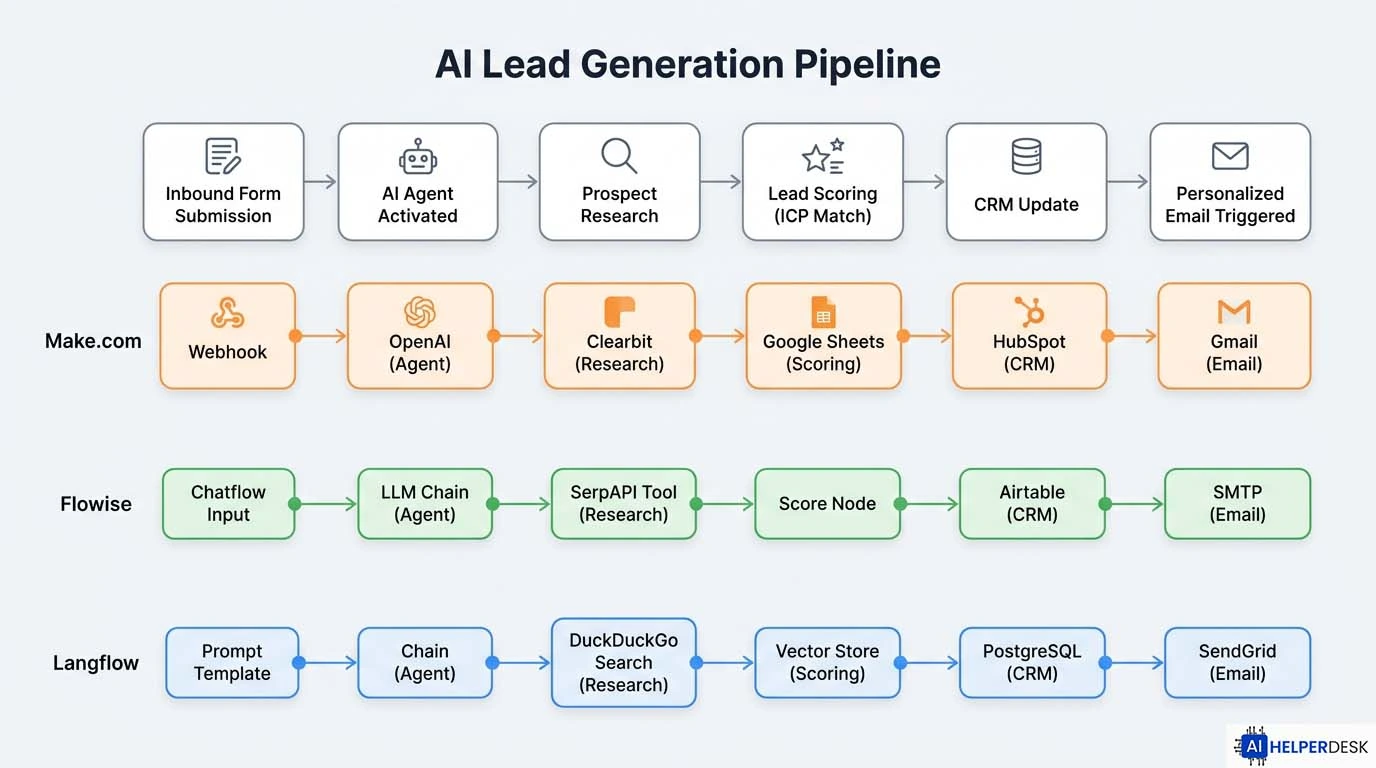
A typical Make.com lead generation scenario has an agent monitor an inbound form, research the prospect company using a connected intelligence tool, score the lead against ICP criteria, update the CRM with enriched data, and trigger a personalized email sequence. The entire workflow runs inside Make’s visual canvas with no code and full decision transparency through the Reasoning Panel.
A Flowise-based lead qualification agent usually sits behind an API endpoint, receives incoming lead data, runs it through a vector-store-backed knowledge base to match against ideal customer profiles, and returns a structured qualification score. Flowise handles this kind of synchronous inference task well, and its document loader integrations make it straightforward to keep the knowledge base current. A Langflow deployment can go further, with a supervisor agent coordinating a web research subagent, a company scoring subagent, and a messaging personalization subagent, all inside one orchestrated flow. That kind of multi-step, multi-agent lead enrichment pipeline is where Langflow’s architecture shows its real strength.
Risks, Challenges, and Limitations to Know Before Deploying
No-code AI agent builders lower the barrier to deployment, but they do not eliminate the hard problems of running AI in production. The most significant challenge in 2026 is governance. Deloitte’s 2026 report found that only one in five organizations has a mature governance model for autonomous AI agents. That means 80% of businesses deploying agents are doing so without the oversight infrastructure to catch errors, audit decisions, or roll back failed actions at scale. Make addresses this more directly than Flowise or Langflow through its built-in reasoning visibility, but none of the three platforms provides an enterprise-grade governance framework out of the box.
Observability is the second major gap. LangChain’s 2026 agent engineering survey found that 89% of builder teams have implemented some form of agent observability. For Flowise and Langflow deployments, that means adding a third-party tool like LangSmith or Langfuse to the stack. Make includes native logging but provides less granular token-level tracing than these external options offer.
The third risk is the gap between adoption and production. Research across the broader agentic AI market shows 79% of teams experimenting with these tools but only 11% running agents in live production workflows. Visual builders make prototyping fast. The real work of integration, error handling, rate limit management, and business alignment is where most projects stall. That is not a reason to hold off. It is a reason to plan the deployment phase as carefully as the build phase.
Expert Analysis
The no-code AI agent builders market in 2026 is not a winner-takes-all situation. It is a segmentation story. Make.com, Flowise, and Langflow have each found a different customer base, and those customers have genuinely different needs that a single product cannot serve well.
Make’s decision to embed its AI agents inside the existing automation canvas rather than ship a separate product is strategically smart. Businesses already running Make scenarios do not need to context-switch or migrate anything. The Reasoning Panel addresses the trust gap that has slowed enterprise adoption more than any technical limitation. Transparency in how an agent reaches a decision is not a power-user feature request. It is a prerequisite for the procurement and compliance teams that sign off on production deployments in regulated industries.
Flowise’s Human-in-the-Loop node is an underappreciated design choice for the same underlying reason. The ability to pause an agent before it commits a destructive action and route that decision to a human reviewer closes a gap that most open-source tools simply ignore. As agentic workflows move closer to core business operations like financial transactions, CRM updates, and contract triggers, that kind of native approval gate will matter more as deployment scales.
Langflow’s MCP server export capability is the most forward-looking bet in this group. The Model Context Protocol is emerging as a de facto standard for agent-to-agent interoperability. If that trajectory holds, any Langflow flow exported as an MCP server becomes a reusable building block in a larger agent ecosystem. That positions Langflow well for the multi-agent architectures that larger enterprises are beginning to design seriously. The risk is that IBM’s acquisition of DataStax may introduce uncertainty around open-source commitments and long-term pricing, something teams making a multi-year platform decision should factor in carefully.
The real strategic question when evaluating these platforms is not which tool has the most features. It is which tool fits the skills, infrastructure, and governance requirements already in place. Teams without developer resources should start with Make. JavaScript developers building customer-facing LLM products should take a close look at Flowise. Python teams building orchestrated multi-agent pipelines should evaluate Langflow.
Future Outlook for No-Code AI Agent Builders
The five trends shaping no-code AI agent builders through the rest of 2026 and into 2027 are multi-agent orchestration, MCP standardization, tighter observability tooling, native human-in-the-loop controls, and template-driven democratization of agent building. All three platforms in this review are moving in these directions, but at different speeds and with different priorities.
The agentic AI market is projected to reach $236 billion by 2034 at a compound annual growth rate exceeding 40%. That growth will drive serious investment into developer tooling, managed hosting, and enterprise compliance features across every major platform. Open-source tools like Flowise and Langflow will face increasing pressure to offer managed cloud tiers with the security certifications that enterprise buyers require. Make will face pressure from developer-native tools as its user base becomes more technically sophisticated over time.
What is clear is that no-code AI agent builders will keep lowering the threshold for who can build and ship production-grade agents. The gap between a business idea and a working automated workflow is now measured in hours. Teams that build internal competency with these platforms in 2026 will have a compounding advantage over those that wait.
Conclusion
No-code AI agent builders have genuinely changed how businesses approach workflow automation in 2026. Make.com, Flowise, and Langflow each represent a distinct philosophy: Make prioritizes business integration and transparent decision-making across thousands of apps; Flowise prioritizes speed and simplicity for LLM product teams; Langflow prioritizes Python depth, multi-agent orchestration, and open interoperability standards. None of these platforms is universally superior. The right choice among no-code AI agent builders comes down to your team’s technical background, your deployment environment, and the complexity of the agentic workflows you plan to run. What is clear is that the era of no-code AI agent builders is not approaching. It is already here, and the teams building with these tools today are setting up the workflows and institutional knowledge that will define competitive advantage for years ahead.
Frequently Asked Questions
No-code AI agent builders are visual platforms that let users create autonomous AI workflows without writing code. They are designed for business teams, marketers, and developers who need to automate multi-step tasks like lead qualification, customer support, and data processing. Make.com targets non-developers with business automation needs, while Flowise and Langflow are aimed at developers who want more architectural control over LLM pipelines.
Yes. Make.com is one of the most practical agentic workflows builders for lead generation in 2026. Its next-generation AI Agents, launched in February 2026, allow an agent to research a prospect, enrich CRM data, score a lead, and trigger email sequences across 3,000 connected apps, all within one visual canvas and without any coding. The Reasoning Panel gives full decision transparency at every step.
The core difference in the Flowise vs Langflow comparison comes down to programming language and multi-agent capability. Flowise runs on Node.js and is optimized for fast chatbot and RAG deployments. Langflow runs on Python and supports native multi-agent orchestration plus MCP server export. Langflow has nearly three times the GitHub stars, while Flowise offers a more approachable interface for non-Python developers and includes a native Human-in-the-Loop approval gate.
Yes. All three platforms support B2B outbound sales automation workflows. Make.com is the fastest to configure for end-to-end CRM integration. Flowise and Langflow are better choices when the agent needs to perform complex reasoning over large internal datasets before generating outreach. The right pick depends on how much customization your sales process requires and whether your team has developer resources available.
For native multi-agent orchestration, Langflow is the stronger option. It supports supervisor-to-specialist agent communication within a single execution context. Flowise handles multi-agent scenarios by routing between flows via API calls, which works but requires more manual wiring. Langflow’s V1.8 release in March 2026 also added MCP server support, making it the more capable choice for interconnected agentic systems.
Partially. No-code AI agent builders are mature enough for many enterprise use cases, but they currently lack built-in governance frameworks. Deloitte’s 2026 report found that only 20% of organizations have a mature governance model for AI agents. Enterprise teams should plan to add observability tools like LangSmith alongside any open-source builder, and should evaluate Make.com’s native decision logging if compliance requirements are strict.

1 Comment: