The Ultimate Guide to Autonomous AI Agents: How They Work (2026)
-
- by Fiaz Ahmad
- May 18, 2026
- in AI Agents & Automation

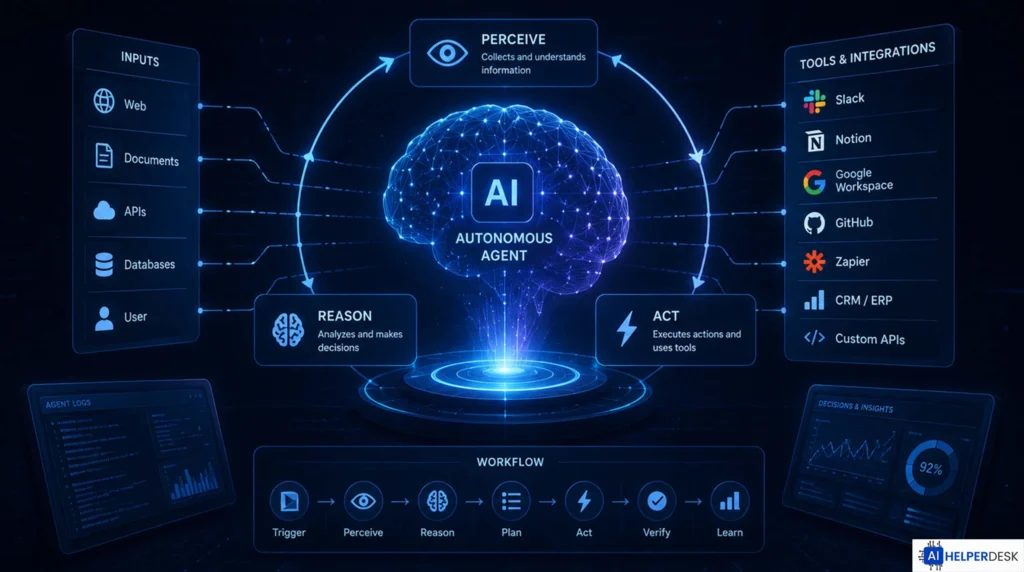
Introduction: Something Fundamental Has Changed
A colleague told me something recently that stopped me mid-conversation. Their company’s AI agent had caught a policy violation in an expense report, autonomously, then generated a full audit trail, notified the right manager, and kicked off a corrective procurement process. All before anyone opened their inbox that morning.
No clicking. No reviewing. No handoff.
That’s not a chatbot. That’s not autocomplete. Autonomous AI agents something categorically different, and it’s becoming increasingly common across industries of all sizes.
We’re at a point where “autonomous AI agent” no longer describes a research prototype. It means production software running inside real businesses, and it’s one of the fastest-moving areas within AI Agents & Automation today. These systems make real decisions, take real actions, and operate inside your actual tools and data. Gartner predicts that by 2028, 15% of day-to-day business decisions will be made autonomously through these kinds of systems. We’re already well on that path.
Here’s the problem: most writing about AI agents either oversimplifies or drowns you in jargon. This guide tries to do neither. By the end, you’ll understand how next-gen AI agents are actually built, what makes them tick under the hood, where they’re being deployed right now, and where they still fall short in 2026.
Let’s get into it.
What Is an Autonomous AI Agent? (And What It Isn’t)
The term “AI agent” has been stretched to cover everything from a basic FAQ chatbot to a fully autonomous workflow system. Those are genuinely different things, so let’s clear this up before going any further.
The Difference Between a Chatbot and an AI Agent
A chatbot responds. You send a message, it sends one back. The interaction is contained, reactive, and usually stateless. When the conversation ends, everything resets to zero.
An AI agent pursues goals. You hand it an objective, and it figures out the steps, calls the tools it has access to, monitors its own progress, adjusts when something goes sideways, and keeps going until the task is done or until it hits something that genuinely requires a human decision.
The simplest framing: a chatbot is an FAQ page that can hold a conversation. An AI agent is more like a junior employee who takes ownership of a task and runs with it.
What Makes an Agent Autonomous?
Autonomy here doesn’t mean unlimited freedom. It means the ability to act across multiple steps without requiring human input at every single one. A properly autonomous agent can:
- Break a complex goal into ordered sub-tasks
- Choose which tools to use and in what sequence
- Check its own outputs for errors
- Handle unexpected results without crashing
- Escalate to a human only when that’s genuinely necessary
That last point is worth dwelling on. The best autonomous agent systems aren’t designed to eliminate human judgment. They’re designed to preserve it for situations where it actually adds value.
How Autonomous AI Agents Actually Work
Most coverage skips the real mechanics of how autonomous AI agents actually function. Let’s fix that.
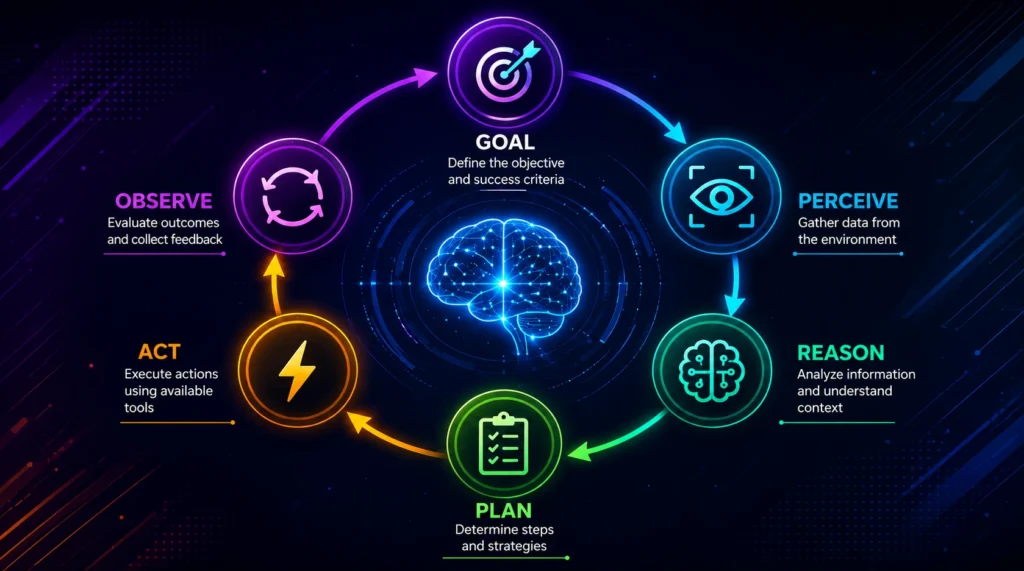
The Core Loop: Perceive → Reason → Act → Observe
Every autonomous AI agent, regardless of platform or underlying model, runs on some version of this cycle:
Goal → Perception → Reasoning → Planning → Action → Observation → Memory Update → back to Reasoning
This loop continues until the task completes, the agent hits a defined stopping point, or something needs a human call.
Think of it like watching a person work through a problem: they read the situation, decide what to try, take a shot at it, see what happened, update their understanding, and try again. An agent does exactly that, just faster, and without ever needing a coffee break.
The Five Core Components
1. Perception Layer
This is how the agent takes in information: text, voice input, API data, file contents, outputs from other systems. The perception layer converts raw inputs into structured formats the reasoning engine can actually work with. Think of it as the agent’s senses.
2. Reasoning Engine
The brain of the operation, almost always powered by a large language model (LLM) like Claude, GPT-4o, or Gemini. The quality of reasoning here determines everything: whether the agent can decompose a vague objective into concrete steps, catch its own mistakes, and navigate ambiguous instructions without going off the rails.
3. Memory System
Early AI tools had no persistent memory whatsoever. Every session started from scratch. Modern agent architecture has moved well past that, using layered memory instead:
- Short-term memory lives inside the model’s context window, covering everything relevant to the task at hand
- Long-term memory is stored externally (typically in a database) and retrieved when needed, including past interactions, user preferences, and historical decisions
- Episodic memory captures specific events with time and context attached, helping agents actually learn from what’s happened before
Research on modern AI memory architectures has shown roughly 26% accuracy improvements alongside reduced processing costs, which is why memory layers are quickly becoming standard in production systems.
4. Planning and Tool Use
Once the agent understands the goal and has pulled in the relevant context, it makes a plan. This is where tool-calling enters the picture. Modern agents can call external APIs, execute code, search the web, read and write files, query databases, and interact with other software systems. The Model Context Protocol (MCP), an open standard gaining serious traction in 2026, is making these integrations far more consistent and reliable across different platforms.
5. Execution and Observation
The agent acts, then watches what happens. Did the API call succeed? Did the output look right? If not, it adjusts. This feedback loop is what separates a sophisticated agent from a script: it doesn’t just execute instructions, it evaluates whether those instructions actually worked.
Types of Autonomous AI Agents in 2026
Not all autonomous AI agents are built the same way. Here’s how the main architectures break down in practice:
Single Agents
One agent handles an entire task from start to finish. This works well for clearly scoped workflows that don’t require specialization. A good starting point, though it has limits as complexity grows.
Multi-Agent Systems
Multiple specialized agents work in coordination, each owning a specific role. A research agent feeds information to a writing agent, which passes its draft to a review agent, all coordinated by an orchestrator. This mirrors how real teams actually function and tends to produce meaningfully better results for complex work.
One significant shift in 2026 is that agents are no longer limited to short exchanges. They can now run for minutes or hours, operating in long-running execution loops that make genuinely complex automation possible.
Human-in-the-Loop Agents
These operate autonomously until they hit a decision point that requires human judgment. Then they pause, surface the question clearly, and wait for input before continuing. This is currently the most common enterprise deployment model, and for good reason: it builds trust, maintains accountability, and catches mistakes before they have a chance to cascade.
Real-World Use Cases: Where Autonomous AI Agents Are Actually Working
Theory is fine, but the real story of autonomous AI agents is what’s happening in actual businesses right now.
Customer Support Operations
In customer service, agents now handle end-to-end workflows for well-defined issue types. A billing agent can verify identity, pull up transaction history, identify a discrepancy, apply resolution rules, issue a credit, and send a confirmation, all without a human touching it. Only the genuinely tricky edge cases get escalated. Industry surveys report 55% of organizations are now seeing measurable impact from AI agents in this area.
Software Development
The world of coding has changed substantially. Agents don’t just suggest code anymore. They investigate repositories, trace bugs to their root cause, write fixes, run tests, and prepare pull requests for human review. Specialized agent teams (Planner → Architect → Implementer → Tester → Reviewer) are emerging as a real pattern, with 57% of organizations reporting meaningful impact in software development workflows.
Sales and Pre-Sales Intelligence
Sales teams are using agents to take over the entire pre-sales research cycle. An agent monitors target accounts across multiple data sources, distills what it finds into a brief, drafts personalized outreach, watches for trigger events like funding announcements or leadership changes, and surfaces the right account to a rep at exactly the right moment. The rep focuses on the relationship, not the hours of background research that used to precede every conversation.
Legal and Compliance Review
Law firms and compliance teams are deploying reasoning-optimized agents for initial contract review, flagging clauses that deviate from standard templates and summarizing areas of risk. The agent doesn’t replace the lawyer. It makes the lawyer’s review significantly faster.
Enterprise Operations
SAP recently unveiled its Autonomous Suite with more than 200 specialized AI agents spanning finance, supply chain, procurement, HR, and customer experience. One real-world outcome: packaging compliance review time cut by more than 50%, and scenario simulation that used to take a full day now runs in under 20 minutes.
The Honest Pros and Cons
Here’s an honest look at what autonomous AI agents actually deliver and where they still struggle.
What Autonomous AI Agents Do Well
- They handle high-volume, repetitive workflows at scale without fatigue or variation in execution
- They run 24/7 and respond faster than any human team realistically can
- The cost curve keeps falling, making complex agent workflows viable even for small businesses
- They bring consistency to processes that previously depended on individual people doing things correctly every time
- They free skilled employees to focus on work that actually requires judgment
Where They Still Fall Short
- Hallucinations remain a real problem. In a chatbot, a hallucinated fact is annoying. In an agent that’s making decisions and calling APIs based on that fact, the error can cascade significantly before anyone notices.
- Ambiguous environments are still hard. Agents perform best when tasks are well-defined and data is clean. Give them vague goals or messy inputs, and results degrade, sometimes badly.
- Runaway agents are a new operational risk. Agents can enter recursive loops, over-query systems, or expand tasks well beyond their intended scope, driving unpredictable costs and instability. Companies like Portal26 are now building dedicated controls specifically to manage this.
- Security surface is real. Any agent with access to your systems is also a potential attack surface. Excessive permissions create exploitable vulnerabilities.
- Governance hasn’t kept up. According to Deloitte, only about 21% of companies currently have mature AI governance frameworks, even as organizations move quickly to deploy autonomous systems. The technology is outpacing the guardrails by a wide margin.
Future Trends: What’s Coming Next
Agent Standardization
The Model Context Protocol (MCP) is fast becoming the connective tissue between AI agents and business software. As this standardization matures, deploying agents across your existing tool stack will require far less custom engineering, closer to plug-and-play than it’s ever been.
Truly Adaptive Agents
Current agents are largely static between deployments. The next frontier is agents that genuinely improve from your specific business’s outcomes over time, learning which approaches work in your context, not just in general training data. The gap between a generic agent and one that’s been running inside your company for six months will become quite meaningful.
Regulatory Frameworks Arriving
The EU AI Act is already shaping how autonomous systems get deployed across Europe. NIST’s AI Agent Standards Initiative, announced in February 2026, signals that US frameworks are also taking shape. Businesses building audit trails and human oversight mechanisms now will be well-positioned when compliance requirements start arriving in earnest, particularly in high-stakes sectors like finance, healthcare, and legal.
The Democratization Continues
Some of the most compelling agent implementations in 2026 are coming from mid-sized companies and startups, not just enterprises with eight-figure AI budgets. The cost curve keeps falling, and the no-code and low-code tools keep getting better. Within 12 to 18 months, building a functional autonomous agent workflow should be a reasonable task for any technically literate operations manager. If you run a small business and want to see what that looks like in practice today, our practical guide to AI agents for small businesses walks through exactly where to start.
Conclusion: The Foundation Is Already Being Poured
The mental model shift here is worth sitting with for a moment. An autonomous AI agent isn’t a tool you use. It’s a collaborator with genuine autonomy, one you design, constrain, monitor, and progressively trust with more responsibility as it earns it.
That reframe changes how you should approach adoption. You’re not buying software. You’re building a capability.
The businesses pulling ahead aren’t waiting to understand autonomous AI agents, they’re already deploying them deliberately. They’re the ones that took the time to understand how these systems actually work and made deliberate, well-governed choices about where to put them first.
If you’re just starting to explore autonomous AI agents, pick one painful, repetitive workflow. Understand the data it touches. Define clearly which decisions it should make on its own, and which ones it should always escalate. Build the guardrails before you build the automation.
That’s how you get results that actually stick and trust that compounds over time.
Found this useful? Share it with someone navigating the AI agent landscape. The more practitioners who understand how this technology genuinely works, not just what it promises, the better the outcomes for everyone building with it.
Frequently Asked Questions
An autonomous AI agent is software that can pursue a goal by breaking it into steps, using tools, checking its own work, and adjusting along the way, without needing human input at every stage. Think of it as a capable, tireless digital collaborator rather than a simple question-answering tool.
Traditional automation follows rigid, predetermined rules: if this, then that. Autonomous AI agents can reason, adapt, handle unexpected situations, and make bounded judgment calls. They handle the kind of variability that reliably breaks traditional scripts.
It’s the core operating cycle of every agent: perceive the situation, reason about what to do, take an action, observe the result, update your understanding, and repeat. This loop is what allows agents to handle multi-step tasks without constant human guidance.
MCP is an open standard that defines how AI agents connect to external tools and data sources. It matters because it removes the need for custom, one-off integrations, making it much easier to build agents that work reliably across your existing software stack.
With the right architecture in place, including appropriate permissions, audit logging, human-in-the-loop checkpoints for high-stakes decisions, and clear escalation paths, yes. The risks are real but manageable. The biggest danger is deploying agents too broadly, too quickly, without adequate oversight.
Software development (57% of organizations reporting impact), customer service (55%), financial services, legal, and healthcare are leading adoption. But implementation is now spreading across nearly every sector with high volumes of knowledge work.
Less so than even a year ago. No-code and low-code platforms have matured significantly. Simple agent workflows can be built by technically literate non-engineers using tools like n8n, Make, or platform-specific agent builders. Complex, deeply integrated systems still benefit from developer expertise, but the floor has dropped considerably.
Treating it like a one-time implementation project rather than an ongoing capability. The businesses seeing the best results pick one well-scoped workflow, get it reliable, measure outcomes honestly, and build from there, rather than trying to automate everything at once and ending up with nothing working well.
