Next-Gen AI Agents: 5 Major Shifts Every Business Owner Must Know in 2026
-
- by Fiaz Ahmad
- May 14, 2026
- in AI Agents & Automation


Introduction: The AI Agent You Used Last Year Is Already Outdated
Remember when a chatbot on your website felt like a genuine competitive advantage? That was only a few years ago. Today, businesses are running next-gen AI agents that can plan projects, negotiate with suppliers, write and test code, and only involve a human when it’s truly necessary.
We’ve crossed a major threshold. Next-gen AI agents are no longer just assistants. They behave more like autonomous teammates, working continuously, retaining context across sessions, and delivering capabilities that would cost a fraction compared to a full-time hire.
Keeping up with the latest AI Agent News shows exactly why this shift matters. According to McKinsey’s 2025 State of AI report, organizations using advanced AI agents achieved 35 to 40% productivity gains in targeted workflows, not by reducing headcount, but by freeing people to focus on higher-value work.
So what’s really changing in 2026? Let’s break it down without the hype.
What Are Next-Gen AI Agents, Really?
Before we move into the five shifts, it’s worth defining the term clearly because “AI agent” gets used too loosely.
A basic AI tool responds to prompts. You ask, it answers, and the interaction ends there.
Next-gen AI agents work differently. They operate around goals. Once you assign a task, they break it into steps, select the right tools (web browsing, APIs, file operations), check their own output, and continue until the task is complete or escalate when human input is needed.
Beyond that, next-gen AI agents go even further. They coordinate with other agents, retain memory across sessions, integrate directly into business systems, and handle ambiguity without failing at the first unclear instruction.
That’s the baseline. Now let’s look at the five major shifts driving everything forward. If you want a deeper technical breakdown of how these systems are actually built, our Ultimate Guide to Autonomous AI Agents covers the full architecture in detail.
Shift 1: From Single Agents to Multi-Agent Systems
One Agent Can’t Do It All, So Now They Work in Teams
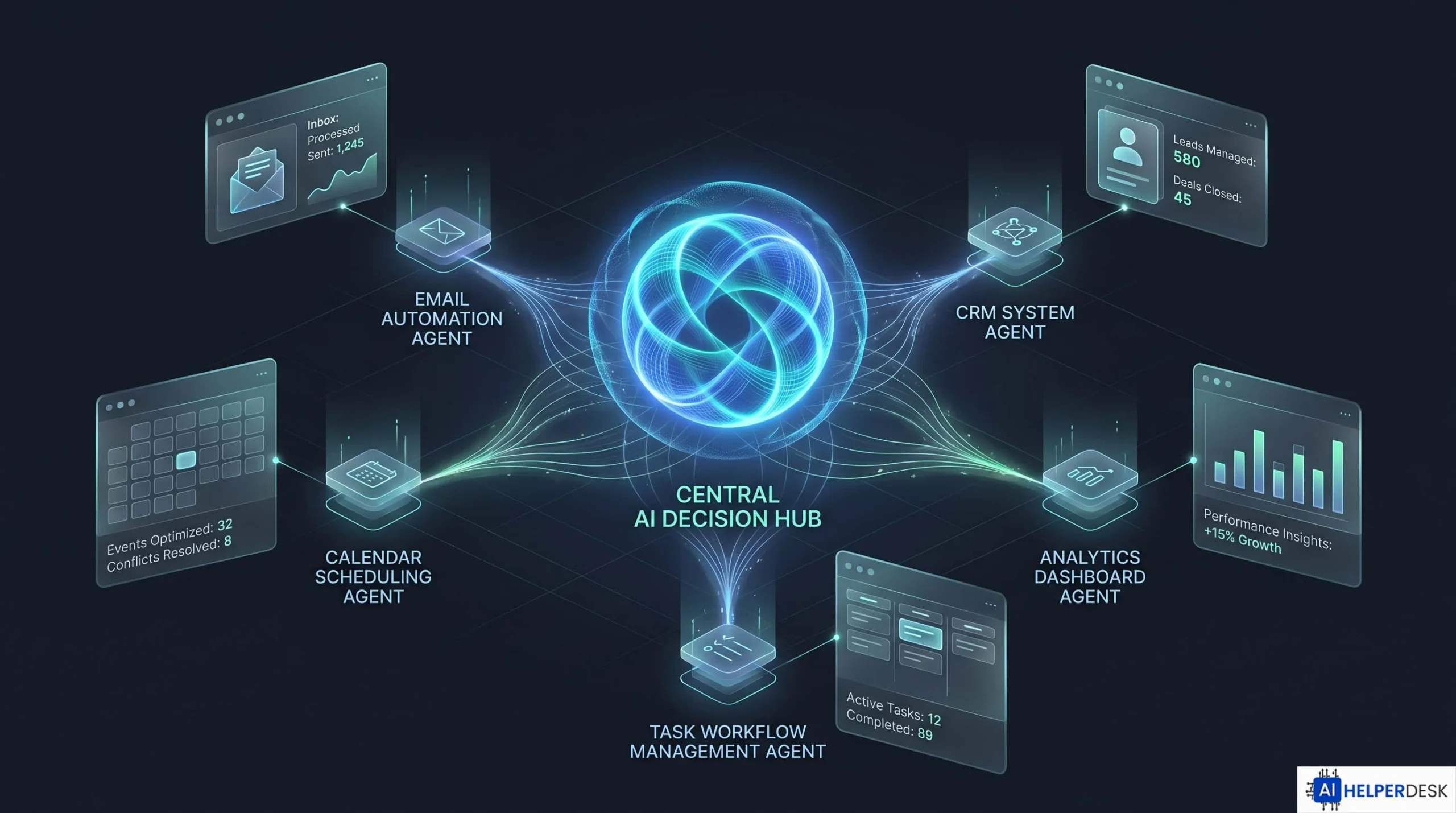
The biggest architectural shift in 2026 isn’t smarter models. It’s coordinated multi-agent systems where specialized agents collaborate like a real team instead of relying on one general-purpose model.
A typical setup includes:
- Research agent: gathers and structures information
- Writing agent: turns research into content
- Review agent: checks tone, accuracy, and SEO alignment
- Orchestrator agent: manages the workflow end-to-end
Frameworks like Microsoft AutoGen, CrewAI, and LangGraph have already made these systems accessible to companies without large engineering teams.
Real example: An e-commerce brand uses multi-agent systems to monitor competitor pricing, generate promotional updates automatically, and push changes directly into their CMS. What used to take hours becomes a quick daily review.
Shift 2: AI Agents Are Getting Persistent Memory
They No Longer Forget Everything After Every Session
Earlier AI tools had a significant limitation: no memory. Every session started from zero, forcing users to re-explain context repeatedly.
That limitation is now fading fast.
Modern next-gen AI agents support persistent memory, allowing them to retain preferences, decisions, and prior outcomes across sessions. In some cases this memory lives in external databases; in others it’s embedded directly into the system architecture.
For businesses, this is where things get genuinely powerful. A sales agent can remember communication preferences for each client. A project agent can recall why a strategy changed months ago without needing a re-briefing. Continuity builds trust, and once trust increases, teams naturally delegate more work, which compounds productivity gains over time.
Shift 3: Agents Are Plugging Directly Into Business Software
The Era of Copy-Paste AI Is Ending
Not long ago, AI workflows were mostly manual. Teams would generate output, copy it into a CRM, move it into spreadsheets, then format it again for Slack. Humans acted as the bridge between systems.
That friction is disappearing in 2026.
Modern next-gen AI agents integrate directly into business tools through APIs and Model Context Protocol (MCP) connections, allowing them to read and write live data inside operational systems.
- An agent inside HubSpot that nurtures leads based on real-time engagement signals
- An inventory agent that triggers reorder workflows and drafts purchase requests
- A support agent that resolves Tier-1 tickets and escalates only complex cases
These systems are no longer standalone tools. They’re becoming part of core business infrastructure.
Important note: This level of integration requires careful governance, permission control, and audit systems. It’s just as much an operational challenge as a technical one.
Shift 4: Reasoning Has Gotten Dramatically Better
Agents Can Now Handle Nuance and Ambiguity
One of the biggest limitations of early agents was handling vague instructions. Tasks like “improve onboarding” often produced generic answers or unnecessary clarification loops.
That gap has narrowed significantly.
Modern reasoning-focused models can now break down complex problems, evaluate trade-offs, identify missing information, and correct their own reasoning mid-task. They’re far better at handling ambiguity without collapsing into guesswork.
They’re not perfect. Errors still occur, especially in mathematical or highly ambiguous contexts. Even so, reliability has improved enough that businesses are deploying next-gen AI agents in real operational workflows with confidence.
Real example: Law firms use reasoning agents to review contracts, flag deviations from standard terms, and prepare summaries for attorneys. It doesn’t replace legal professionals, but it speeds up their review process considerably.
Shift 5: The Cost Curve Has Dropped Sharply
Automation Is Now Economically Accessible
This is one of the most impactful shifts in AI adoption, and also one of the least discussed.
Over the last few years, running AI agents has become dramatically cheaper. What once cost tens of dollars per million tokens has dropped to near-zero for many use cases, thanks to smaller models, caching improvements, and optimized architectures.
The economics of automation have changed completely because of this. Processes that once cost $10 per task now make sense at $0.05 or less. And this shift is no longer limited to large enterprises.
Solo consultants can automate research and client communication. Startups can build full content pipelines. Mid-sized businesses can run advanced personalization workflows without dedicated data teams. AI automation is no longer a luxury. It’s becoming standard.
Pros and Cons of Embracing Next-Gen AI Agents
Key Benefits
- Significant efficiency gains in repetitive work
- 24/7 availability without operational constraints
- Elastic scalability during demand spikes
- Consistent execution for compliance and quality
- Rapidly improving ROI due to falling costs
Key Challenges
- Requires thoughtful system design, not quick setup
- Not fully reliable for high-stakes decisions
- Expanded security and permission considerations
- Organizational change management challenges
- Process quality directly impacts output quality
The strongest results consistently come from companies that treat AI adoption as an ongoing capability rather than a one-time project.
What Comes Next
Several trends are shaping the next phase of next-gen AI agents.
Learning from real business data: Agents will increasingly adapt based on outcomes within specific organizations, not just general training data.
Voice-first interaction: More natural, conversational AI systems will enable hands-free workflows in everyday work environments.
Stronger regulation: Governments are beginning to define clearer rules around accountability, especially in sensitive industries like finance and healthcare. The EU AI Act is already shaping how these systems get deployed across Europe.
Conclusion: The Window to Get Ahead Is Still Open, But Not for Long
Here’s the reality right now: next-gen AI agents are no longer experimental tools. They’re already in production use across industries, powering sales pipelines, marketing workflows, customer support systems, and day-to-day operations.
The opportunity window is still open. Widespread, deeply integrated adoption is still in its early stages, which means businesses that act now have a real chance to stay ahead instead of playing catch-up later.
The five shifts we explored: multi-agent collaboration, persistent memory, deeper software integration, improved reasoning, and rapidly falling costs. These are not future concepts. They’re already here and actively reshaping how work gets done.
The question is no longer whether next-gen AI agents matter. The real question is: which workflow are you going to improve first?
Start small. Pick one repetitive or time-consuming process and apply an agent solution to it. Measure the impact clearly, then expand from there once you understand what works in your environment.
The companies that will lead the next five years aren’t necessarily the ones with the biggest AI budgets. They’re the ones that started early, experimented intelligently, and learned how to apply these systems effectively before everyone else caught on.
If this was helpful, consider sharing it with another business owner who is still exploring AI agents. And if you’re already using agent-based workflows in your business, real-world experiences are always valuable. They help move the conversation beyond theory into what actually works.
Frequently Asked Questions
A next-generation AI agent is an autonomous software system designed to pursue goals rather than just respond to prompts. It can use external tools, maintain context across sessions, and even collaborate with other agents to complete complex tasks. In short, it goes far beyond a basic chatbot or simple prompt-response system.
Traditional automation tools like Zapier rely on fixed “if-this-then-that” rules. AI agents, on the other hand, can reason through tasks, adapt to changing conditions, work with ambiguity, and make contextual decisions within defined boundaries. A simple way to think about it is: automation follows scripts, while agents behave more like flexible digital workers.
Yes, provided they are set up correctly. Safety depends on things like clearly defined permissions, audit logs, and human approval steps for high-impact actions. The core principle is simple: agents should only have the level of access they genuinely need to perform their tasks.
Any business dealing with high-volume, repetitive knowledge work can benefit. This includes customer support, marketing, legal review, financial analysis, HR workflows, and e-commerce operations. Even small businesses can now adopt useful agent systems without needing enterprise-level infrastructure.
It depends on complexity. Simple workflows built with tools like Make, n8n, or Zapier Central can cost under $100 per month. Larger, custom multi-agent systems for enterprises can require significant upfront investment. That said, ongoing per-task costs have dropped so much that they are often negligible for everyday use cases.
Not always. Modern no-code and low-code platforms allow non-developers and operations teams to build functional AI agent workflows without writing code. However, more complex or deeply integrated systems still benefit from technical expertise, especially when it comes to security and scaling.
The most common mistake is trying to automate everything at once. The most successful approach is focused and gradual: start with one high-impact, well-defined workflow, make it reliable, measure results carefully, and then expand step by step.
