AI Agents for Small Businesses: A Practical Implementation Guide (2026)
-
- by Fiaz Ahmad
- May 22, 2026
- in AI Agents & Automation, AI Business Solutions

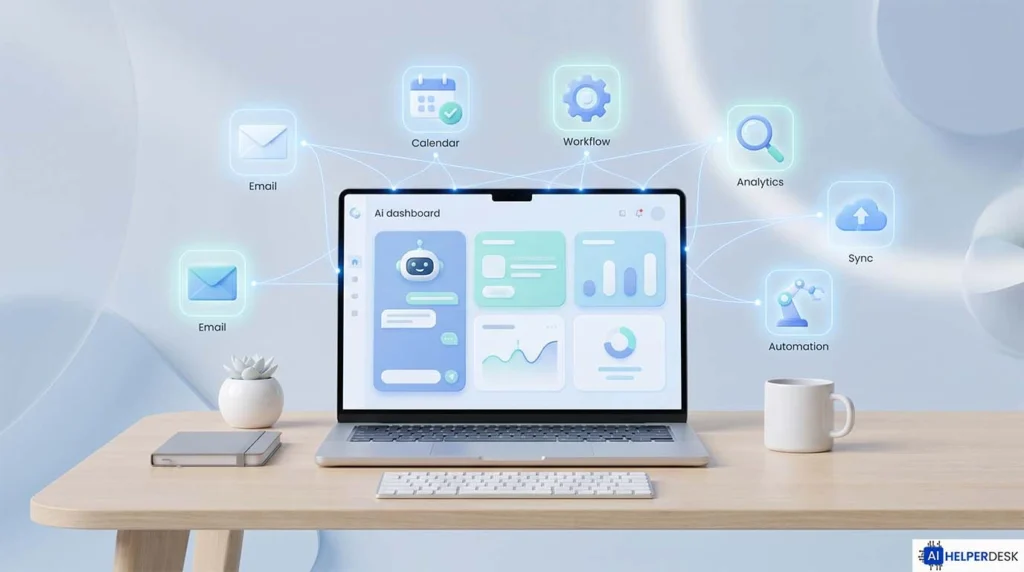
Introduction: The Playing Field Just Changed
Not long ago, “AI automation” was basically enterprise territory: big budgets, dedicated IT teams, and software that most small businesses couldn’t touch. That story has changed pretty dramatically.
In 2026, a two-person e-commerce shop, a local accounting firm, or a solo consultant can realistically deploy AI agents for small businesses to handle customer queries at 2 a.m., follow up with leads, draft content, and update spreadsheets without anyone lifting a finger. And this isn’t some distant future version of the technology. It’s available right now, at prices that make actual sense.
The numbers back this up. According to the U.S. Chamber of Commerce, close to 60% of small businesses are now using AI, up 18% year-over-year in 2025, which is double the adoption rate since 2023. And among high-tech adopters, 84% report measurable gains in sales and profits compared to businesses that haven’t made the leap.
That said, there’s a real difference between adopting AI and using it well. This guide is about the latter: how to implement AI agents for small businesses practically, affordably, and without needing a tech background.
What Exactly Is an AI Agent (and Why It’s Different from a Chatbot)?
This distinction matters more than most people realize, so let’s clear it up before getting into tactics.
A chatbot responds to what you ask. An AI agent acts on your behalf. It can browse the web, update a CRM, send emails, trigger workflows, pull data from multiple systems, and make judgment calls, all on its own, working toward a goal you’ve defined.
Here’s an analogy that usually clicks: a chatbot is a receptionist who answers your questions. AI agents for small businesses are more like capable executive assistants, ones that schedule your meetings, draft your responses, and follow up on pending tasks without being asked twice. For a small business owner already wearing six hats, that’s not a subtle difference.
Before picking a tool, it also helps to understand the broader landscape. Our guide on the 10 Best AI Tools for Entrepreneurs to Scale Business Workflows covers the wider toolkit that works alongside these agents, and is worth reading if you want context on how everything fits together.
Why 2026 Is the Right Time to Start
Honestly, the timing is genuinely good right now, not in the “there’s always a reason to act now” sales sense, but structurally.
Costs have come down a lot. Enterprise-level tooling from two years ago is now available on monthly SaaS plans under $100. The market for AI agents for small businesses is projected to grow at over 45% CAGR through 2030, and that competition is driving prices down while quality keeps improving.
No-code platforms have grown up. You don’t need a developer anymore. Tools like Lindy, Make, and Zapier let you build automation logic visually, connecting your apps through point-and-click interfaces most people can figure out in an afternoon.
Everything integrates now. Most modern AI agents for small businesses plug directly into software you’re probably already using: Gmail, Slack, HubSpot, Notion, Shopify, QuickBooks. You’re not ripping out your existing stack; you’re adding intelligence on top of it.
Your competition isn’t sitting still. A 2025 survey found that 80% of small businesses are actively accelerating AI adoption because they see competitors moving. Waiting has stopped being a neutral decision.
The 5 High-Impact Use Cases for AI Agents in Small Businesses
Not every AI use case delivers equal value. These five areas consistently produce the fastest, most tangible results when deploying AI agents for small businesses.
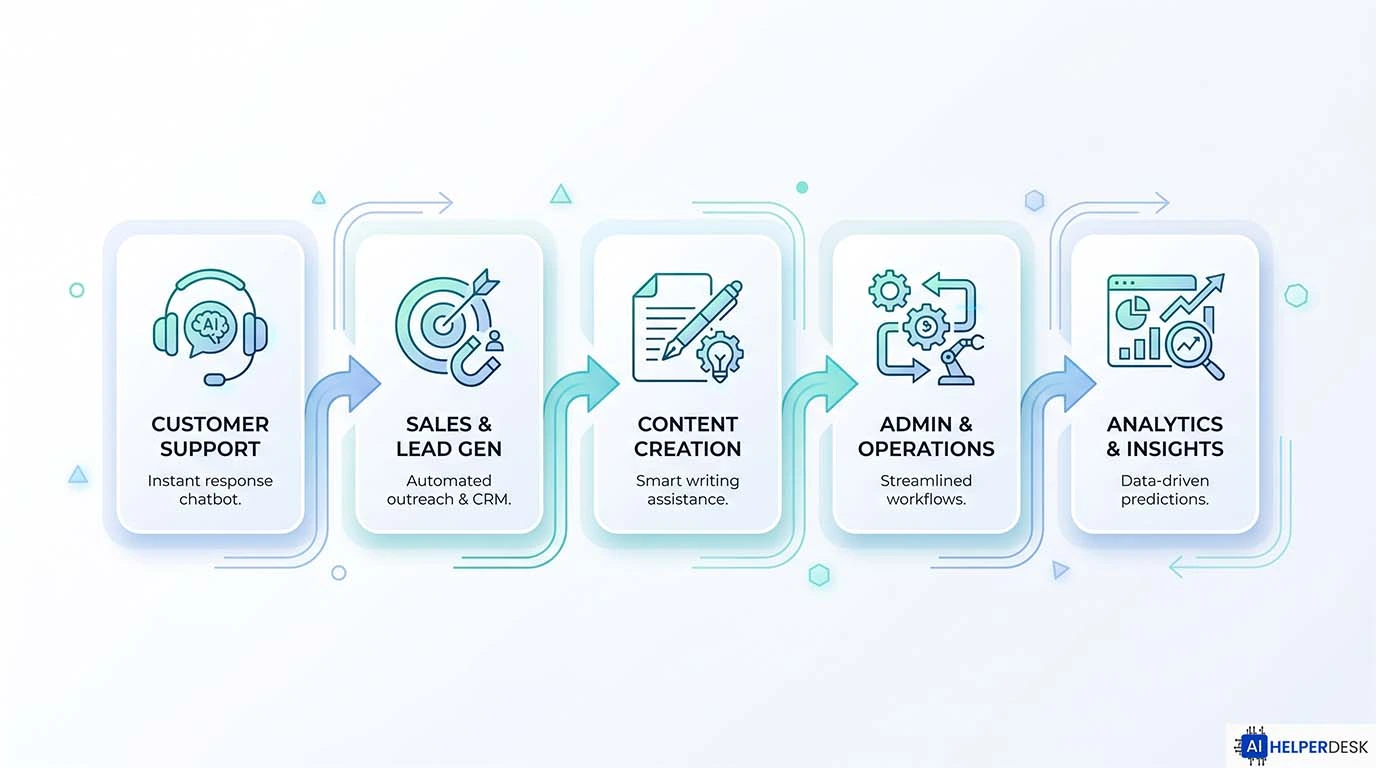
1. Customer Support Automation
This is where most businesses start, and there’s a good reason for that. AI agents for small businesses handle FAQs, order status checks, refund requests, and appointment bookings around the clock with no human on standby required.
More sophisticated setups go further: the system looks up order data in your backend, updates records in real time, and escalates genuinely complex issues to a human teammate with all the relevant context already written up. Tools like Intercom’s Fin, Tidio, and Freshdesk’s Freddy AI are purpose-built for this, and they don’t require any coding knowledge to get running.
Real example: A small skincare brand with two customer service reps deployed an AI support agent to handle first-contact queries. Within 60 days, it was resolving 67% of tickets without human intervention, which freed the team to focus on complex complaints and VIP customers rather than answering “where’s my order” for the 40th time that week.
2. Sales and Lead Follow-Up
Manually chasing leads is one of the biggest time sinks in small business, and it’s one of the clearest wins for AI agents for small businesses. A well-configured sales agent can qualify new leads through a short conversation, send personalized follow-up emails on a defined schedule, log activity in your CRM, and book calls directly on your calendar.
Platforms like Warmly, Amplemarket, and Clay specialize in agentic sales workflows. For teams that want to build something more custom without hiring a developer, Lindy is worth looking at.
Real example: A B2B consulting firm set up an AI agent to respond to contact form submissions within 90 seconds, qualify the lead, and book a discovery call automatically. Lead-to-call conversion improved by 40% in the first month, largely because speed matters more than most people expect in that initial window.
3. Content Creation and Social Media
AI content tools have moved well beyond “generate a blog post.” You can set up a workflow that monitors your industry for trending topics, drafts posts in your brand voice, resizes content for different platforms, schedules posts, and pulls engagement reports, all in one connected pipeline.
Real example: A local fitness studio now has a setup that pulls weekly class highlights, turns them into Instagram captions and email newsletter content, and schedules everything for the week. That task used to eat 3-4 hours of the owner’s Sunday.
HubSpot’s 2025 State of Marketing report found that AI-using small businesses save 5 to 15 hours per week on content work alone. At $25 an hour, that’s over $6,500 in reclaimed time annually, before you even count the improved consistency.
4. Internal Operations and Admin
Invoicing, appointment reminders, data entry, meeting summaries, expense tracking: these tasks feel small individually but add up to a shocking amount of time each week. This is exactly where AI agents for small businesses deliver some of their quietest but most consistent wins.
Tools like Notion AI, Microsoft Copilot, and Zapier’s AI automations can connect your calendar, email, project management, and accounting tools so routine admin basically runs itself.
Real example: A small law firm set up a workflow to auto-generate meeting summaries from Zoom calls, extract action items, and assign them to the right team member in their project tracker. Time saved across the team: roughly 6 hours per week.
5. Analytics and Business Reporting
Most small business owners are sitting on more data than they ever have time to actually look at. AI agents for small businesses can pull summaries from your CRM, ad platforms, and e-commerce tools, translate performance numbers into plain English, flag anything unusual, and send a weekly digest directly to your inbox.
No data analyst required. Just the right tool connections and a clear reporting template. For many owners, this is the one that genuinely changes how they make decisions day to day.
How to Actually Implement AI Agents: A Step-by-Step Approach
Here’s a practical framework for rolling out AI agents for small businesses, regardless of your size or technical background.
Step 1: Identify Your Highest-Pain Task. Start with one process: something repetitive, time-consuming, and rule-based. Don’t try to automate everything at once. The narrower your starting point, the faster and cleaner your first win will be.
Step 2: Map the Workflow Before You Automate It. Write out every step a human follows to complete this task. What kicks it off? Which tools are involved? What does “done” actually look like? Automation follows logic, so you need to have that logic clearly defined before handing it off.
Step 3: Choose the Right Tool. Match tools to your use case and comfort level:
- No-code, ready to deploy: Lindy, Tidio, Freshdesk Freddy AI, Sintra AI
- Visual workflow builder: Make (formerly Integromat), Zapier
- Sales-specific: Warmly, Clay, Amplemarket
- All-in-one productivity: Microsoft Copilot, Notion AI
Step 4: Start with a Narrow Pilot. Run the setup in parallel with your existing process for 2-4 weeks. Measure accuracy, catch edge cases, and build confidence before handing over full control. This step is where most implementations of AI agents for small businesses succeed or stall. Don’t skip it.
Step 5: Review, Refine, Expand. Once your first workflow is running well, document what worked and replicate the approach. Most AI-using small businesses now run a median of five tools as part of their operational stack, but they got there one tool at a time.
Pros and Cons of Using AI Agents in Small Businesses
Before committing to any platform, it helps to weigh both sides. Here is an honest look at what AI agents for small businesses do well and where they still fall short.
The Advantages
Works 24/7 without burning out. These tools don’t need sleep, don’t take holidays, and don’t have off days. For customer-facing work, that alone is a meaningful competitive edge.
Scales without adding headcount. Adding 500 new customers doesn’t mean hiring five more staff if your workflows are properly set up.
Consistent output. Automation follows the same process every single time. No missed steps, no forgotten follow-ups, no “I thought someone else was handling that.”
Affordable entry points. Most AI agents for small businesses start between $29-$99/month. That’s less than 10 hours of part-time help in most markets.
The Limitations
Quality of output depends on quality of input. If your workflow is poorly defined, an AI agent will execute it poorly at scale, just faster and more consistently than a human would.
Edge cases still need people. Unusual situations, emotionally charged conversations, and nuanced judgment calls still require a human. Plan for escalation paths from the start.
Initial setup takes real time. Depending on complexity, configuration can take anywhere from a few hours to a few days. Don’t underestimate this.
Data privacy requires attention. Verify that any platform you use complies with GDPR or CCPA as applicable, and check whether they use your data to train their models. Most reputable platforms are transparent about this, but you have to ask.
What’s Coming Next: Trends Worth Keeping an Eye On
What we’re seeing in 2026 is still early innings. A few developments worth watching as AI agents for small businesses continue to evolve:
Multi-agent collaboration. Rather than one agent doing everything, businesses will increasingly use teams of specialized tools that pass context between each other. One handles lead qualification, another writes the proposal, a third books the meeting.
Voice-first interfaces. AI tools are becoming increasingly voice-accessible, which means a business owner can brief a system the way they’d brief a human: by talking to it.
Deeper CRM and ERP integration. Platforms like Salesforce Einstein and HubSpot’s AI suite are embedding agentic capabilities directly into software small businesses already use daily, which significantly reduces setup friction.
Blended human-AI teams. By 2028, analysts project that 38% of organizations will have AI agents working alongside human teams as active contributors, not just background automation, but participants in actual projects.
For small businesses, the competitive edge won’t come from simply having AI agents. It’ll come from knowing how to direct them well.
Conclusion: Start Small, Move Fast
The gap between businesses using AI agents for small businesses effectively and those ignoring them is widening. But you don’t have to close it all at once.
Pick one process. Map it out clearly. Deploy a focused tool. Measure what happens. Then move to the next one.
The businesses that look back at 2026 as a turning point won’t necessarily be the ones with the largest budgets. They’ll be the ones that picked something practical, learned quickly from it, and kept building.
If you want to dig deeper, Lindy’s small business guide and Warmly’s AI agent overview are two of the more honest, non-salesy resources out there. For broader context on where the market is heading, Salesmate’s breakdown of AI agent trends is worth your time.
The tools are there. The price is right. The only move left is to actually start.
If this was useful, it is worth sharing with another small business owner who is still figuring out where to start with AI agents. And if you have already been down this road, the comments are open. Real experiences, whether wins or hard lessons, tend to move the conversation forward faster than any guide can.
Frequently Asked Questions
Not anymore. Most tools designed for small businesses are no-code or low-code: you configure them through visual interfaces, not programming. If you can use a CRM, you can handle most of these platforms.
Entry-level tools typically start at $29-$99/month. More sophisticated platforms with multi-agent capabilities can run $200-$500/month. Even at the mid-tier, most options cost less per month than 10 hours of part-time help.
For customer support, Tidio or Freshdesk’s Freddy AI are popular starting points. For sales and lead follow-up, Warmly or Lindy work well. For content and social media, Sintra AI has purpose-built tools that are worth exploring. Start with your biggest pain point and work from there.
Reputable platforms follow enterprise-grade security standards including SOC 2 compliance and data encryption. Before committing to any tool, verify it offers data deletion options and doesn’t train models on your proprietary data. For businesses handling EU or California customer data, check GDPR and CCPA compliance specifically. Don’t just take the sales rep’s word for it.
In most cases, no, and that framing tends to lead to the wrong decisions anyway. These tools handle tasks, not roles. They free up your people (or your own time) to focus on higher-value work: building relationships, solving genuinely hard problems, doing the creative thinking that actually moves the needle. The businesses getting the best results treat AI agents as a force-multiplier, not a replacement.
For straightforward use cases like FAQ handling or lead follow-up emails, most small businesses see measurable results within 30-60 days of deployment. More complex workflows may take a full quarter to fully optimize, which is normal and worth planning for.
