AI Lead Generation Agents: How to Automate Your Cold Outreach Legally (2026 Guide)
-
- by Fiaz Ahmad
- June 3, 2026
- in AI Agents News, AI Business Solutions

Introduction: Cold Outreach Isn’t Dead. It Just Got Smarter
Let’s be real for a second. Traditional cold outreach was exhausting. You’d spend half your day pulling contacts from LinkedIn, stitching together half-personalized emails, and watching most of them vanish without a trace. Open rates in the low single digits. Replies that barely existed. Follow-up sequences that felt robotic because, well, they were.
Fast forward to 2026, and the game has changed in a meaningful way.
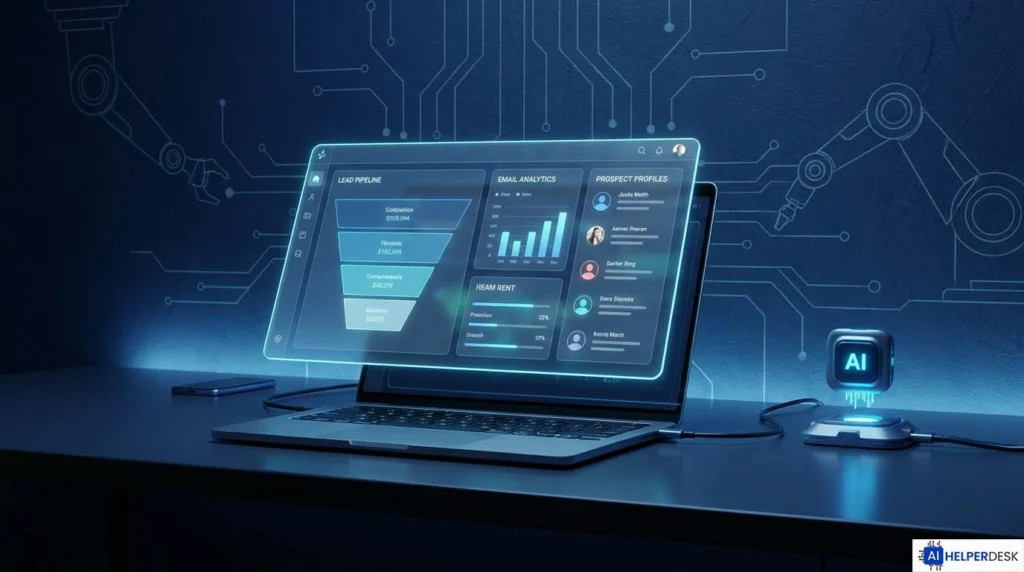
AI Lead Generation Agents are no longer just sending emails faster than a human can. They’re actively researching prospects in real time, crafting genuinely personalized messages, handling replies, booking meetings, and doing all of this with minimal human involvement. The technology has matured to a point where the gap between a skilled human SDR and a well-configured AI agent is closing faster than most sales leaders expected.
But here’s the part that trips people up: more automation means more legal exposure. Set things up carelessly, and that scale becomes a serious liability rather than a competitive edge.
This guide covers exactly what AI Lead Generation Agents are, how they work under the hood, how to get the most out of them, and most importantly, how to do all of it without landing in legal trouble.
What Are AI Lead Generation Agents, Exactly?
AI Lead Generation Agents are software tools that work autonomously to find, qualify, and contact potential customers on your behalf. Unlike the email automation tools most teams have been using for years, these agents combine large language models (LLMs) with real-time data access to do something fundamentally different.
Traditional outreach platforms automate the sending side of things, but they still depend on static workflows and templates a human has to write in advance. AI agents flip that model. They research each lead and generate personalized outreach on the fly. They find new prospects, write human-like emails, respond to replies, and learn from each interaction, all without constant hand-holding.
In practice, capable AI Lead Generation Agents in 2026 can do the following:
- Scrape LinkedIn, company websites, and news sources to identify warm intent signals
- Write unique, contextually relevant emails for each individual prospect
- Automatically follow up based on engagement behavior
- Route hot leads into your CRM and alert your sales team
- Handle initial replies without any human involvement
This is not science fiction anymore. Tools like Agent Frank by Salesforge, Coldreach.ai, and AiSDR are already doing exactly this for thousands of B2B teams right now.
Why the Timing Matters: The 2026 Landscape
Adoption has accelerated sharply. Around 80% of Fortune 500 companies are already using generative AI tools internally, and roughly 20% of marketers plan to deploy AI Lead Generation Agents specifically for marketing automation tasks. When enterprise players move that aggressively, mid-market and startup teams face a clear choice: adapt or get left behind.
Speed is also more critical than ever. According to Harvard Business Review, companies that reach out to a lead within one hour of an initial inquiry are nearly seven times more likely to qualify that lead compared to teams that wait just one additional hour. Delay contact by 24 hours or more and the probability of qualifying that lead drops by over 98%.
AI Lead Generation Agents do not sleep or have off days. A lead comes in at 2 a.m. and your agent responds by 2:01 a.m. That kind of responsiveness is simply not something a purely human team can pull off consistently.
How AI Lead Generation Agents Actually Work
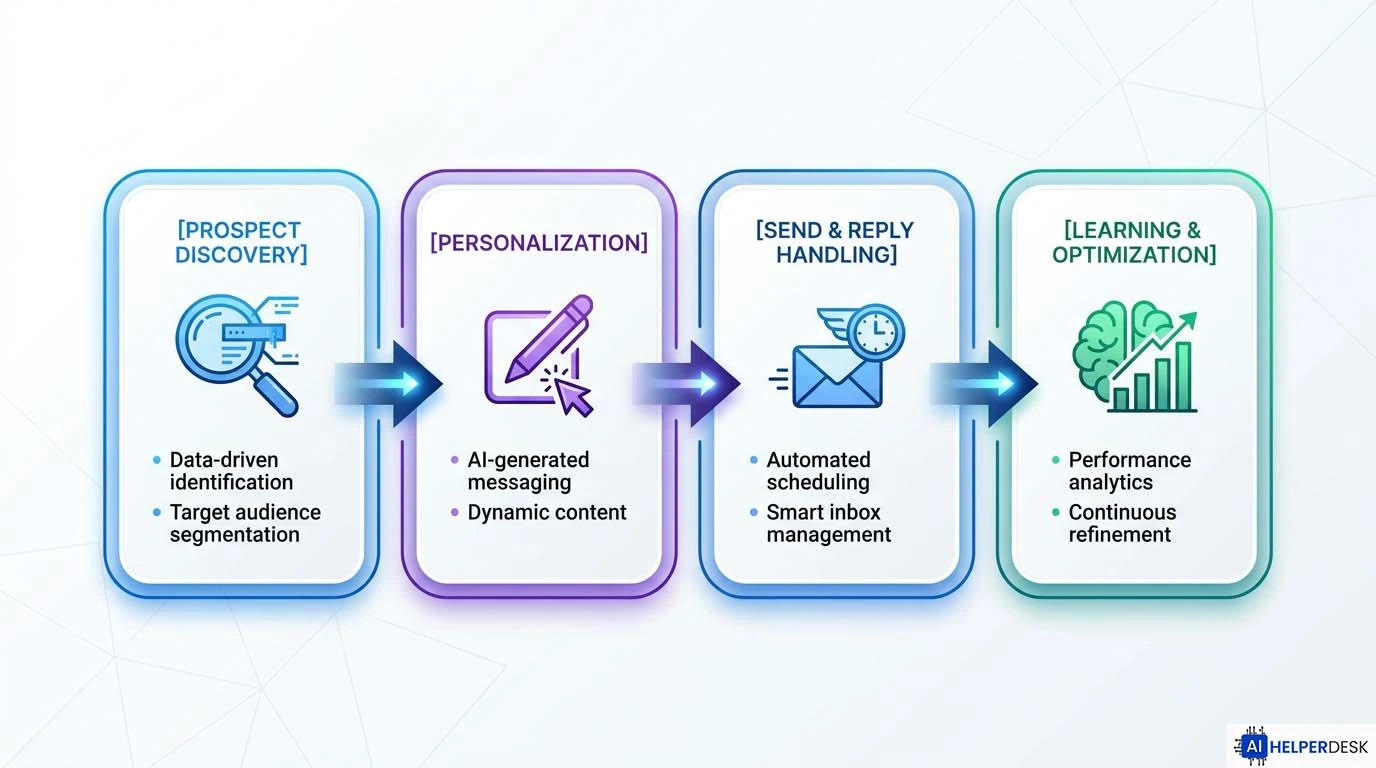
Step 1: Prospect Discovery and List Building
The agent starts by sourcing leads that match your ideal customer profile (ICP). It pulls data from platforms like Apollo, LinkedIn Sales Navigator, or proprietary databases, then enriches each contact with firmographic details including company size, funding stage, tech stack, and recent news events.
The best sales teams in 2026 are using AI to find what you might call the “hook” that makes an email impossible to ignore. The agent monitors quarterly reports, podcast appearances, job postings, and social updates to identify the specific problem a prospect is actively working on right now. That context changes everything.
Instead of a generic pitch about your product’s features, your agent sends something like: “Noticed your team just announced a Series B and you’re hiring three SDRs. Here’s how we’ve helped companies at exactly that stage ramp faster without adding headcount.” That’s relevance. That’s what gets replies.
Step 2: Personalization at Scale
This is where the LLM does its heaviest lifting. The agent takes all that enriched lead data and generates a unique email for each prospect. Good agents vary the subject lines, opening hooks, value propositions, and calls to action based on persona, industry, and intent signals. It’s not just swapping in a first name. The entire message is shaped around what the agent knows about that specific person at that specific moment.
AI tools handle research, verification, scoring, and outreach at a volume no human team can realistically match. The most effective setups combine both: AI handling volume and humans focusing on high-value conversations once genuine interest is established.
Step 3: Sending, Sequencing, and Reply Handling
Once emails are sent, AI Lead Generation Agents monitor replies and track engagement. Positive responses get routed directly to your sales team or calendar booking tool. Non-responses trigger follow-up sequences at the right intervals. Bounces and opt-outs are removed automatically from the pipeline. More advanced agents can even handle the initial back-and-forth with prospects before escalating to a human sales rep.
Step 4: Learning and Optimization
Over time, AI Lead Generation Agents learn which messages, subject lines, and send times produce the best outcomes. This kind of continuous feedback loop is something traditional A/B testing simply cannot replicate at any meaningful scale. The system gets smarter with every campaign.
The Legal Layer: Staying Compliant While Automating
This is where most teams get sloppy. And it’s a mistake that can be very expensive.
The penalties are not hypothetical. The FTC’s CAN-SPAM Act carries fines of up to $51,744 per non-compliant email. GDPR can impose penalties of up to 4% of global annual revenue. And a 2025 Washington State Supreme Court ruling created $500-per-email penalties for misleading subject lines, with at least eight lawsuits already filed under that precedent.
Here is what you need to know across the three major regulatory frameworks.
CAN-SPAM (United States)
Cold B2B email is explicitly permitted under CAN-SPAM. No prior consent is required. You must include an opt-out mechanism, a physical mailing address, and accurate sender information. The key rules are straightforward: no deceptive subject lines, no falsified header information, and opt-out requests must be honored within 10 business days.
GDPR (European Union and UK)
GDPR does not ban cold email. Article 6(1)(f) permits B2B cold outreach under legitimate interests, provided you pass a three-part test covering purpose, necessity, and balancing. You must honor opt-outs immediately, include a postal address, and maintain proper documentation of your legal basis. Explicit consent is required for B2C outreach, and enforcement agencies have been increasingly aggressive about companies that fail to clearly identify themselves or make opting out difficult.
Here is the compliance silver lining that most people overlook: permission-based email campaigns outperform non-compliant ones, with 38% higher open rates and 68% higher click-through rates. Following the rules is not just about avoiding fines. It actually makes your campaigns perform better.
CASL (Canada)
CASL is the strictest of the three frameworks and requires implied or express consent before you can send commercial email. If you are reaching out to Canadian contacts, your compliance approach needs to be more rigorous than what CAN-SPAM requires.
One more thing worth flagging for 2026: the EU AI Act’s transparency requirements for AI-generated content take effect in August of this year. Companies sending AI-generated outreach to EU recipients should be building their compliance strategy now rather than scrambling later.
Practical Compliance Checklist for AI Outreach
- Always include a physical business address in every email
- Add a clear, functional unsubscribe link (it actually improves deliverability too)
- Document your legal basis for contacting each lead
- Use verified, opt-in-sourced data and avoid scraped-only lists
- Process opt-out requests immediately and automatically
- Segment your lists by geography so you apply the correct regulatory standard
Cold email is legal. Buying B2B email lists is legal. What destroys domains, pipelines, and businesses is running outreach on unverified, non-compliant lists without controls to enforce opt-outs, authenticate senders, and document your legal basis for each contact.
Real-World Use Cases
SaaS Startup Doing Outbound at Seed Stage
A 10-person SaaS team uses Leadsforge to build ICP-matched lists and pairs it with Agent Frank to run the full outbound sequence from first email to booked demo. The founders review conversations but do not write a single cold email themselves. The result: over 40 demos booked per month with just one part-time ops person managing the entire stack.
Marketing Agency Prospecting New Clients
A boutique agency uses Coldreach.ai to monitor job postings and funding announcements as buying signals. When a company hires a Head of Marketing or closes a funding round, an AI agent fires off a personalized email within hours. The team closes more deals not because they are sending more emails, but because they are sending the right email at exactly the right moment.
Enterprise Team Scaling SDR Capacity
A 200-person company has augmented its SDR team with AI Lead Generation Agents that handle all Tier 2 and Tier 3 accounts, the companies that would not otherwise receive any personalized attention. Human SDRs focus entirely on strategic accounts. Pipeline coverage has doubled without adding a single headcount.
Pros and Cons of AI Lead Generation Agents
The Upside
Scale without proportional cost. AI Lead Generation Agents can handle the prospecting and outreach volume of several SDRs at a fraction of the price.
Speed to lead. Automated agents respond within minutes. In competitive markets where deals consistently go to the fastest responder, that matters enormously.
Consistent quality. No bad days, no copy-paste errors, no forgotten follow-ups. The quality stays level across every single contact.
Better data over time. AI agents learn from campaign performance and continuously improve message quality the more they run.
The Downsides
Setup requires real thought. Before deploying AI Lead Generation Agents, you need a well-defined ICP, clean data, and a solid compliance setup. Rushing this leads to spam complaints and a damaged domain reputation that is difficult to recover from.
Personalization has its limits. AI is excellent at data-driven personalization, but it can still produce awkward or off-target messages when the underlying data is wrong or missing entirely.
Inbox deliverability is a constant battle. High volume without proper domain warming, SPF/DKIM/DMARC authentication, and engagement monitoring will get your domain blacklisted quickly.
Legal exposure scales with volume. Every non-compliant email is a separate violation. At scale, the math on potential fines becomes genuinely alarming.
What’s Coming Next: Future Trends in AI-Powered Outreach
Voice and video personalization. Some early-stage tools are already generating personalized video clips at scale. Picture a 30-second video where the AI references a prospect’s recent LinkedIn post by name. It is not mainstream yet, but it is closer than most people think.
Multimodal agent workflows. Future AI Lead Generation Agents will not just handle email. They will coordinate across LinkedIn DMs, WhatsApp, email, and phone calls, choosing the channel most likely to get a response based on the individual prospect’s behavior patterns.
Tighter regulatory scrutiny. As AI-generated outreach becomes more widespread, regulators are going to tighten the rules further. Teams that build compliance into their infrastructure now will have a meaningful head start. Stay updated with the latest developments by following AI Agents News so you never miss a regulatory shift that affects your outreach stack.
Signal-based outreach replacing cold lists. The future of outbound is not blasting your ICP with a generic pitch. It is monitoring buying signals like hiring activity, funding announcements, tech stack changes, and leadership transitions, then reaching out at precisely the right moment. AI makes this feasible at genuine scale.
For a deeper look at compliance frameworks and best practices, the Instantly.ai B2B email compliance guide is worth bookmarking. For regulatory updates on the EU AI Act, the official EU AI Act resource page is the most reliable ongoing source.
Conclusion: Build the Machine, Then Stay in Control
AI Lead Generation Agents represent a genuine shift in how outbound sales works. The teams winning in 2026 are not the ones sending the most emails. They are the ones sending the right emails, to the right people, at the right time, with the compliance infrastructure in place to protect their domain reputation and stay on the right side of the law.
The technology is accessible. The legal frameworks are navigable. What remains is the execution.
If you are ready to start, explore available AI Lead Generation Agents, pick the one that fits your stack, define your ICP tightly, get your compliance setup in place, and run a small test campaign before scaling. Begin with 50 emails a day, not 500. Watch the data closely. Iterate based on what you see.
The compound advantage of getting this right early, cleaner data, stronger deliverability, smarter targeting, is something your competitors will spend the next six months trying to catch up to.
Have questions about setting up a compliant AI outreach stack? Drop them in the comments below. Happy to help you work through specific setups.
Frequently Asked Questions
Yes. In most jurisdictions, using AI agents for B2B cold outreach is completely legal as long as you follow the applicable regulations. In the US, CAN-SPAM permits cold email without prior consent provided you include an opt-out mechanism and accurate sender information. In the EU, B2B outreach is allowed under GDPR’s legitimate interest basis with proper documentation. Canada’s CASL is the strictest of the three and requires implied or express consent before contact.
They combine enriched prospect data including company news, role details, funding events, and LinkedIn activity with large language models to generate unique email content for every individual contact. The AI does not just fill in a name field. It tailors the entire message based on what it knows about that prospect’s current situation and most likely pain points.
Traditional email automation tools send pre-written sequences. AI lead generation agents research, write, adapt, and respond autonomously. They can handle replies, adjust messaging based on engagement, and learn from campaign performance over time. All of that requires direct human intervention in standard automation platforms.
This depends on your domain setup, not the tool’s raw capability. A properly warmed domain with a strong sender reputation can typically support 50 to 150 emails per day per inbox. Most serious outbound teams run multiple domains and inboxes in parallel. Sending too many emails too quickly, regardless of your AI configuration, will destroy your deliverability fast.
Common sources include LinkedIn via Sales Navigator or OSINT methods, Apollo, ZoomInfo, Crunchbase, company websites, news aggregators, and job boards. The quality of your AI lead generation agent’s output is directly tied to the quality and freshness of the data it is working with. Garbage in, garbage out still applies.
Warm your sending domains gradually before scaling up to high-volume campaigns. Authenticate your domains with SPF, DKIM, and DMARC records. Keep bounce rates below 2% and spam complaint rates below 0.3%. Always include unsubscribe links since they reduce complaints and protect deliverability. Monitor your sender score regularly using tools like Google Postmaster or Warmforge.
For volume and broad coverage, AI outreach wins at a significantly lower cost. For high-value, relationship-driven deals, experienced humans still matter a great deal. The smartest approach in 2026 is a hybrid model: AI lead generation agents handle prospecting and initial outreach while humans take over once genuine interest is established. This keeps your sales team focused entirely on conversations that have a real chance of closing.
