5 AI Automation Trends That Will Change Small Businesses This Year
-
- by Fiaz Ahmad
- July 5, 2026
- in AI Agents News, AI Business Solutions

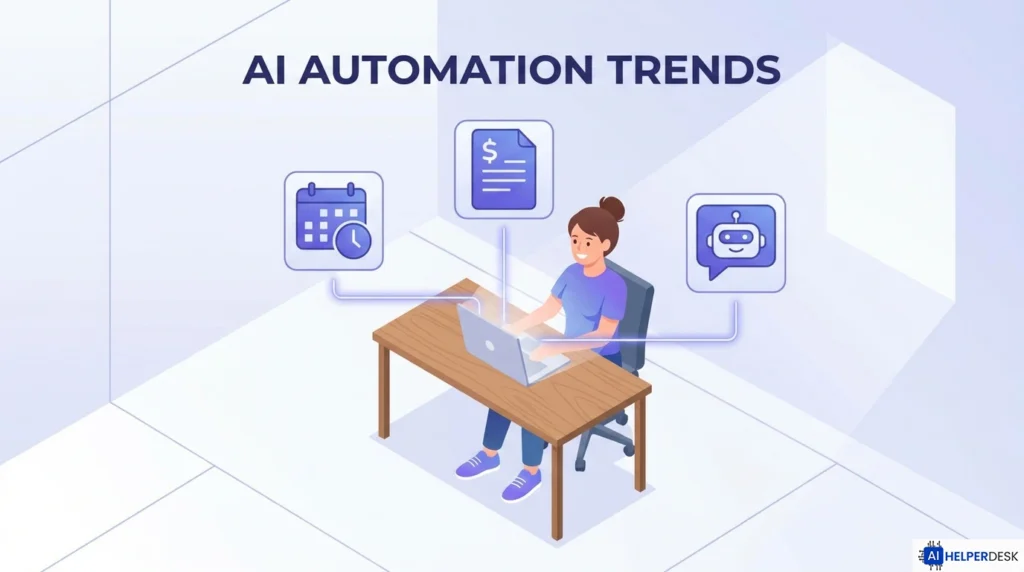
Small business owners no longer need to guess where artificial intelligence is heading. The AI automation trends shaping this year are already visible in daily operations, from customer service inboxes to invoice processing queues. What started as scattered experiments with chatbots and content generators has turned into structured, budgeted deployments that owners track against real performance numbers. Understanding these AI automation trends now matters more than ever, because the businesses that adapt early are pulling ahead of competitors who are still treating automation as a side project.
This shift is not theoretical. Analyst firms, industry surveys, and government reports all point to the same conclusion: small businesses are moving from AI experimentation to AI infrastructure. Below are the five AI automation trends most likely to reshape how small businesses operate, hire, and compete this year, along with the data, real-world use cases, and expert analysis needed to act on them wisely. Tracking these AI automation trends closely is quickly becoming a basic requirement for staying competitive, not an optional upgrade.
Why AI Automation Trends Matter for Small Business Owners Right Now
For years, automation meant rigid, rule-based software. If a condition was met, a fixed action followed. That model still has a place, but it cannot handle nuance, exceptions, or judgment calls. What has changed is the arrival of systems that can read context, make decisions within a defined scope, and adjust their approach when circumstances shift. That distinction is at the center of nearly every conversation about the future of business automation today.
Small firms are adopting these tools inside the software they already use, such as customer relationship management platforms, accounting tools, and scheduling systems, rather than buying separate standalone products. According to the U.S. Chamber of Commerce, most small businesses are already using artificial intelligence for small business tasks such as writing emails, summarizing notes, and building strategies, with over half saying it improves how their teams work day to day, according to a recent LinkedIn economic research report cited by the U.S. Chamber of Commerce.
1. Autonomous AI Agents 2026 Move From Pilot to Production
The clearest of all the AI automation trends this year is the shift away from copilots that simply assist and toward agents that act. Autonomous AI agents 2026 are being built to read information, make a decision, and trigger an action across connected systems, largely without a human clicking through every step. Gartner projects that forty percent of enterprise applications will carry task-specific AI agents by the end of this year, up from under five percent in 2025, and small business software vendors are following the same path by embedding agents directly into CRM, help desk, and finance tools.
For a solo operator or a ten-person team, this looks less like a dramatic robotic takeover and more like a scheduling assistant that checks calendars, proposes a meeting time, sends the invitation, and follows up with anyone who has not responded, all from a single instruction. The agent is not just answering a question. It is completing the workflow.
2. Commercial AI Scaling Through Usage Based Pricing
Commercial AI scaling used to be blocked by cost and complexity. That barrier is falling fast. Inference prices for AI models have dropped sharply over the past few years, which means small businesses can now run automated workflows that would have been priced out of reach only two or three years ago. Vendors have responded by shifting how they charge for access.
Instead of flat monthly software fees, many platforms now charge per resolved support ticket, per processed invoice, or per qualified lead generated. This changes the math for a small business owner. A support tool priced at a fixed amount per ticket resolved is easy to compare against the hourly cost of a support hire, which makes budgeting far more predictable. This pricing shift is one of the more practical AI automation trends because it removes the guesswork that used to keep smaller companies on the sidelines.
3. Multi-Agent Systems Replace Single-Task Automation
Traditional automation handled one task at a time. A rule fired, an action ran, and the process ended. The newer pattern involves multiple specialized agents working together under a shared goal, each handling a distinct part of a larger job. One agent might draft content, another might schedule its release, and a third might track engagement and report results back.
This structure is already visible in marketing operations. A business publishing across several channels can rely on a coordinated set of agents rather than a single tool, similar to the approach outlined in our guide to building multi-agent systems for social media content creation, where separate agents manage research, drafting, scheduling, and performance tracking as one connected pipeline. Analysts expect this pattern, often called multi-agent orchestration, to expand quickly through the year as more vendors package it into affordable, no-code tools that do not require an in-house developer.

4. Governance and Oversight Become Standard, Not Optional
As autonomy increases, so does the need for oversight. Gartner has warned that a significant share of agentic AI projects will be scaled back or shut down within the next two years because organizations skipped basic controls such as usage logging, defined access limits, and human review of higher-risk actions. In fact, Gartner has cautioned that treating all AI agents under one uniform governance policy, rather than matching controls to each agent’s level of autonomy, is itself a common cause of failure.
For a small business, governance does not require a compliance department. It can be as simple as reviewing which systems an agent can access, setting a spending cap on automated tasks, and keeping a human in the loop for anything that touches money, legal terms, or customer commitments. Owners who build this habit early will avoid the costly surprises that come from an agent making a decision nobody approved.
5. Artificial Intelligence for Small Business Becomes Core Infrastructure, Not a Side Tool
The fifth and broadest trend is the normalization of artificial intelligence for small business as a permanent layer of daily operations rather than an occasional experiment. Surveys point to a majority of small employers now running several AI-powered tools at once rather than testing a single product in isolation. This mirrors what happened with cloud software adoption a decade earlier: once the tooling became reliable and affordable, it stopped being optional.
What separates this year from prior cycles is where the budget goes. Spending is concentrated in customer service, bookkeeping, sales follow-up, and marketing operations, because these are the workflows where a missed response or a late invoice has a direct, measurable cost. Standalone content generation, by contrast, is losing budget priority to tools that are wired directly into the software a business already depends on.
Key Statistics and Insights Behind This Year’s AI Automation Trends
A handful of figures capture the scale of this shift clearly. Gartner projects that spending on AI agent software will rise sharply this year compared to the prior year, reflecting how quickly budgets are moving from pilot programs into production systems. Separately, Gartner’s own hype cycle research found that only a small share of organizations have deployed AI agents so far, even though a clear majority expect to do so within the next two years, which signals a fast-approaching wave of adoption rather than a slow crawl.
On the small business side, and consistent with the broader AI automation trends described above, U.S. Chamber of Commerce research built on LinkedIn economic data found that most small businesses already use AI in some form, with a majority saying it helps them save time and reduce costs. At the same time, Gartner’s governance research is a useful counterweight: a meaningful share of agentic AI projects are expected to be scaled back over the next two years due to unclear value or weak oversight, a reminder that adoption speed and adoption quality are two different things.
Real-World Use Cases Small Businesses Are Already Running
A local service business with a small office staff can use an agent-based scheduling system to triage incoming calls, book appointments, and send confirmation texts without a receptionist manually managing every request. A boutique accounting practice can route invoices through an automated system that reads the document, checks it against expected totals, and flags only the exceptions for a human to review, cutting manual entry time dramatically.
Marketing teams inside small agencies are pairing content drafting agents with scheduling and analytics agents so that a single campaign brief turns into a published, tracked, and reported set of posts with minimal manual handling. Retailers are running predictive tools that flag stock shortages before they happen, based on sales velocity rather than a fixed reorder date. None of these require an internal engineering team. Most run on no-code or low-code platforms that a non-technical owner can configure directly, which is exactly why these AI automation trends are spreading so quickly among smaller companies.
Benefits and Opportunities Worth Prioritizing
The clearest benefit is time. Business owners who once spent evenings answering customer emails are reclaiming hours by letting an agent handle first-response messages and routine questions. The second benefit is consistency. An automated follow-up sequence does not forget to contact a lead, even during a busy week. The third is affordability, since usage-based pricing means a small operation only pays for the volume it actually processes rather than a flat fee sized for a much larger company.
There is also a competitive angle. Because small businesses have shorter approval chains than larger firms, they can pilot a new automated workflow and know within weeks whether it is working, something that takes much longer inside a large organization with multiple layers of sign-off. This agility is quietly becoming one of the clearest advantages small businesses hold over larger competitors when it comes to acting on new AI automation trends.
Risks, Challenges, and Limitations to Take Seriously
None of this comes without friction. Dirty or inconsistent records, undocumented processes, and too many overlapping software tools are common reasons a promising automation stalls after launch. Staff resistance is also real, and it tends to be a cultural problem rather than a technical one, since employees who feel replaced rather than supported are less likely to help a new system succeed.
There is also the governance risk already mentioned. An agent given too much access, or left unmonitored, can make decisions that violate a policy, misinterpret its goal, or generate unexpected costs from running continuously in the background. Small businesses without a dedicated IT function need to be especially deliberate about setting boundaries before an agent is given access to sensitive systems such as billing, payroll, or customer data. Ignoring this side of the AI automation trends conversation is one of the fastest ways to turn a promising pilot into a costly mistake.
Expert Analysis
Taken together, the data behind this year’s AI automation trends tells a story of uneven but accelerating change. The technology curve and the organizational curve are not moving at the same speed. Analysts are consistent on one point: the businesses seeing measurable returns are not simply installing software on top of an existing mess. They are rethinking the workflow itself before adding automation to it. A support process with unclear ownership will not improve just because an agent is inserted into it. It will only move faster toward the same unclear outcome.
Among all the current AI automation trends, the pricing shift toward usage-based models is arguably more consequential for small businesses than the technology itself. It removes the biggest historical barrier, which was paying enterprise-sized subscription fees for tools sized for enterprise volume. A ten-person business can now match spending to actual usage, which lowers the cost of experimentation and makes it easier to test, discard, or scale a workflow based on real results rather than a sales pitch.
At the same time, the governance warnings from analyst firms should not be dismissed as enterprise-only concerns. A small business that connects an agent to its accounting software or its customer database is taking on real operational risk, and the businesses that build even a lightweight review habit now will be better positioned than those that treat automation as fully autonomous from day one. The opportunity is genuine, but it rewards businesses that pair speed with a basic level of discipline rather than those chasing the newest tool without a clear owner for quality control.
Future Outlook for AI Automation Trends
Expect the gap between businesses that act on these AI automation trends and those that do not to widen further as usage-based pricing and no-code platforms lower the barrier to entry even more. Cloud marketplaces are increasingly becoming the place where small businesses discover and deploy these tools, arriving pre-packaged with compliance credentials and consumption-based billing that removes much of the earlier setup burden. Multi-agent systems are likely to become the default pattern rather than the exception, since coordinating several narrow agents tends to outperform asking one general system to do everything.
Governance tooling built specifically for smaller teams, rather than adapted from enterprise platforms, is also likely to expand, since small businesses need lightweight oversight rather than heavyweight compliance frameworks. The businesses that treat this year’s AI automation trends as operational infrastructure, with a clear owner and a measurable goal for each workflow, are the ones most likely to still be running these systems successfully next year.
Conclusion
The AI automation trends defined this year are less about flashy new tools and more about a fundamental change in how small businesses operate day to day. Autonomous AI agents 2026, usage-based commercial AI scaling, multi-agent coordination, stronger governance habits, and the normalization of artificial intelligence for small business are converging into a single reality: automation has become infrastructure, not an experiment. Owners who treat it that way, with a clear process, a defined owner, and a measurable goal for every workflow, are the ones positioned to benefit most from these AI automation trends in the months ahead.
Frequently Asked Questions
The most significant shifts are the move from AI copilots to autonomous AI agents 2026, usage-based commercial AI scaling, multi-agent systems replacing single-task tools, stronger governance expectations, and artificial intelligence for small business becoming a permanent operational layer rather than a side experiment.
Usage-based pricing has made this far more accessible than it was even two years ago. Many tools now charge per ticket, per invoice, or per lead rather than a flat enterprise-style subscription, which lets a solo operator pay only for what they actually use.
Not usually. Most of the tools driving current AI automation trends are built on no-code or low-code platforms designed for non-technical owners, covering tasks such as scheduling, invoice routing, and customer support triage.
Weak oversight is the most common failure point. Giving an agent broad access without a spending cap, a usage log, or a human check on higher-risk actions is the leading cause of automation projects that get scaled back or abandoned.
