The AI Automation Stack 2026: Tools, Costs, and What Actually Works
-
- by Fiaz Ahmad
- June 23, 2026
- in AI Agents & Automation, AI for Developers

Getting your AI automation stack 2026 right is no longer a nice-to-have project for ambitious IT teams. It is a core business decision that determines how fast your company moves, how much you spend on repetitive labor, and whether you can keep pace with competitors who have already moved beyond static workflows to autonomous agents. According to Gartner, 40% of enterprise applications will include task-specific AI agents by the end of 2026, up from less than 5% just twelve months ago. That is not a gradual shift. It reflects a market that has moved decisively from experimentation into production-grade deployment, and it puts real pressure on every business still running disconnected tools and manual handoffs.
This guide cuts through the noise. It maps the tools that make up the modern AI automation stack 2026, breaks down pricing models with honesty, and explains where teams are seeing real returns and where they are still losing money on hype. Whether you are evaluating your AI automation stack 2026 for the first time or rebuilding a stack that has grown too expensive to scale, everything here is grounded in verified data and real-world implementation patterns.
What the AI Automation Stack 2026 Actually Looks Like
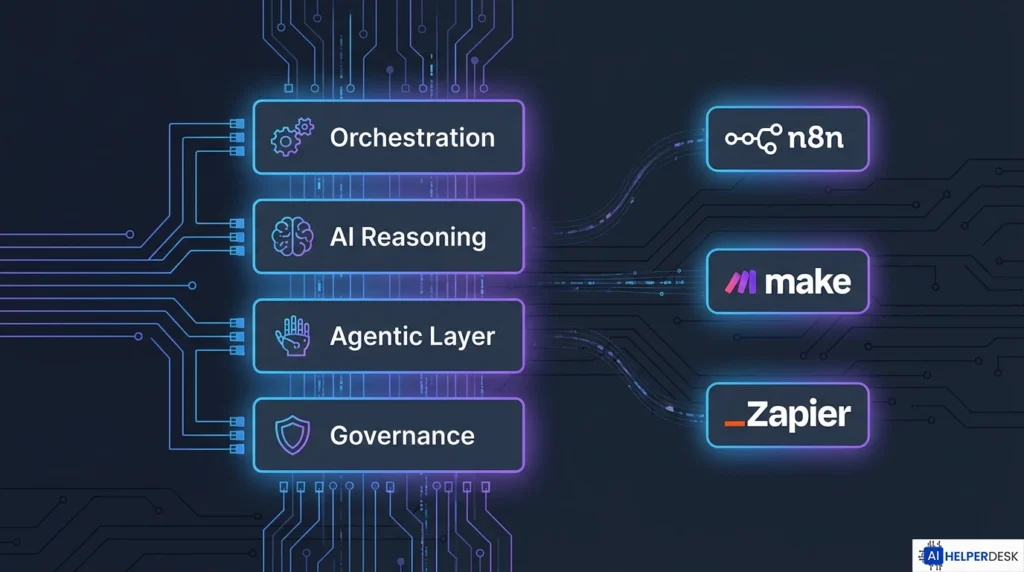
Not long ago, “automation stack” simply meant a single platform connecting apps through triggers and actions. That definition no longer cuts it. A well-built AI automation stack 2026 has distinct layers, each serving a different function, and getting the assembly right is where most teams either pull ahead or burn budget. A complete AI automation stack 2026 built for agentic workflows has four core components.
At the foundation sits a workflow orchestration layer, which handles routing, scheduling, and conditional logic across connected systems. Above that is the AI reasoning layer, where large language models process unstructured data, generate outputs, and make context-aware decisions. The third layer is agentic orchestration, where autonomous agents plan and execute multi-step tasks across systems without waiting for human sign-off at every step. Rounding it out is a governance and observability layer that tracks what agents are doing, who authorized each action, and whether outputs meet compliance requirements.
The defining shift between 2025 and 2026 has been the arrival of native agentic capabilities inside platforms that previously only handled triggers and actions. Zapier now offers autonomous agents across 8,000-plus connected apps. Make launched AI Agents, generally available since early 2026, built directly into its visual canvas. n8n shipped version 2.0 in January 2026 with native LangChain integration and over 70 AI nodes. Understanding which of these tools belongs in your AI automation stack 2026 requires looking past feature lists and into pricing architecture, data sovereignty, and the real cost of complexity at scale.
The Three Core Platforms: n8n vs Make vs Zapier
These three platforms dominate the mid-market automation space, and each has taken a noticeably different approach to agentic AI. The right fit for your AI automation stack 2026 comes down to your team’s technical depth, workflow volume, and data governance requirements.

Zapier: Breadth and Accessibility
Zapier remains the most accessible entry point into automated workflows. Its 8,000-plus pre-built integrations cover more applications than any competitor, and the natural language Copilot feature lets non-technical users build working automations from plain-English descriptions. Zapier Agents extend this into autonomous territory, allowing AI systems to execute multi-step tasks across the connected app library without human prompting at each stage.
The pricing model, though, creates a real scaling problem. Zapier charges per task, where each action in a workflow counts individually. A ten-step workflow that runs 1,000 times per month consumes 10,000 tasks. At the Professional tier ($19.99 per month on annual billing for 750 tasks), heavy users hit ceilings quickly. For teams running high-volume, multi-step agentic workflows, Zapier’s cost structure can become a serious constraint.
Where Zapier earns its place in the AI automation stack 2026 is in environments where integration breadth matters more than technical depth: marketing teams connecting CRM, email, and social tools; ops teams routing data between SaaS platforms; and organizations where the bottleneck is speed of deployment rather than workflow complexity.
Make: Visual Power at Competitive Cost
Make (formerly Integromat) sits in the middle ground between Zapier’s simplicity and n8n’s technical depth. Its flowchart-style canvas makes complex, branching logic visible and debuggable in a way that Zapier’s linear builder simply cannot match. The platform serves over 250,000 active businesses and carries ISO 27001 and SOC 2 Type II certification, which matters for teams in regulated sectors.
Make’s AI Agents, built directly onto the canvas with step-by-step reasoning logs, let builders see exactly why an agent made each decision. That transparency is genuinely valuable when debugging autonomous workflows that interact with live customer data. Make also integrates natively with OpenAI, Anthropic Claude, and Google’s AI models, giving teams flexibility in their AI reasoning layer without requiring custom code.
Pricing is based on operations rather than tasks, and Make’s free tier (1,000 operations monthly with two active scenarios) is the most generous in the category. At scale, Make typically costs roughly one-third of equivalent Zapier usage, making it a strong option for growing businesses that need visual workflow design without paying enterprise-tier prices.
For teams evaluating no-code and low-code options within the broader agentic landscape, a deeper comparison of platforms like Make alongside Flowise and Langflow is worth reviewing in this no-code AI agent builders comparison for 2026, which covers architecture differences that matter when choosing an orchestration foundation.
n8n: Maximum Flexibility for Technical Teams
n8n is architected differently from both Zapier and Make, and that architecture is the source of both its greatest strengths and its steepest learning curve. As an open-source, self-hostable platform operating under a fair-code license, n8n gives technical teams complete data sovereignty. For organizations in healthcare, finance, or government, keeping workflow data entirely inside their own infrastructure is often a non-negotiable requirement.
The January 2026 release of n8n 2.0 was a meaningful moment for the AI automation stack 2026 landscape. It shipped native LangChain integration, an AI Agent Tool Node for multi-agent orchestration, persistent memory across executions, and vector database integrations for retrieval-augmented generation (RAG) workflows. These are capabilities that Zapier and Make are still working toward at the architectural level. For teams building custom AI agents with complex logic, n8n is currently the most capable platform in this category.
Pricing is execution-based on the cloud plan, meaning a 20-step workflow costs the same as a 2-step workflow to run. A self-hosted n8n instance on a $50 per month server can handle workflow volumes that would cost $1,500 or more on Zapier. That difference compounds fast at scale. The trade-off is that self-hosting requires server management knowledge, ongoing maintenance, and a team comfortable working at the infrastructure level.
Beyond the Big Three: Rounding Out the AI Automation Stack 2026
The orchestration layer is only one part of the picture. The complete AI automation stack 2026 for most businesses also includes tools across several adjacent categories.
Enterprise orchestration suites such as Microsoft Power Automate and Copilot Studio serve organizations already deeply invested in the Microsoft 365 ecosystem. Power Automate connects Outlook, Teams, SharePoint, and Excel to hundreds of third-party services, while Copilot Studio has evolved into a full agent-building environment with external publishing and governance built in. For a Microsoft-centric organization, that native fit reduces onboarding friction significantly.
AI reasoning and foundation models form the intelligence layer of any serious stack. OpenAI’s GPT-5.5 and GPT-5.4 mini are the most widely integrated options, while Anthropic’s Claude API offers strong performance for tasks requiring nuanced document processing and complex reasoning. These models connect into workflow platforms via API calls, either natively or through HTTP request nodes in n8n and Make.
Specialist agent platforms like Lindy and UiPath handle specific workflow categories with purpose-built agent architectures. Lindy focuses on knowledge work automation, handling email triage, lead qualification, and CRM updates through LLM-powered agents that understand context rather than following rigid rules. UiPath remains the enterprise standard for robotic process automation combined with AI, particularly in document processing and compliance-heavy environments.
Key Statistics and Market Signals
The data behind the AI automation stack 2026 investment wave is not speculative. Enterprise AI agent deployments grew 466.7% year-over-year, according to BeyondTrust’s 2026 report. At the same time, 80% of organizations report their AI agent investments have already delivered measurable financial impact, according to Anthropic’s State of AI Agents Report. Companies investing in AI agents report an average ROI of 3.5 times their investment, with top performers achieving over 8 times returns.
Workflow automation, when deployed correctly, can cut repetitive tasks by up to 95% and save teams as much as 77% of their time on the processes it covers. AI automation reduces operational costs by up to 30% in repetitive enterprise workflows, particularly in customer service and IT support. That said, Gartner also expects more than 40% of agentic AI projects to be canceled by 2027 due to poor risk management, unclear ROI, and insufficient governance. The gap between intent and operational maturity remains wide.
Real-World Use Cases That Deliver ROI
Knowing which workflows actually deliver returns helps teams decide where to start building their AI automation stack 2026. The following use cases are the highest-ROI entry points for any AI automation stack 2026 investment.
Lead qualification and CRM enrichment is one of the most proven areas. A typical workflow monitors inbound leads, enriches contact data through a third-party API, scores leads based on firmographic criteria, routes qualified leads to the correct sales sequence, and updates the CRM record, all without manual intervention. On n8n or Make, this runs at a fraction of what it would cost at Zapier task pricing, and the agent handles exceptions that would have required a human decision in a traditional rules-based setup.
Finance and accounts receivable automation illustrates the closed-loop pattern that is becoming standard in 2026. An AI agent monitors accounts receivable data, identifies invoices at risk of going overdue based on historical payment patterns, drafts personalized follow-up emails, sends them automatically, and logs every action for audit purposes. The human role shifts to exception handling rather than execution.
Customer support triage is another high-ROI category. Insurance companies moved from 8% full AI adoption in 2024 to 34% in 2025, driven largely by AI agents handling document-heavy claims workflows. In retail, AI recommendation agents are delivering up to 20% higher conversion rates by personalizing product suggestions in real time based on behavioral signals.
A global logistics provider that implemented a hybrid AI automation stack in late 2025 combined UiPath for document processing with custom language models for exception handling. The result was a 36% reduction in shipment delays and $18 million in annual operational cost savings. The key insight from that case is that the most effective stacks combine multiple tools, each strong in its category, rather than relying on a single vendor to cover every layer.
Risks, Limitations, and What Still Does Not Work
The risks in any AI automation stack 2026 deployment are real, and overlooking them is where most failed projects start. Choosing the wrong tools or skipping the governance layer costs significantly more to fix after a workflow is live than it does to address during platform selection.
Data quality is the primary blocker. Over half of organizations cite poor data foundations as their main obstacle to AI agent deployment. IDC predicts a 15% productivity loss by 2027 for companies that fail to establish AI-ready data foundations before scaling agents. An agent drawing from inconsistent, duplicate, or incomplete records will make decisions no human would make, and tracing those errors back to the root cause is time-consuming work.
Governance gaps are underestimated. Only 21% of organizations currently have a mature governance model for autonomous agents. As agents take on more decision-making responsibility, businesses need audit logs, permission models, and human-in-the-loop gates for high-stakes actions. Platforms differ significantly here: Zapier’s SOC 2 Type II certification and OAuth credential management offer a solid baseline. n8n’s self-hosted model gives maximum control but requires teams to implement governance themselves.
Vendor lock-in is a structural risk. Workflow formats across Zapier, Make, and n8n are incompatible. Moving from one platform to another typically means rebuilding workflows from scratch, and consulting firms that specialize in automation migrations note that rebuilding is usually faster than attempting conversion. That makes the initial platform choice more consequential than it may seem during a free-trial evaluation.
AI bias and unintended outputs remain a concern in any workflow where agents make decisions affecting customers or employees. Unexamined models can encode historical biases into automated decisions, creating reputational and legal exposure. Production-grade deployments need regular audits of agent outputs, not just initial validation.
Expert Analysis
The AI automation stack 2026 market is at an inflection point that is easy to misread. The headline numbers, 466.7% growth in enterprise agent deployments and 80% of investments delivering measurable returns, look like a wave of success. The reality is more nuanced.
Most of that growth is coming from early adopters deepening their usage, not from widespread adoption across the broader market. Only 23% of companies currently use agentic AI at least moderately, according to Deloitte. The 96% of executives who report optimism about AI agents and the 80% who claim measurable returns are drawn from organizations that have already committed significant resources, built technical foundations, and moved past the pilot stage. They are not representative of the average business evaluating the AI automation stack 2026 for the first time.
The pricing architecture of the three dominant orchestration platforms is also underappreciated as a strategic consideration. Teams that choose Zapier for its ease of use and then scale to high-volume agentic workflows often find themselves paying five to ten times what an equivalent n8n setup would cost. The platform that is cheapest and fastest to get started with is frequently the most expensive to operate at production scale. Building cost modeling into the platform evaluation before the first workflow goes live is a decision that pays for itself quickly.
The other insight worth emphasizing is that domain specificity matters more than general capability. According to enterprise AI statistics, domain-specific agents in healthcare, financial services, and legal are the fastest-growing architecture segment, at 62.7% CAGR, outperforming general-purpose agents in measurable business impact. The companies winning with AI automation in 2026 are not building all-purpose assistants. They are building agents that know one business process deeply, have access to the right data, and operate within clear boundaries. That is a harder product to build than a chatbot connected to a workflow tool, and it is exactly where the real competitive advantage is developing.
Future Outlook: Where the AI Automation Stack Is Heading
Gartner’s maturity roadmap for agentic AI places 2026 as the year of task-specific agents, 2027 as collaborative agents working across departments, and 2028 as cross-app ecosystems where agents from different platforms coordinate autonomously. By 2029, Gartner projects that half of all knowledge workers will be building and managing AI agents as a routine part of their job.
For anyone building or upgrading their AI automation stack 2026, several trends are already reshaping tool selection in ways that will matter through 2028 and beyond. The Model Context Protocol (MCP), which allows AI models to interact with external tools in a standardized way, is being adopted across platforms. Zapier has announced MCP support, and n8n’s architecture positions it well to serve as an MCP orchestration layer for custom agent deployments.
According to IDC, year-over-year spending on AI is expected to grow at 31.9% annually between 2025 and 2029, with the global AI automation market projected to reach over $1 trillion by 2033. That growth will continue pushing automation capabilities into tools that today are still purely record-keeping systems, CRMs, ERPs, and financial platforms. The AI automation stack of 2028 will look meaningfully different from what is being deployed today, which means building on platforms with strong API extensibility and active development roadmaps matters as much as current feature sets.
Conclusion
The AI automation stack 2026 is not a single tool. It is a set of layered decisions: which orchestration platform matches your team’s technical capacity, which pricing model scales with your workflow volume, which AI reasoning layer handles your data type, and which governance approach satisfies your compliance requirements. Zapier serves teams that need breadth and speed. Make serves teams that need visual power at competitive cost. n8n serves teams that need deep AI agent capabilities with full data control.
The statistics are compelling. Enterprise deployments have grown nearly 470% year-over-year, and 80% of organizations report measurable returns. But 40% of agentic AI projects are still expected to fail by 2027, and the gap between claimed adoption and operational maturity remains significant. The AI automation stack 2026 that delivers durable ROI is built on clean data, clear governance, realistic ROI targets, and platforms chosen for how they perform at scale rather than how quickly they can be set up on a free trial. That combination is harder to assemble than any individual tool, and it is where the real competitive advantage is being built right now.
Frequently Asked Questions
For small businesses assembling their AI automation stack 2026, Make or Zapier are the most practical entry points. Make offers the most generous free tier with 1,000 operations monthly and handles moderate workflow complexity without requiring technical expertise. Zapier works better for teams that prioritize integration breadth and need to connect a large number of SaaS tools quickly. Small businesses with technical staff who need full data control can explore n8n’s self-hosted option, which is free to run on a low-cost server.
Costs within the AI automation stack 2026 vary significantly by platform and volume. Zapier’s Professional tier starts at $19.99 per month but scales steeply with task volume. Make’s paid plans start at competitive rates with operation-based pricing that typically runs about one-third of Zapier’s cost at equivalent complexity. n8n’s cloud plan charges per workflow execution, while a self-hosted n8n instance can run on a server costing $50 per month with unlimited executions. Enterprise platforms like UiPath and Microsoft Power Automate use negotiated pricing. A realistic mid-market AI automation stack, including orchestration, AI API costs, and tooling, typically runs between $500 and $5,000 per month depending on workflow volume.
When comparing AI automation stack 2026 options, technically capable teams building agentic workflows with LangChain, persistent memory, vector databases, and custom AI logic will find that n8n 2.0 offers capabilities that Zapier does not yet match at the architectural level. Zapier remains the better choice for teams prioritizing ease of use, fast deployment, and access to a broader library of pre-built integrations. The right call depends on your team’s technical depth and the complexity of the workflows you need to run autonomously.
In any AI automation stack 2026 deployment, data quality is the most common failure point. Agents make poor decisions when drawing from inconsistent records. Governance gaps are the second major risk, with only 21% of organizations having mature oversight models for autonomous agents. Platform lock-in is a structural risk, since migrating workflows between Zapier, Make, and n8n typically requires rebuilding from scratch. Gartner expects over 40% of agentic AI projects to be canceled by 2027 due to poor risk management and unclear ROI definitions.
Customer service, ecommerce, finance automation, and software engineering are the proven ROI categories in 2026. Insurance companies moved from 8% to 34% full AI adoption between 2024 and 2025. Retailers using AI recommendation agents are achieving up to 20% higher conversion rates. Manufacturing AI agents are reducing downtime by 15% to 20% through predictive maintenance. Domain-specific agent deployments consistently outperform general-purpose automation across industries.
