The Developer’s Guide to Building Custom AI Agents: Low-Code vs Full-Stack
-
- by Fiaz Ahmad
- June 4, 2026
- in AI for Developers

If you have been waiting for the right moment to start building custom AI agents, that moment has already passed. In 2026, AI agents are not research prototypes or experimental side projects anymore. They are production infrastructure. According to data compiled from Gartner and S&P Global Market Intelligence, 80% of enterprise applications shipped or updated in Q1 2026 embed at least one AI agent. For developers tasked with creating lead generation systems, customer qualification pipelines, or autonomous outreach tools, the strategic question is no longer whether to build. It is which approach to use: low-code visual platforms or a full-stack code-first framework.
This guide answers that question with practical depth, covering the real architecture decisions, the current tool landscape, and the tradeoffs that actually matter in production when building custom AI agents for sales and marketing.
Why AI Lead Generation Agents Are a Priority Right Now
Sales and marketing teams are seeing measurable results from agentic deployments. AI lead scoring has been shown to boost conversion rates by 25% to 215% depending on implementation, and sales reps using AI tools are reportedly 3.7 times more likely to hit quota. Teams that integrate AI across prospecting, qualification, and nurture automation are compounding advantages that manual workflows simply cannot replicate.
The broader market reflects this urgency. The AI agents market is projected to exceed $10.9 billion in 2026, growing at a compound annual growth rate above 45%. Sales and marketing lead generation pipelines are among the top documented use cases, right alongside customer service and operations. For developers building these systems, the two dominant paths are low-code agent platforms and full-stack frameworks like LangChain, and each comes with a genuinely different cost-benefit profile.
Understanding the Architecture Before Choosing a Path
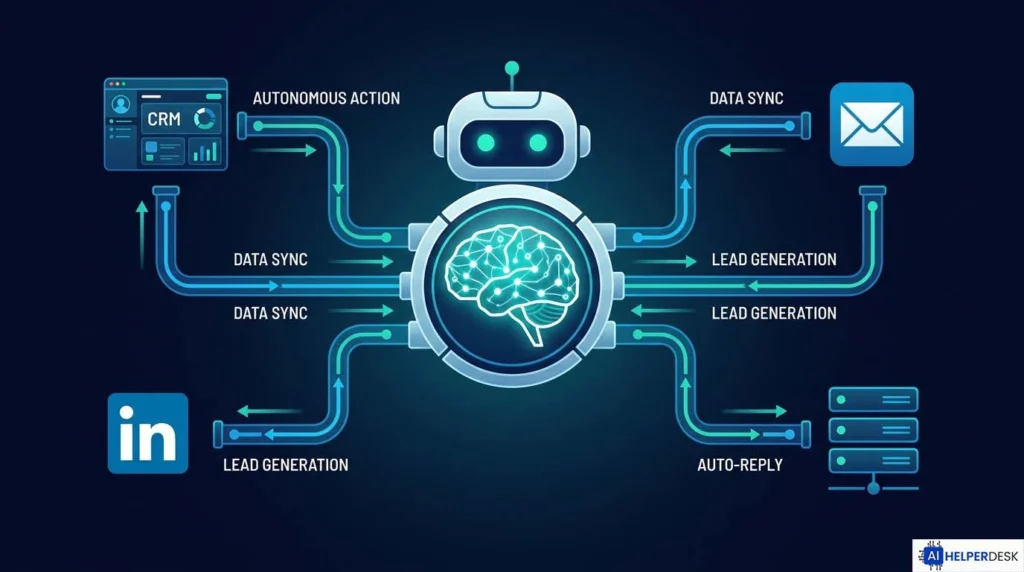
Regardless of the tooling you choose, building custom AI agents for lead generation requires understanding a common production architecture. There are three functional layers. The first is the LLM backbone, which handles reasoning and language generation. The second is the tool layer, which connects the agent to external systems like CRMs, email APIs, LinkedIn scrapers, and enrichment databases. The third is the memory layer, which allows the agent to retain context about prospects across sessions and interactions.
When you tie these together with an orchestration layer, whether that is a visual graph in Flowise or a LangGraph state machine in Python, you get an agent capable of autonomous multi-step tasks: finding a lead, qualifying them against criteria, drafting a personalized email, and logging the result to a CRM, all without human input at each step.
The choice between low-code and full-stack determines how much of that architecture you configure visually versus how much you write and own in code.
To understand how these agents fit into broader autonomous workflows, the Ultimate Guide to Autonomous AI Agents provides strong architectural context on how memory, planning, and tool use combine in production deployments.
Low-Code Agent Development: Speed With Meaningful Depth
Low-code platforms for building custom AI agents have matured considerably. The early stereotype that these tools were only suitable for simple chatbots or marketing demos no longer holds. Modern platforms like Flowise, n8n, Langflow, and Stack AI offer genuine agent orchestration with support for RAG pipelines, multi-step reasoning, external API calls, and custom logic injection.
What Flowise Offers in 2026
Flowise remains one of the most widely used visual AI builders for developers who want to ship quickly without abandoning LangChain’s capabilities. Built on top of LangChain.js, it reached version 3.1.0 in March 2026, introducing an AgentFlow SDK for multi-agent orchestration, LangChain v1 migration support, and HTTP security hardening enabled by default. As of that release, Flowise had over 36,000 GitHub stars and more than 24,000 forks, which reflects genuine developer adoption rather than passive interest.
For lead generation use cases, Flowise’s drag-and-drop interface lets a developer connect a document loader, a vector store, a CRM API node, and an LLM reasoning block in a single afternoon. The platform includes a pre-built embeddable chat widget, a growing marketplace of templates for common agent patterns, and a testing playground for real-time prompt tuning.
The limitation is architectural. Flowise runs one agent per flow and routes between flows via API calls. If your lead generation system requires a supervisor agent coordinating several sub-agents in parallel, say a research agent, a scoring agent, and an outreach agent operating simultaneously, Flowise requires you to chain flows externally. That approach is workable, but it adds complexity that full-stack frameworks handle more cleanly.
n8n and the Hybrid Code Approach
n8n occupies a practical middle ground. It is an open-source workflow automation platform with strong AI integration, and its visual loop and branching nodes are genuinely superior for agents that need conditional logic. If your lead agent must search a database, evaluate results, and retry with a different query when the first attempt fails, n8n’s visual looping system handles that more cleanly than simple RAG builders. Developers can inject JavaScript or Python code nodes anywhere in the flow for precise control, making it a strong option for teams that want visual orchestration without giving up programmatic flexibility.
Full-Stack Agent Development: Control, Complexity, and LangChain
For developers comfortable with Python and willing to own the infrastructure, LangChain remains the dominant full-stack framework for building custom AI agents in 2026. The release of LangChain 1.0 alongside LangGraph 1.0 in October 2025 resolved much of the earlier criticism about opacity and over-abstraction. Agents now run on LangGraph as their underlying runtime, giving developers the choice to work at the high-level LangChain API or drop into LangGraph for full state machine control.
According to LangChain’s April 2026 State of Agent Engineering report, 57% of surveyed organizations had deployed agents into production, with another 30.4% actively building toward deployment. LangChain’s integration count has surpassed 600 as of 2026, covering vector databases like Pinecone and Weaviate, cloud platforms including AWS, GCP, and Azure, and the CRM systems that lead generation pipelines depend on.
The LangGraph Advantage for Lead Generation
LangGraph introduces stateful, graph-based agent architectures that go well beyond the linear chain model. For lead generation, this matters because real qualification workflows are not linear. An agent may need to research a prospect, pause for human review of the scoring decision, receive approval, and then proceed to outreach. LangGraph’s human-in-the-loop checkpointing handles exactly this pattern. Developers define nodes (reasoning steps), edges (transitions between steps), and checkpoints (pause points for human input), producing workflows that are auditable and interruptible. Those two properties are something enterprise compliance teams are increasingly requiring.
The production stack for a LangChain lead agent in 2026 typically includes LangGraph for orchestration, LangSmith for observability and debugging, a Postgres or Pinecone backend for vector memory, and LangChain’s built-in tool integrations for web search, CRM writes, and email dispatch. This stack gives developers maximum control, but it requires genuine infrastructure work: logging, governance, evaluation pipelines, and deployment tooling all need to be wired up manually.
You can explore the official LangChain documentation and LangGraph architecture guides at python.langchain.com for the most current implementation patterns.
LangChain vs Flowise: A Practical Decision Framework
The question developers ask most often is whether to build with LangChain directly or to use Flowise as a visual abstraction over the same underlying library. The answer comes down to three factors: team skill, deployment timeline, and workflow complexity.
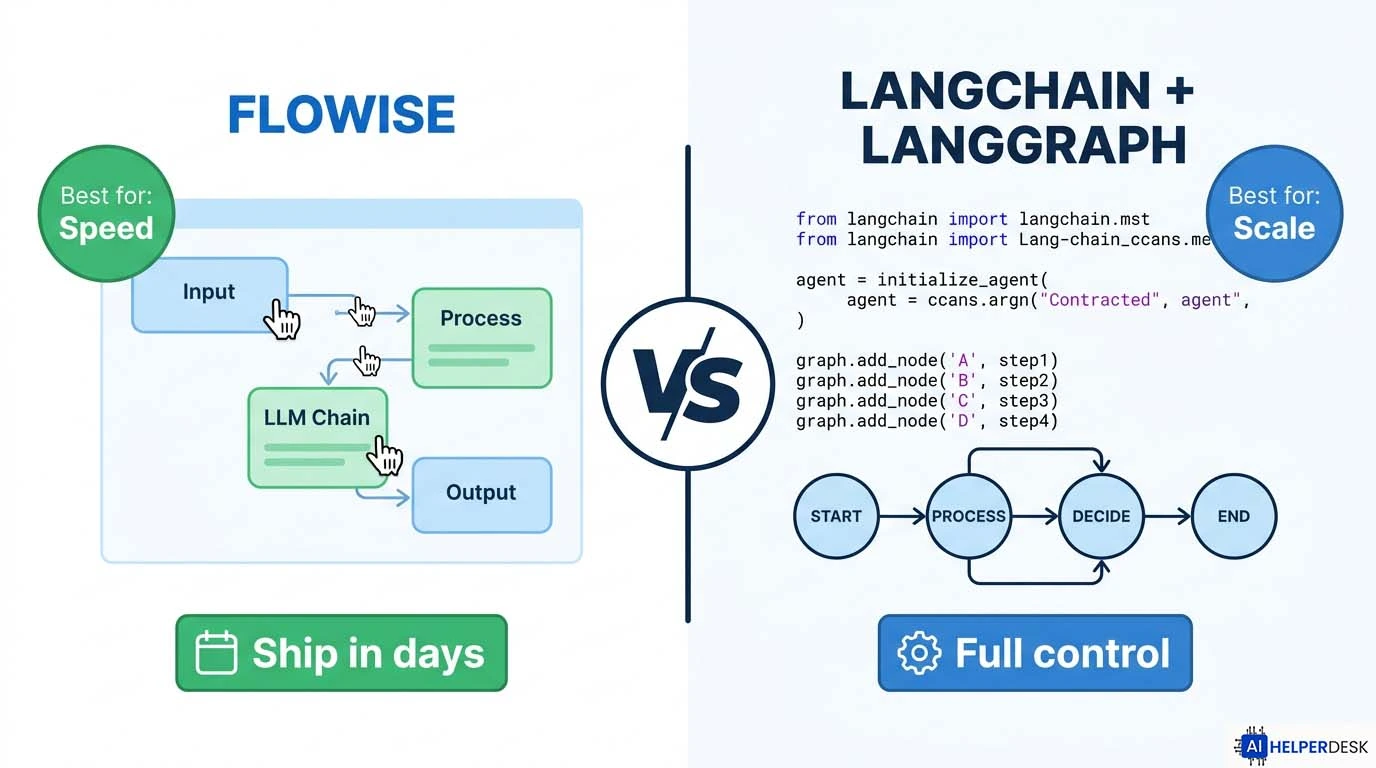
Flowise is the right choice when your team wants to ship a functional lead agent within days, when the primary workflow is a defined RAG pipeline or a single-agent qualification flow, and when iteration speed matters more than architectural ownership. The visual canvas accelerates prototyping, and the embeddable widget reduces frontend integration time to near zero.
LangChain with LangGraph is the right choice when building custom AI agents that require multi-agent coordination, when you need fine-grained control over state transitions and memory management, when compliance or auditability requirements are strict, or when your team is already fluent in Python and prefers owning the full stack.
Langflow, backed by DataStax and now IBM, is worth considering as a third option for Python teams. It reached version 1.8 in March 2026, introducing a V2 Workflow API and MCP server and client support. It has approximately 146,000 GitHub stars, reflects LangChain’s Python community, and supports complex multi-agent systems natively. That said, its learning curve is steeper than Flowise, and it requires stronger Python fluency to extend meaningfully.
For deeper technical comparisons of AI agent frameworks for developers, the DataCamp overview of the 2026 agent ecosystem at datacamp.com/blog/best-ai-agents is a well-maintained reference worth bookmarking.
Key Statistics and Insights
The data framing this decision for anyone building custom AI agents is unusually consistent across research sources.
Gartner reported that by 2026, 80% of enterprise applications embed at least one AI agent. Gartner also forecast that 80% of low-code tool users will sit outside formal IT departments, which means developers are building tools that non-technical colleagues will operate daily. That reality makes low-code interface design relevant even for full-stack teams. SDR-specific AI agents are reporting a median payback period of 3.4 months according to BCG and Forrester 2026 surveys, the shortest payback window across agent deployment categories. AI agents in sales and marketing are producing two to three times improvements in pipeline velocity, based on documented results from current enterprise deployments cited by Gartner and IDC. The Model Context Protocol (MCP) crossed 9,400 public servers as of April 2026, a figure that matters for developers choosing frameworks, as MCP compatibility is now a baseline expectation for agent tool integrations.
Real-World Use Cases for AI Lead Generation Agents
Outbound Prospecting Automation
A mid-market B2B software company deployed a LangGraph-based multi-agent system in early 2026 to automate outbound prospecting. Building custom AI agents for this use case involved a research sub-agent that queries LinkedIn and company databases, a scoring sub-agent that evaluates fit against ICP criteria, and an outreach sub-agent that drafts personalized emails. Human SDRs review and approve before anything goes out. The system reduced prospecting time per account from 45 minutes to under 4 minutes, with no degradation in reply rates.
Inbound Lead Qualification Chatbots
Several e-commerce and SaaS companies have deployed Flowise-based qualification agents embedded directly on pricing and product pages. These agents ask BANT-style questions through a conversational interface, score the lead against defined thresholds, and automatically route qualified leads to a calendar booking flow while placing unqualified leads into a nurture sequence. Implementation time from initial prototype to production was under two weeks for teams with one developer experienced in Flowise.
CRM Enrichment Agents
Teams using n8n have built agents that trigger on new CRM entries, automatically pull firmographic and technographic data from enrichment APIs, update contact records, and flag high-fit accounts for immediate SDR action. The hybrid code approach in n8n allowed developers to inject custom scoring logic in JavaScript while keeping the broader workflow visual and maintainable by non-engineers.
Benefits and Opportunities
The clearest opportunity when building custom AI agents for lead generation is the compounding ROI of automation at the top of the funnel. Because lead generation is a volume business, agents that operate continuously across time zones and without fatigue produce pipeline volume that human teams simply cannot match at equivalent cost. The 3.4-month payback period for SDR agents is among the most compelling investment cases in enterprise software right now.
For developers, the opportunity is equally significant. Teams that build strong agent development capabilities in 2026 are acquiring infrastructure skills that will compound over the next several years. Multi-agent adoption is forecast to surge 67% by 2027 as enterprises stitch individual agents into coordinated systems. Developers who understand LangGraph state machines, MCP tool integration, and RAG memory architectures are building expertise that will stay relevant and in demand.
Risks, Challenges, and Limitations
The failure modes when building custom AI agents for lead generation are worth examining honestly. Deloitte’s State of AI 2026 found that only 21% of companies have a mature governance model for agents. The 22% of deployments reporting negative ROI almost always lost the scoping fight, not the model fight. Agents built without clearly defined success metrics, fallback logic, and human review gates tend to produce poor-quality leads at scale, which is actually worse than no automation at all.
Hallucination remains a real risk in any LLM-based system. A lead agent that confidently writes a prospect’s job title incorrectly, or claims a company has a specific technology stack without verifying it, causes reputational damage that is hard to recover from. Developers must build verification steps and confidence thresholds into any agent that generates external-facing content.
Multi-agent system costs can accumulate quickly. A complex 20-step lead qualification workflow can cost between $1 and $5 per execution when chaining high-performance models. At scale, those costs require careful model selection: economical models for intermediate steps and high-capability models only for critical reasoning junctions.
Finally, 73% of enterprise leaders cited security and data privacy as their top concerns about agentic AI in Deloitte’s 2026 survey of over 3,200 business and IT leaders. For lead generation agents handling personal contact data, GDPR compliance and data residency requirements are not optional. They must be designed into the architecture before the first line of code is written.
Expert Analysis
The surface-level narrative around building custom AI agents in 2026 is that low-code tools have democratized access. That is partially true, but it obscures the more important strategic reality: the meaningful differentiation in AI lead generation now comes from architectural depth, not tooling novelty.
Any reasonably technical team can deploy a Flowise chatbot that qualifies leads. The competitive advantage belongs to teams that have built multi-agent pipelines with stateful memory, fine-tuned scoring logic calibrated against their specific ICP, and governance frameworks that can operate at enterprise scale. That architecture requires code-first thinking, even when the implementation uses visual builders for parts of the workflow.
The LangChain versus Flowise debate is also somewhat of a false choice. In practice, the most effective production teams in 2026 use both: Flowise or Langflow for rapid prototyping and for workflows that non-engineers need to modify, and LangGraph for the stateful core logic that requires precision. The skill being developed is not platform proficiency. It is the ability to reason about agent architecture across the full stack and match the right tool to each layer of the system.
There is also a maturity gap that the statistics reveal clearly. While 51% of enterprises have agents running in production, only 21% have mature governance. Most deployed systems are operating without adequate observability, failure handling, or compliance review. For developers entering this space, building with governance in mind from the start is both a technical differentiator and a meaningful risk mitigation strategy. Gartner’s warning about project failure rates applies directly here: undisciplined adoption produces abandoned initiatives, and the companies that will scale AI lead generation successfully are those that invest in eval pipelines and monitoring before they invest in additional agent capability.
A Rasa analysis from April 2026 frames this precisely, noting that the tradeoff between low-code and traditional development is not speed versus quality but speed versus initial control, and that the right low-code platform can eliminate that tradeoff entirely. The operative phrase is “the right low-code platform.” Choosing that platform requires understanding what you are building well enough to evaluate what you are giving up.
Future Outlook
The trajectory for building custom AI agents points toward convergence rather than fragmentation. The Model Context Protocol is establishing a standardized interface between agents and tools that reduces the integration overhead of choosing any particular framework. As MCP adoption grows beyond its current 9,400 public servers, the tool layer becomes increasingly portable across platforms.
Multi-agent systems are the clear next phase. According to Salesforce’s 2026 Connectivity Report, 50% of AI agents currently operate in isolated silos. That figure is expected to fall sharply as enterprises stitch individual agents into coordinated networks. For lead generation specifically, this means the next generation of systems will coordinate research agents, enrichment agents, scoring agents, outreach agents, and follow-up agents in dynamic orchestration, with humans reviewing outputs at key decision points rather than managing each step.
The developers who invest in understanding LangGraph’s state machine model, MCP server integration, and multi-agent orchestration patterns in 2026 are acquiring the foundational skills for this next wave. The tooling will keep changing. The architectural principles governing agent design will not.
Conclusion
Building custom AI agents for lead generation in 2026 is a genuinely solved problem from a technical standpoint. The frameworks are mature, the integrations are comprehensive, and the documented ROI in sales and marketing deployments is among the strongest in enterprise software. The open question for most developer teams is not whether the technology works. It is which architecture path matches their skills, timeline, and operational requirements.
Low-code platforms like Flowise and n8n deliver real value at high speed for teams building custom AI agents who need to ship quickly or that require non-engineers to maintain workflows. Full-stack frameworks like LangChain and LangGraph deliver the control and architectural depth that production multi-agent systems require. The most effective approach in 2026 is not picking one and ignoring the other. It is understanding both well enough to match each layer of your system to the right tool.
The developers and teams investing in this foundational knowledge now are building capabilities that will compound as multi-agent adoption surges through 2027 and beyond. The window for building genuine competitive advantage through agent architecture is open, but it will not stay open indefinitely.
Frequently Asked Questions
The answer depends on your team’s skill level and workflow complexity. LangChain with LangGraph is the most capable full-stack option and is best for multi-agent systems with complex state management. Flowise is the fastest path to a working lead qualification agent for teams that want to ship quickly with minimal custom code. Many production teams use both in the same architecture.
With Flowise or a similar low-code platform, a qualified developer can ship a working single-agent lead qualification chatbot in two to five days. A full-stack LangGraph multi-agent system with CRM integration, memory, and human-in-the-loop review typically takes four to eight weeks to reach production readiness.
Low-code platforms allow developers to build visually while injecting custom code in specific nodes for logic that requires precise control. No-code platforms are fully visual and restrict code access entirely. For lead generation agents with custom scoring logic or non-standard CRM integrations, low-code is typically the minimum viable approach.
LangChain, particularly with LangGraph as the runtime engine, remains one of the most widely used and best-supported frameworks for code-first agent development. Its 600-plus integrations, active open-source community, and LangSmith observability tooling make it a practical choice for production systems. CrewAI, AutoGen, and Mastra are credible alternatives for specific use cases.
The top risks are poor scoping (building the agent before defining success metrics), hallucination in prospect-facing content, data privacy non-compliance for personal contact data, and runaway costs in multi-step multi-agent pipelines using high-cost models. Each of these is manageable with deliberate architecture decisions made before development begins.
Flowise is a visual wrapper over LangChain.js that trades some architectural flexibility for dramatically faster prototyping. LangChain gives developers direct access to the full framework with Python. If your team works primarily in JavaScript and wants rapid iteration, Flowise is compelling. If your team works in Python and needs stateful multi-agent coordination, LangChain with LangGraph is the stronger choice.
